Pennsylvania practice test
Pennsylvania permit practice test.
Get to know the format, try six study questions, and check the explanations before opening a full Roadwise practice test. This course’s simulation is based on the format described below.
- Questions
- 18
- Correct to pass
- 15
- Practice timer
- No timer
- Study question bank
- 803
The format in this course
Pennsylvania Knowledge Test
To pass this Roadwise simulation, answer at least 15 of 18 questions correctly. Answers and explanations appear after you finish. Unanswered questions count as incorrect.
This practice format uses one overall passing threshold, without a separately scored sign section.
This Roadwise practice format has no countdown, so you can take the time you need.
The handbook states the format directly for the non-commercial Class C Knowledge Test. It does not list a time limit or separately-scored sections. You may retake the test the next business day if you fail, and only once per day at any location.
Try a few practice questions
Read the question, decide on an answer, then open it to check the explanation. These are Roadwise study questions based on the source handbook.
How long before a driver's 16th birthday may the health care provider's physical exam on the DL-180 be dated?
- No more than 30 days prior
- Up to 6 months prior
- No more than 1 year prior
- Any time before age 16
Answer: Up to 6 months prior
The physical exam date may not be more than six months before the applicant's 16th birthday.
Handbook p. 5 ↗At a four-way stop, if two vehicles reach the intersection at the same time, who goes first?
- The driver on the right goes first
- The driver on the left has the right-of-way
- The larger vehicle goes first
- The driver going straight
Answer: The driver on the right goes first
When two vehicles arrive together, the driver on the left yields to the driver on the right.
Handbook p. 14 ↗How do you measure your following distance using a fixed roadside object?
- Count seconds from when the vehicle ahead passes it until you reach it
- Estimate the number of car lengths behind
- Measure the distance with your speedometer only
- Count seconds from when you start braking
Answer: Count seconds from when the vehicle ahead passes it until you reach it
Watch the vehicle ahead pass a marking, then count seconds until you reach the same spot.
Handbook p. 40 ↗What is the authority of a flagger in a work zone compared to standard traffic signs?
- A flagger's signals are only advisory
- You must ignore a flagger if a sign says otherwise
- Flaggers can only direct pedestrians
- Their directions override signs and signals
Answer: Their directions override signs and signals
Flaggers have authority that overrides conventional traffic control devices in a work zone.
Handbook p. 58 ↗If necessary to maintain 4 feet of clearance from a bicyclist, may you cross a double yellow centerline?
- Yes, if it can be done safely
- No, this is never allowed
- Only on rural roads
- Only when passing a group of cyclists
Answer: Yes, if it can be done safely
Drivers may cross a double yellow line if needed and safe to maintain the required clearance.
Handbook p. 96 ↗What does this sign mean?
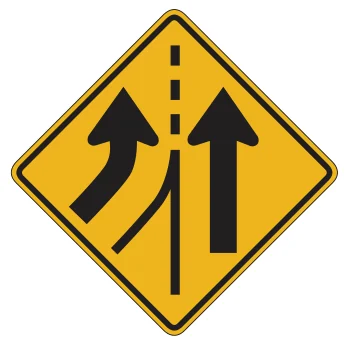
- An additional lane begins ahead without merging.
- Warns the main road curves left and a side road joins at the curve.
- Warns that the bridge ahead is narrower than the road.
- Road curves right then left ahead.
Answer: An additional lane begins ahead without merging.
Added lane: An additional lane begins ahead without merging. Continue in your lane; no need to merge for the new lane.
Handbook p. 18 ↗What to study next
The practice question pool spans the course. Use the topics below to read the rules behind an answer, then return to practice.
5 lessons
Getting Licensed
Permits, junior rules, license classes and tests
Explore3 lessons
Traffic Signals
Lights, arrows, flashing, lane-use and pedestrian signals
Explore7 lessons
Traffic Signs
Regulatory, warning, work zone and guide signs
Explore2 lessons
Pavement Markings
Centerlines, lane lines and painted words
Explore3 lessons
Fit to Drive
Vehicle checks, distraction, fatigue, alcohol and drugs
Explore7 lessons
Space, Speed and Conditions
Space cushion, scanning, speed, night, weather and signaling
Explore6 lessons
Turns, Intersections and Highways
Turning, passing, right-of-way, roundabouts, curves and highways
Explore6 lessons
Sharing the Road
Pedestrians, cyclists, motorcycles, trucks, buses and special situations
Explore5 lessons
Parking and Emergencies
Parking, emergency maneuvers, floods and road rage
Explore4 lessons
Driving Record and Penalties
Points, suspensions, police stops, crashes and DUI
Explore5 lessons
Occupant Safety and Other Laws
Seat belts, child seats, texting, inspections and safe passing
Explore