roadwise.Open study app

Pennsylvania driving lesson · Traffic Signs

STOP, YIELD and one-way signs

A 4-minute lesson from the Pennsylvania course. Read the rules and examples, follow the handbook page references, and check your understanding before you move on.

Read time
4 minutes
Course unit
Traffic Signs
Checkpoint questions
6
Source pages
14, 15

Signs come in three categories: regulatory, warning and guide. Most have a special shape and color, so you can recognize them before you can read them. Regulatory signs state the law; ignoring one can cost you a fine and points on your record.

Know the rule

Regulatory signs tell you what you must or must not do by law: speed limits, direction of traffic, turning and parking restrictions. Disobeying them can mean fines and points.

Handbook p. 14 ↗

Regulatory sign colors

  • Black and white vertical rectangles or squares, like SPEED LIMIT
  • Black, white and red, like the NO LEFT TURN sign with a circle and slash
  • Red and white, like STOP, YIELD, DO NOT ENTER and WRONG WAY
Handbook p. 14 ↗
Stop
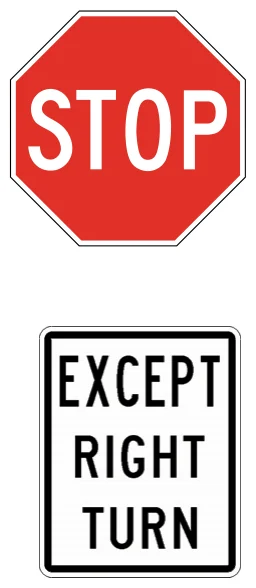
STOP sign with EXCEPT RIGHT TURN plate

Know the rule

The STOP sign is the only 8-sided (octagon) sign on the highway. Stop completely and check for pedestrians and cross traffic before going. Slowing without a full stop is illegal.

Handbook p. 14 ↗

Know the rule

At a crosswalk or white stop line, stop before the front of your vehicle reaches the first painted line. If you still can't see traffic, yield to pedestrians, then pull forward slowly past the line until you can see clearly.

Handbook p. 14 ↗

Know the rule

An EXCEPT RIGHT TURN plate under a STOP sign lets you make the right turn without stopping.

Handbook p. 14 ↗
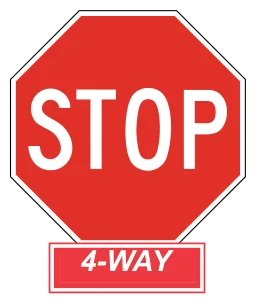
All-way stop
STOP sign with 4-WAY plate

Know the rule

At a FOUR-WAY STOP all traffic stops. The first vehicle to arrive goes first. If two arrive together, the driver on the left yields to the driver on the right. Drivers facing each other may both proceed with caution, watching for turns.

Handbook p. 14 ↗
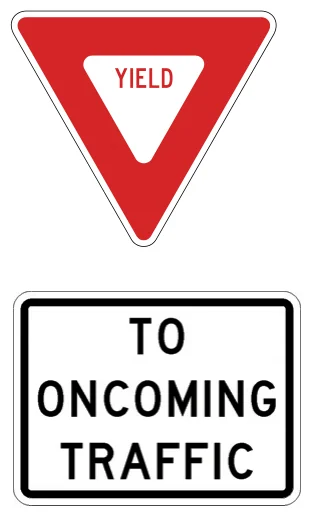
Yield
YIELD sign with TO ONCOMING TRAFFIC plate

Know the rule

YIELD signs are triangles (3-sided). Slow down, check traffic and give the right-of-way to pedestrians and approaching cross traffic; stop only when necessary. At STOP or YIELD you need a sufficient gap before going.

Handbook p. 14 ↗

Know the rule

A TO ONCOMING TRAFFIC plate under a YIELD sign marks a one-lane bridge or underpass where you must yield to opposing traffic.

Handbook p. 14 ↗
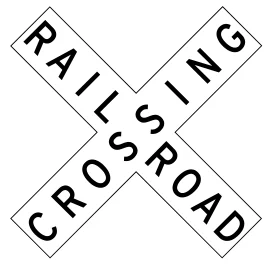
Railroad crossbuck
Railroad crossbuck sign

Know the rule

Treat the railroad crossbuck as a YIELD sign: slow down and prepare to stop if you see or hear a train.

Handbook p. 14 ↗
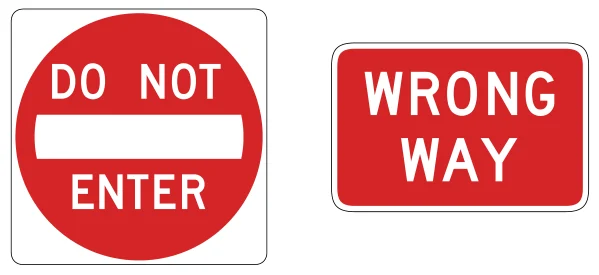
Do not enter
DO NOT ENTER sign

Know the rule

DO NOT ENTER signs stand at the start of one-way streets and ramps; WRONG WAY signs are farther along to catch drivers who turned in by mistake. ONE WAY means traffic moves only in the arrow's direction.

Handbook p. 15 ↗

Put it into practice

You reach a four-way stop at the same moment as a car on the cross street to your right. You are the driver on the left, so you yield and let that car go first.

Check your understanding

Read the question, decide on an answer, then open it to check the explanation. These are Roadwise study questions based on the source handbook.

What shape is a STOP sign?
  1. A triangle
  2. A pentagon
  3. An octagon (8 sides)
  4. A diamond

Answer: An octagon (8 sides)

The STOP sign is the only octagon-shaped sign on the highway.
Handbook p. 14 ↗
What shape is a YIELD sign?
  1. An octagon
  2. A square
  3. A diamond
  4. A triangle (3 sides)

Answer: A triangle (3 sides)

YIELD signs are triangular (3-sided) in shape.

Handbook p. 14 ↗
At a four-way stop, if two vehicles reach the intersection at the same time, who goes first?
  1. The driver on the right goes first
  2. The driver on the left has the right-of-way
  3. The larger vehicle goes first
  4. The driver going straight

Answer: The driver on the right goes first

When two vehicles arrive together, the driver on the left yields to the driver on the right.

Handbook p. 14 ↗
At a STOP sign with limited visibility of cross traffic, what should you do after stopping?
  1. Proceed immediately since you already stopped
  2. Pull forward slowly until you can see clearly, then proceed when clear
  3. Wait for another driver to wave you through
  4. Wait 5 seconds, then proceed

Answer: Pull forward slowly until you can see clearly, then proceed when clear

If you can't see traffic, yield to pedestrians and pull forward slowly until you have a clear view.

Handbook p. 14 ↗
How should you treat a railroad crossbuck sign?
  1. Like a STOP sign requiring a full stop every time
  2. As purely informational with no action required
  3. Like a YIELD sign — be ready to stop
  4. As a warning sign only, not regulatory

Answer: Like a YIELD sign — be ready to stop

The crossbuck sign should be treated like a YIELD sign near railroad tracks.

Handbook p. 14 ↗
What do a DO NOT ENTER sign and a WRONG WAY sign have in common?
  1. Both mean the road is closed for construction
  2. Both warn of two-way traffic ahead
  3. Both are guide signs
  4. Both mark a one-way road you shouldn't enter

Answer: Both mark a one-way road you shouldn't enter

DO NOT ENTER is at the start of a one-way street; WRONG WAY is placed further in to catch a wrong turn.

Handbook p. 15 ↗
Take the lesson checkpoint in the app

More in Traffic Signs