A 3-minute lesson from the Pennsylvania course. Read the rules and examples, follow the handbook page references, and check your understanding before you move on.
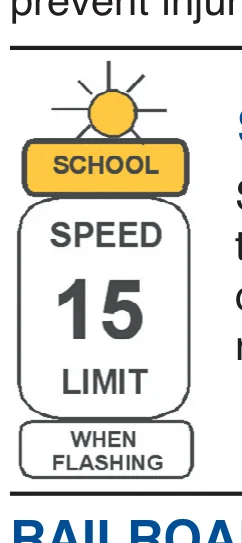
Pedestrian signals, school zone flashers and railroad crossing signals protect the people most at risk. As a driver you need to know what walkers are being told, when to slow to 15 mph, and every signal that means a train is coming.
Know the rule
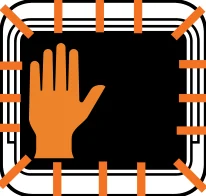
Pedestrians must obey WALK/DON'T WALK signals (or the walking person and upraised hand). Where there are no pedestrian signals, they obey the red, yellow and green traffic lights.
Near a blind pedestrian carrying a white cane or walking with a guide dog, slow down, always yield the right-of-way, proceed with caution and be prepared to stop.
Never move forward or go around a gate, or ignore any signal of an approaching train. Proceed only after all signals are completed and no train is approaching.
At a crossing with no signals, slow down and prepare to stop if you see or hear a train. Stop if a train has sounded its signal or is plainly visible and dangerously close.
Traffic ahead is stopped at a light just past a railroad crossing, and the only open space is right on the tracks. Stay behind the crossing until there's room for your whole vehicle on the far side.
Check your understanding
Read the question, decide on an answer, then open it to check the explanation. These are Roadwise study questions based on the source handbook.
At a pedestrian signal, what does an upraised hand mean?
Walk quickly
Proceed if no cars are near
Walk, but yield to traffic
Don't walk
Answer: Don't walk
An upraised hand at a pedestrian signal means don't walk.
Which of these is NOT one of the signals that requires you to stop at a railroad crossing?
A round RAILROAD CROSSING AHEAD sign
Flashing red lights
A lowered crossing gate
A flagger signaling you to stop
Answer: A round RAILROAD CROSSING AHEAD sign
Flashing red lights, a lowered gate, a flagger or a train's horn require a stop; the advance warning sign only tells you to begin looking and listening.