Warning signs: lanes, intersections and road hazards
A 3-minute lesson from the Pennsylvania course. Read the rules and examples, follow the handbook page references, and check your understanding before you move on.
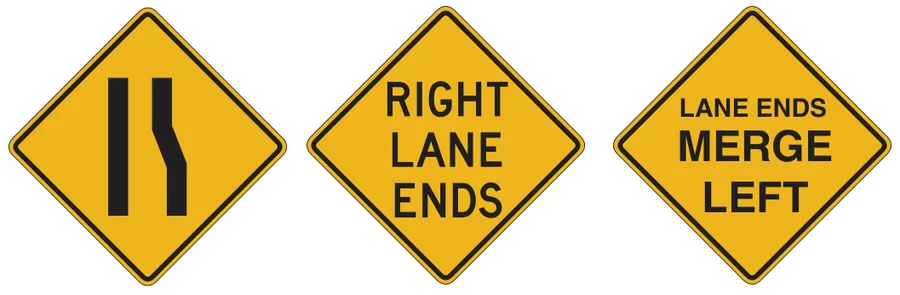
These warning signs describe the road itself: lanes ending, how an intersection is shaped, narrow bridges, soft shoulders and hidden signals. Each one tells you to search ahead and be ready to slow.
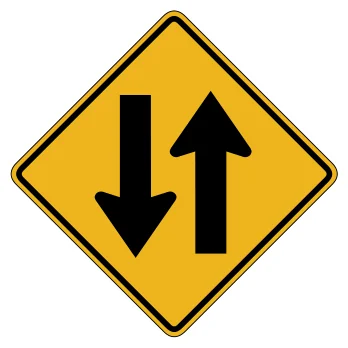
Two-way traffic ahead sign
Know the rule
TWO-WAY TRAFFIC AHEAD: the one-way road ends and you'll share the road with oncoming traffic. Stay in your lane, right of the centerline.
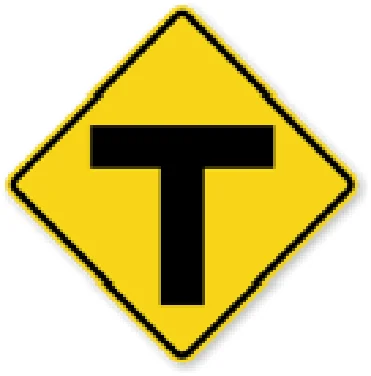
Intersection signs (T, Y, side road, crossroad) show in advance how roads join and warn when your road doesn't continue straight. Approach with extra caution, search ahead and be ready to slow.
NARROW BRIDGE: lanes get narrower and there's usually no shoulder. Slow, stay in your lane, and wait if an oncoming wide vehicle takes part of your lane.
TRAFFIC SIGNAL AHEAD and STOP SIGN AHEAD: the signal or sign is hidden by a curve or hill, and vehicles may be stopped in line ahead. Slow down and prepare to stop.
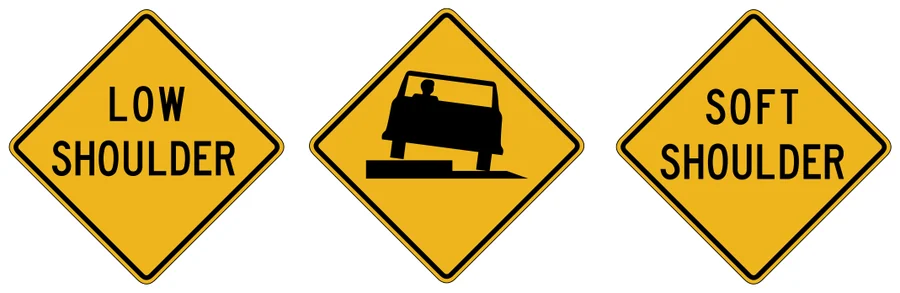
Past a LOW SHOULDER sign, your right wheel slips off the edge. Don't slam on the brakes or steer sharply to get back on; you can easily lose control. Ease off the gas and recover gradually.
Check your understanding
Read the question, decide on an answer, then open it to check the explanation. These are Roadwise study questions based on the source handbook.
The SLIPPERY WHEN WET sign warns you to:
Use cruise control to hold a steady speed
Reduce speed and increase following distance in wet weather
Keep your speed but brake earlier than usual
Slow down only if it is also snowing
Answer: Reduce speed and increase following distance in wet weather
In wet weather, reduce your speed and increase your following distance, and avoid quick acceleration or braking.