roadwise.Open study app

Pennsylvania driving lesson · Pavement Markings

Centerlines and passing

A 3-minute lesson from the Pennsylvania course. Read the rules and examples, follow the handbook page references, and check your understanding before you move on.

Read time
3 minutes
Course unit
Pavement Markings
Checkpoint questions
6
Source pages
26

Lines on the pavement tell you who's beside you and whether you may cross over. Color tells direction: yellow separates opposite directions, white separates lanes going your way. Style tells permission: broken lines may be crossed, solid lines may not.

Know the rule

Yellow lines divide traffic traveling in opposite directions. They mark the center of two-lane roads and the left edge of divided highways, one-way streets and ramps.

Handbook p. 26 ↗

Know the rule

Solid white lines divide lanes of traffic traveling in the same direction and also mark the right edge of the road.

Handbook p. 26 ↗

Know the rule

As a general rule, broken lines can be crossed and solid lines cannot, except when making a turn.

Handbook p. 26 ↗
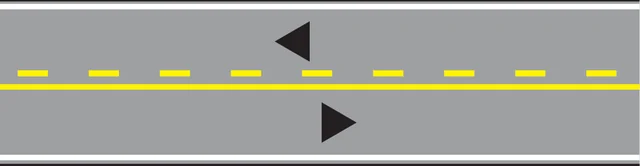
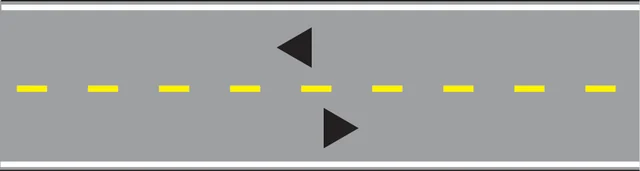
Broken yellow center line
Single broken yellow centerline

Know the rule

Single broken yellow centerline (two-way, two-lane road): passing is permitted on either side if safe. When passing, you use the lane belonging to oncoming traffic.

Handbook p. 26 ↗
Broken yellow center line
Double solid yellow centerline

Know the rule

Double solid yellow centerline: passing is not allowed in either direction, even if no NO PASSING sign is posted.

Handbook p. 26 ↗
Solid and broken yellow lines
Solid yellow with broken yellow centerline

Know the rule

Solid yellow plus broken yellow: you may pass if the broken line is on your side and it's safe; you may not pass when the solid line is on your side.

Handbook p. 26 ↗
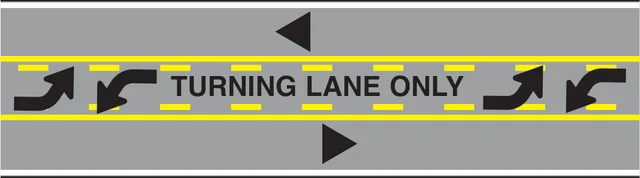
Two-way left turn lane markings
Center two-way left-turn lane markings

Know the rule

On many three-lane or five-lane highways, an outside solid yellow line means you cannot use the center lane for passing; the inside broken and solid yellow lines mean traffic from either direction may use it only for left turns.

Handbook p. 26 ↗

Centerline summary

Centerline summary
Your side of the centerlineMay you pass?
Single broken yellowYes, if safe
Broken yellow (solid on other side)Yes, if safe
Solid yellow (broken on other side)No
Double solid yellowNo, in either direction
Handbook p. 26 ↗

Put it into practice

On a two-lane road you're behind a slow tractor. The centerline on your side is solid yellow with a broken line on the far side. You may not pass; wait until the broken line is on your side and the oncoming lane is clear.

Check your understanding

Read the question, decide on an answer, then open it to check the explanation. These are Roadwise study questions based on the source handbook.

What do yellow lines on a roadway generally divide?
  1. Traffic traveling in the same direction
  2. Traffic moving in opposite directions
  3. Bike lanes from car lanes
  4. Parking lanes from travel lanes

Answer: Traffic moving in opposite directions

Yellow lines mark the center of two-way roads and divide opposing traffic.
Handbook p. 26 ↗
As a general rule, which type of line can be legally crossed to pass, if conditions are safe?
  1. A solid line
  2. A double solid line
  3. Any yellow line
  4. A broken line

Answer: A broken line

Broken lines can generally be crossed; solid lines cannot, except when turning.

Handbook p. 26 ↗
What does a single, broken yellow centerline on a two-lane road allow?
  1. Passing on either side when safe
  2. No passing under any circumstances
  3. Passing only during daylight
  4. Passing only on the right shoulder

Answer: Passing on either side when safe

A single broken yellow centerline permits passing when safe conditions exist, using the oncoming lane.

Handbook p. 26 ↗
What does a double, solid yellow centerline mean for passing?
  1. Passing is allowed from one direction only
  2. Passing is not allowed by traffic in either direction
  3. Passing is always allowed if there's no oncoming traffic
  4. Passing is allowed only in daylight

Answer: Passing is not allowed by traffic in either direction

A double solid yellow centerline prohibits passing by traffic moving in either direction.

Handbook p. 26 ↗
On a road marked with a solid yellow line paired with a broken yellow line, when can you pass?
  1. When the solid line is on your side
  2. Anytime, regardless of which line is on your side
  3. When the broken line is on your side, if safe
  4. Never, this marking always forbids passing

Answer: When the broken line is on your side, if safe

You may pass only when the broken line is on your side of the road.

Handbook p. 26 ↗
On a three- or five-lane highway with a center lane, what is the purpose of the inside broken/solid yellow markings around the center lane?
  1. To mark a passing lane for both directions
  2. To indicate the center lane is for parking
  3. To mark a bicycle lane
  4. To allow vehicles from either direction to use the center lane only for left turns

Answer: To allow vehicles from either direction to use the center lane only for left turns

These markings show the center lane may be used only for left turns from either direction, not for passing.

Handbook p. 26 ↗
Take the lesson checkpoint in the app

More in Pavement Markings