Most crashes come from human error, and drivers with less than five years of experience make the most. Space is your time to react: if the driver near you makes a mistake, a cushion around your car lets you steer or brake without a panic stop.
Major crash types for new (16- and 17-year-old) PA drivers
- Hitting a stationary object
- Crashes where roads intersect (driveways, entrance ramps, intersections)
- Rear-end collisions
- Head-on collisions
Share of all crashes and of crash deaths linked to just these four crash types
Handbook p. 39 ↗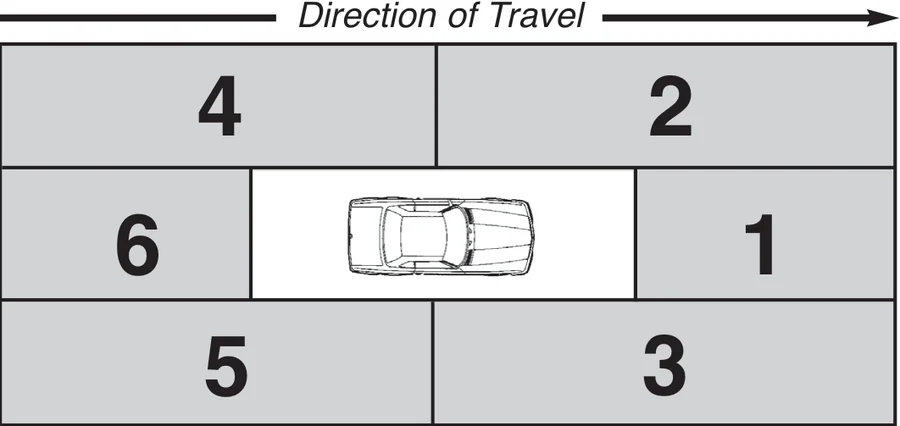
Know the rule
There are six areas of space around your vehicle to manage: ahead (1), the sides (2 and 3), the left-rear and right-rear (4 and 5) and behind (6). Keep a space cushion on all sides.
Handbook p. 39 ↗Safe following distance on dry pavement; it lets you steer or brake to avoid a hazard
Handbook p. 39 ↗Know the rule
To measure it, note when the rear bumper of the vehicle ahead passes a marking or object such as a telephone pole, then count the seconds until you reach it. Under four seconds means you're too close.
Handbook p. 40 ↗Allow MORE following distance when:
- Roads are wet, slippery or unpaved
- The driver behind you wants to pass
- You follow a truck, bus, van or trailer whose driver can't see behind, or that blocks your view
- You follow a heavy load or trailer, or approach slow vehicles including bicycles
- You follow school buses, taxis, buses or hazardous-material trucks, which stop at railroad crossings
- You're going downhill, or stopped uphill where the vehicle ahead may roll back
Know the rule
Side space (areas 2 and 3) is your escape path. Avoid driving alongside others on multi-lane roads, keep away from parked cars (doors open, people step out), and move to an inside lane when safe to make room for entering traffic.
Handbook p. 40 ↗If you don't have this much space on at least one side as an escape path, increase your following distance
Handbook p. 40 ↗Know the rule
With parked vehicles on your right and oncoming traffic on your left, slow down and split the difference by steering a middle course.
Handbook p. 40 ↗Know the rule
Behind you (area 6), keep a steady speed and signal early before slowing. If tailgated, move to the right lane; if there isn't one, wait until the road ahead is clear and tap your brakes gently to slowly reduce speed.
Handbook p. 41 ↗Know the rule
The left-rear and right-rear areas (4 and 5) are blind spots. Always check them by turning your head before changing lanes.
Handbook p. 41 ↗Put it into practice
A car rides your bumper on a two-lane road with no right lane. Don't speed up or brake hard. When the road ahead is clear, tap your brakes gently and slow down gradually to encourage the driver to pass.