Pennsylvania driving lesson · Space, Speed and Conditions
Scanning ahead, to the sides and behind
A 3-minute lesson from the Pennsylvania course. Read the rules and examples, follow the handbook page references, and check your understanding before you move on.
Good drivers see problems early. Look far down the road, check both ways wherever traffic streams meet, and know what's behind and beside you before changing lanes or backing up. Your mirrors help, but they never replace turning your head.
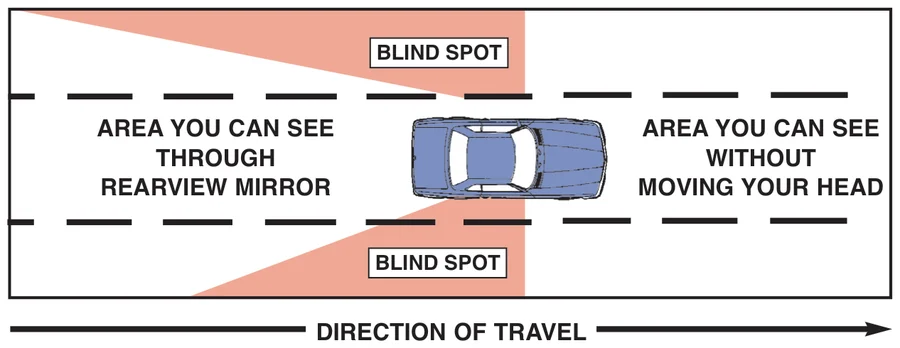
Blind spot
Any place around a vehicle that the driver cannot see without moving their head.
Avoid driving on either side and slightly behind another vehicle for long; both positions are in its driver's blind spot. Speed up or drop back, and when passing, get past the blind spot quickly and safely.
At intersections, driveways, shopping center entrances and highway ramps, use the left-right-left rule: look left first (those vehicles are closer), look right, then look left again before pulling out.
Don't assume other traffic will stop, even at a stop sign or signal. If buildings, shrubs or parked cars block your view, move forward slowly until you can see clearly.
Before changing lanes: signal, check your rearview and side mirrors, and look over your shoulder; don't rely on mirrors or sensors alone. Don't take your eyes off the road ahead for more than a second. On roads with 3+ lanes, check all lanes.
Before backing, check behind the vehicle before you get in, since children and small objects are hard to see. Then turn your head and look through the rear window; don't depend on mirrors or sensors alone.
You're pulling out of a driveway onto a busy street. Look left, then right, then left again. A car you missed the first time appears on the left, so you wait until it passes.
Check your understanding
Read the question, decide on an answer, then open it to check the explanation. These are Roadwise study questions based on the source handbook.
About how far ahead should you be identifying potential problem situations while driving?
2 to 3 seconds ahead
30 to 45 seconds ahead
12 to 15 seconds ahead
5 seconds ahead
Answer: 12 to 15 seconds ahead
You should scan and identify problems 12 to 15 seconds ahead of your vehicle.