Texas practice test
Texas permit practice test.
Get to know the format, try six study questions, and check the explanations before opening a full Roadwise practice test. This course’s simulation is based on the format described below.
- Questions
- 30
- Correct to pass
- 21
- Practice timer
- No timer
- Study question bank
- 798
The format in this course
Texas DPS Class C Knowledge (Written) Exam
To pass this Roadwise simulation, answer at least 21 of 30 questions correctly. Answers and explanations appear after you finish. Unanswered questions count as incorrect.
This practice format uses one overall passing threshold, without a separately scored sign section.
This Roadwise practice format has no countdown, so you can take the time you need.
The Texas Driver Handbook itself states only that a grade of 70% or better is required to pass any knowledge exam (p.13) and does not give a fixed question count. The 30-question format with 21 needed to pass is corroborated by multiple third-party TX permit-test prep sites (e.g. driving-tests.org, nextdoordriving.com, dmv-permit-test.com) referencing the official DPS Class C knowledge exam; some prep sites describe it informally as split into a road-signs portion and a traffic-laws portion, but no separately-scored sections are documented on the official DPS site, so the practice test uses one combined score.
Try a few practice questions
Read the question, decide on an answer, then open it to check the explanation. These are Roadwise study questions based on the source handbook.
A 17-year-old wants a learner license. What must the accompanying licensed driver meet?
- At least 18 years old with any driving experience
- At least 21 with one year of driving experience
- At least 25 years old with a clean record
- At least 21 years old, no experience requirement
Answer: At least 21 with one year of driving experience
The supervising driver must be at least 21 with one year of driving experience and sit beside the learner.
Handbook p. 7 ↗A two-lane road intersects a divided highway with no signals. Who yields?
- The vehicle on the divided highway always yields
- The vehicle on the two-lane road
- Whichever driver arrives first has the right-of-way
- Neither driver has to yield
Answer: The vehicle on the two-lane road
A single- or two-lane road must yield to a divided road or one with three or more lanes.
Handbook p. 26 ↗You need to obey a stop sign momentarily. Does that count as illegal parking?
- Yes, any stop longer than 5 seconds is parking
- No, temporarily stopping to obey a sign isn't considered parking
- Yes, unless your hazard lights are on
- No, but only on residential streets
Answer: No, temporarily stopping to obey a sign isn't considered parking
Temporarily stopping to obey signs or signals is not considered parking or standing.
Handbook p. 48 ↗How does typical social-dose marijuana use affect a driver, according to the handbook?
- It has no measurable effect on driving
- It can impair concentration and judgment
- It affects only night vision
- It slightly improves reaction time
Answer: It can impair concentration and judgment
Even typical social doses of marijuana can impair concentration, judgment, and sensory and perceptual skills.
Handbook p. 61 ↗A child is 7 years old and 4 feet 10 inches tall. Is a car seat required?
- No, because the child is taller than 4'9"
- Yes, a car seat is always required under age 8
- Yes, unless the child weighs over 80 lbs
- No, only children under age 5 need car seats
Answer: No, because the child is taller than 4'9"
Children under 8 need a car seat unless they're taller than 4'9".
Handbook p. 70 ↗What does this sign mean?
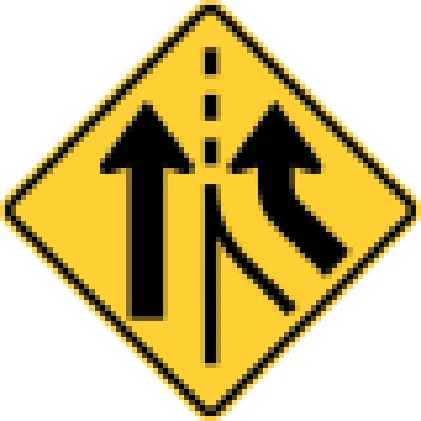
- Warns that slow-moving vehicles may be on the road ahead.
- Warns that the road may be icy.
- An additional lane begins ahead without merging.
- Warns that low vehicles may get caught crossing raised tracks.
Answer: An additional lane begins ahead without merging.
Added lane: An additional lane begins ahead without merging. Continue in your lane; no need to merge for the new lane.
Handbook p. 33 ↗What to study next
The practice question pool spans the course. Use the topics below to read the rules behind an answer, then return to practice.
8 lessons
Your License to Drive
Permits, GDL, classes, exams, renewals, suspensions
Explore4 lessons
Vehicle Requirements, Registration & Insurance
Equipment, inspection, registration, liability insurance
Explore5 lessons
Right-of-Way
Intersections, trains, emergency vehicles, school buses, pedestrians
Explore8 lessons
Signals, Signs & Markings
Signals, sign colors and shapes, every sign table, markings, work zones
Explore3 lessons
Signaling, Passing & Turning
Signals, passing rules, turning steps
Explore4 lessons
Parking, Stopping & Standing
No-stop zones, distances, disabled parking, parallel and hill parking
Explore3 lessons
Speed and Speed Limits
Following distance, stopping distance, limits, move over, racing
Explore8 lessons
Special Driving Situations
Highways, night, emergencies, weather, sharing the road, distraction
Explore5 lessons
Alcohol and Drugs
Effects, BAC, implied consent, zero tolerance, DWI penalties
Explore3 lessons
Motor Vehicle Crashes
Duties at the scene, reports, penalties, first aid
Explore3 lessons
Pedestrian & Bicycle Safety
Pedestrian rules, bicycle laws, equipment
Explore8 lessons
Additional Safety & Traffic Stops
Belts, open beds, traffic stops, road rage, cargo, glossary
Explore