roadwise.Open study app

Texas driving lesson · Signaling, Passing & Turning

Signaling

A 3-minute lesson from the Texas course. Read the rules and examples, follow the handbook page references, and check your understanding before you move on.

Read time
3 minutes
Course unit
Signaling, Passing & Turning
Checkpoint questions
5
Source pages
44

A surprise move often causes a crash. Signals tell other drivers what you're about to do so they can plan ahead. Signal every time, in plenty of time, even when you think no one is around.

Always signal when you are going to:

  • Change lanes
  • Make a turn
  • Pull away from a parking space parallel to the curb
  • Slow down or stop
  • Enter or leave a highway
  • Pull over to the side of the road
Handbook p. 44 ↗

Know the rule

You may use turn signal lights or hand-and-arm signals. For hand signals, extend your hand and arm well out of the window, and make sure your signals are easy to see and given in plenty of time.

Handbook p. 44 ↗

Know the rule

Hand and arm signals are usually difficult to see during non-daylight hours, so make sure your signal lights work properly.

Handbook p. 44 ↗

Know the rule

When signaling a stop, pump your brakes a few times to attract attention.

Handbook p. 44 ↗
100 ft

Signal continuously for at least this distance before turning or stopping

Handbook p. 44 ↗

Know the rule

Turn off your signal once your turn is complete. An unintended signal still means "turn" to other drivers.

Handbook p. 44 ↗
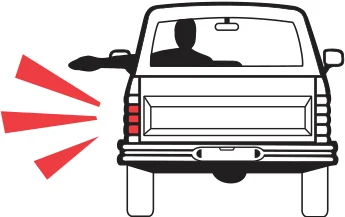
Hand signal left turn
Hand signal: left turn (arm straight out)
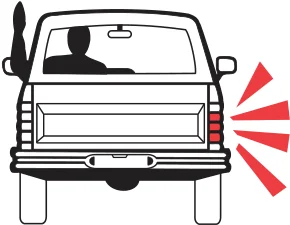
Hand signal right turn
Hand signal: right turn (arm bent up)
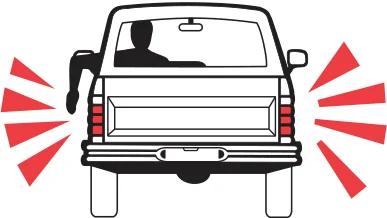
Hand signal stop or slow
Hand signal: stop or slow down (arm bent down)

Put it into practice

You finish a lane change on the freeway and forget to cancel your signal. A driver waiting at the next on-ramp may think you're about to exit or move over and pull out in front of you. Always switch the signal off once your move is done.

Check your understanding

Read the question, decide on an answer, then open it to check the explanation. These are Roadwise study questions based on the source handbook.

For how many feet before turning or stopping should you signal continuously?
  1. At least 50 feet
  2. At least 300 feet
  3. At least 20 feet
  4. At least 100 feet

Answer: At least 100 feet

Signal continuously for at least 100 feet before turning or stopping.
Handbook p. 44 ↗
You changed lanes but forgot to turn off your signal. What's the risk?
  1. Other drivers may think you're about to turn
  2. Other drivers may think you're about to stop
  3. Other drivers may think your car is disabled
  4. None; signals only matter while turning

Answer: Other drivers may think you're about to turn

An unintended signal still communicates "turn" to other drivers, which can cause confusion.

Handbook p. 44 ↗
What should you do with your brakes when signaling a stop, to draw attention?
  1. Slam the brakes once, hard
  2. Pump the brakes a few times
  3. Coast without braking at all
  4. Flash your headlights instead

Answer: Pump the brakes a few times

Pumping the brakes a few times helps attract attention when signaling a stop.

Handbook p. 44 ↗
Which of these situations requires you to signal, according to the handbook?
  1. Driving through a school zone
  2. Pulling out of a parallel parking spot
  3. Maintaining a constant highway speed
  4. Driving straight through a green light

Answer: Pulling out of a parallel parking spot

You must signal before pulling away from a space parallel to the curb.

Handbook p. 44 ↗
Hand and arm signals are usually difficult to see during non-daylight hours.
  1. True
  2. False

Answer: True

Hand signals are hard to see at night, making working signal lights more important.

Handbook p. 44 ↗
Take the lesson checkpoint in the app

More in Signaling, Passing & Turning