Work zones use orange devices to guide you safely past workers and equipment. Expect lane changes and sudden stops, obey flaggers, and remember fines double when workers are present.
In a construction or maintenance work zone, be prepared:
- To slow down or stop as you approach workers and equipment
- To change lanes
- For unexpected movements of workers and equipment
Know the rule
Orange is the basic color for work zone devices: signs, barricades, vertical panels, drums, cones, tubes, flashing arrow panels, and flaggers. Most work zone signs are diamond-shaped; a few are rectangular.
Handbook p. 41 ↗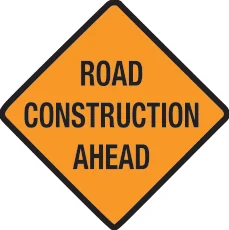
Traffic fines for violations in construction zones where workers are present
Handbook p. 41 ↗When you meet any channelizing device (barricades, panels, drums, cones, tubes):
- Slow down and prepare to change lanes when it is safe
- Be prepared for drivers who wait until the last second to move to the open lane
- Keep your reduced speed until you clear the zone (a sign shows you're leaving it)
- Return to your normal lane only after checking traffic behind you
Know the rule
Diagonal stripes on barricades and vertical panels point where to pass: stripes sloping down to the right mean bear right; sloping down to the left mean bear left.
Handbook p. 42 ↗
Know the rule
Large flashing or sequencing arrow panels may be used day and night to guide you into certain lanes and show part of the road ahead is closed.
Handbook p. 42 ↗Flag person rules
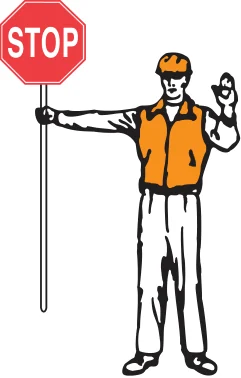
- Flaggers wear an orange vest, shirt or jacket and use stop/slow paddles or red flags
- Flaggers are used in cases of extreme hazard; their instructions must be obeyed
- When told to stop, stop in your lane; don't veer right or left
- Don't go forward until the flagger tells you to
- Proceed with caution and watch for oncoming vehicles in your lane
Automated flagger assistance device (AFAD)
A remotely operated device that controls traffic through temporary work zones, letting the flag person stand out of the lane of traffic.
Handbook p. 42 ↗Know the rule
Disobeying a warning sign, signal or marking, or driving around a barricade, is a misdemeanor with a fine of $1 to $200, doubled in a work zone when workers are present.
Handbook p. 43 ↗Know the rule
Driving around a warning sign or barricade placed where water covers any part of the road is a Class B misdemeanor: up to $2,000 and/or up to 180 days in jail.
Handbook p. 43 ↗Know the rule
Impact-cushion barrels reduce the seriousness of crashes; they're usually placed in front of solid obstacles in high-crash areas.
Handbook p. 41 ↗Know the rule
A special flag on the back of a bicycle (or a sign on a vehicle) means the rider or driver may be hearing impaired. Slow down.
Handbook p. 41 ↗Put it into practice
A flagger turns the paddle to STOP as you approach a one-lane work zone. Stop in your lane without drifting toward the shoulder, and wait until the flagger signals you forward. Then proceed slowly and watch for oncoming vehicles in your lane.