roadwise.Open study app

Texas driving lesson · Signals, Signs & Markings

Railroad signs & pavement markings

A 4-minute lesson from the Texas course. Read the rules and examples, follow the handbook page references, and check your understanding before you move on.

Read time
4 minutes
Course unit
Signals, Signs & Markings
Checkpoint questions
6
Source pages
38, 39, 40

Railroad signs warn you before you reach the tracks. Pavement markings work like signs painted on the road: yellow lines separate opposite directions, white lines separate lanes going the same way, and solid means don't cross.

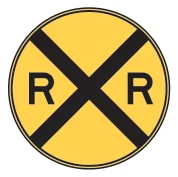
Railroad crossing ahead
Railroad advance warning sign

Know the rule

Round railroad advance warning sign: you're within a few hundred feet of a crossing. Slow down and be prepared to stop. If you see a train coming, STOP; never try to beat a train.

Handbook p. 38 ↗
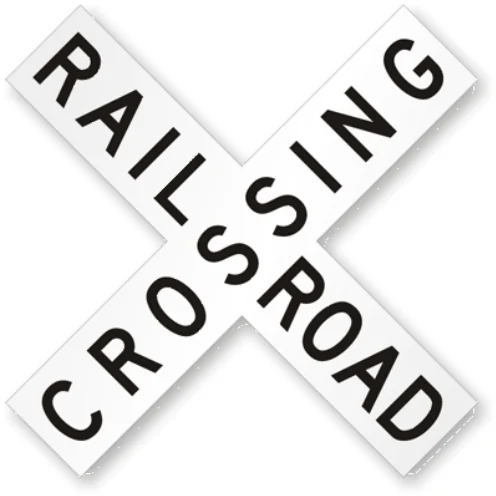
Railroad crossbuck
Railroad crossbuck

Know the rule

Crossbucks are posted at every railroad grade crossing and show where the tracks are. If more than one track must be crossed, the sign shows the number of tracks. Slow down, look, listen, and be ready to yield to a train.

Handbook p. 38 ↗

Know the rule

Emergency Notification System signs show an emergency number and the USDOT National Crossing Inventory Number, which identifies the crossing's exact location.

Handbook p. 38 ↗

Know the rule

Stop 15 to 50 feet from the nearest rail when a flag person directs you, when red lights flash or bells sound, or when any warning device shows a train is coming.

Handbook p. 39 ↗

Know the rule

Two-lane road with two-way traffic: keep right of the yellow center line. You may cross a broken line to pass or when the right half of the road is closed, but not if it's unsafe or the line is solid yellow.

Handbook p. 39 ↗
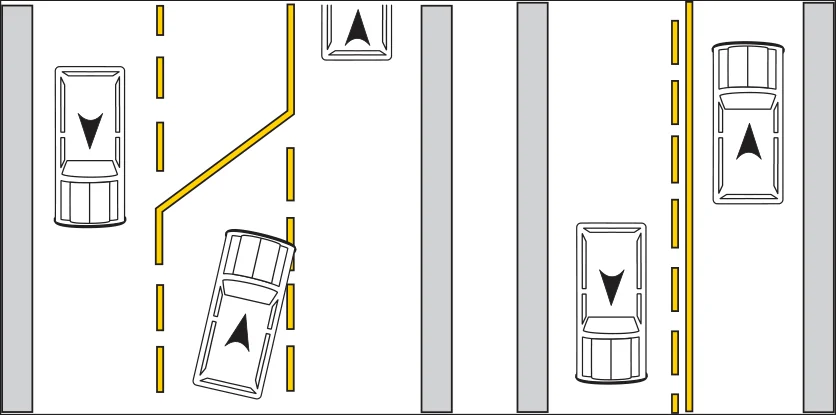
Lane merge
Solid yellow line on your side marks a no-passing zone

Know the rule

A solid yellow line on your side marks a no-passing zone. Broken or dashed lines let you pass or change lanes, if safe.

Handbook p. 40 ↗

Know the rule

Three-lane one-way roads marked with broken white lines: you may drive in any lane. Before turning, move into the lane closest to your turn well in advance.

Handbook p. 39 ↗

Know the rule

Center left-turn lane: enter it only where you'll have time to slow or stop for a safe left turn. It's never for passing or through traffic.

Handbook p. 39 ↗

Know the rule

On a multi-lane highway (four or more lanes), don't cross the double yellow line to pass, stay in your lane as much as possible, and keep right if you're slower.

Handbook p. 39 ↗

Know the rule

White stop lines: where present, stop behind them. White crosswalk lines mark pedestrian crossings; where there's no stop line, stop before the crosswalk when signs, signals, or pedestrians require it.

Handbook p. 40 ↗

Know the rule

Solid white lines mark edges, shoulders, channelizing, transitions and lane use; avoid crossing them if possible. Crossing double solid white lines is prohibited.

Handbook p. 40 ↗

Know the rule

A solid yellow line on the left edge of the road (found on interstates) means driving to its left is prohibited.

Handbook p. 40 ↗

Put it into practice

On a two-lane road, the center line on your side turns solid yellow as you near a hill. That's a no-passing zone. Even if the oncoming lane looks clear, stay behind the slow car until the line on your side is broken again.

Check your understanding

Read the question, decide on an answer, then open it to check the explanation. These are Roadwise study questions based on the source handbook.

What does a railroad crossbuck sign with two crossed bars, marked with a number, indicate?
  1. The speed limit at the crossing
  2. The distance to the next town
  3. The height clearance of the crossing
  4. The number of tracks to cross

Answer: The number of tracks to cross

If more than one track is present, the crossbuck sign shows the number of tracks.
Handbook p. 38 ↗
A solid yellow line on your side of a two-way road means what?
  1. It's a no-passing zone
  2. You may pass anytime it's convenient
  3. It marks a bike lane
  4. It's a merge lane

Answer: It's a no-passing zone

A solid yellow line on your side marks a no-passing zone.

Handbook p. 40 ↗
On a two-lane road, when may you cross a broken yellow center line?
  1. Never; any yellow line prohibits crossing
  2. When passing, or when the right half of the road is closed
  3. Only to turn into a driveway
  4. Only when no oncoming car is within 100 feet

Answer: When passing, or when the right half of the road is closed

You may cross a broken yellow line when passing another vehicle or when the right half of the road is closed, if it is safe.

Handbook p. 39 ↗
What does a solid yellow line on the left edge of an interstate highway indicate?
  1. It marks a passing lane only
  2. It marks the edge of a bike lane
  3. Driving left of that line is prohibited
  4. It indicates an upcoming exit

Answer: Driving left of that line is prohibited

This yellow edge line guides drivers that driving to its left is prohibited.

Handbook p. 40 ↗
What do white crosswalk lines painted across a road indicate?
  1. A pedestrian crossing area
  2. A school bus loading zone
  3. The end of a no-passing zone
  4. A railroad crossing ahead

Answer: A pedestrian crossing area

White crosswalk lines mark pedestrian crossing areas across a road.

Handbook p. 40 ↗
Crossing is prohibited where pavement markings show double solid white lines.
  1. True
  2. False

Answer: True

Double solid white lines prohibit crossing between lanes.

Handbook p. 40 ↗
Take the lesson checkpoint in the app

More in Signals, Signs & Markings