roadwise.Open study app

Texas driving lesson · Signals, Signs & Markings

Warning signs II: intersections, surfaces & hazards

A 4-minute lesson from the Texas course. Read the rules and examples, follow the handbook page references, and check your understanding before you move on.

Read time
4 minutes
Course unit
Signals, Signs & Markings
Checkpoint questions
4
Source pages
34, 35

These warning signs cover intersections ahead, tricky road surfaces, and hazards at the edge of the road. Most tell you to slow down; several also tell you not to pass or not to brake suddenly.

Intersections and people

Intersections and people
SignMeaning / what to do
T-intersectionRoad ends: turn left or right; be ready to yield
Y-intersectionY-intersection or side road traffic to the right
MergeOther lanes join yours; watch for that traffic
Highway intersection aheadSlow, look left and right, be prepared to stop
Pedestrian crossingMany pedestrians cross; slow down and watch
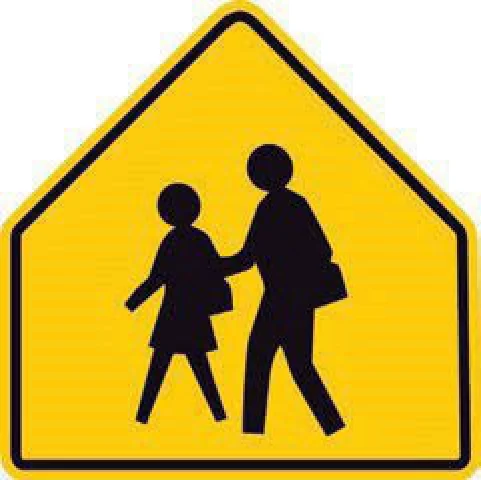
School (pentagon)Slow, watch for children, be ready to stop suddenly
Handicapped crossingWatch for people who may be disabled or in wheelchairs
Handbook p. 34 ↗
School zone
School crossing (pentagon)

Road surface and shape

Road surface and shape
SignMeaning / what to do
Loose gravelGo slow; no sudden braking or sharp turns
DipLow place in road; slow to avoid losing control
BumpSudden high place in road; slow down
Soft shoulderSoft dirt beside pavement; don't run off the road
Narrow bridgeBridge narrower than road; slow, use caution
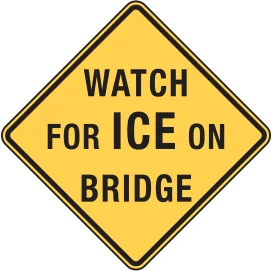
Ice on bridgeShown all winter; slow, no sudden braking or moves
Double sharp turnSharp right then sharp left: slow, keep right, no pass
Handbook p. 34 ↗
Watch for ice on bridge

More hazards (page 35)

More hazards (page 35)
SignMeaning / what to do
Keep either side (split arrows)Traffic may pass on either side of island/obstruction
Hill (truck on downgrade)Downgrade ahead; a lower gear may be needed
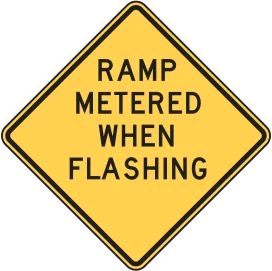
Ramp metered when flashingRamp meter (red/green) tells you when to enter
Truck crossingSlow; watch for trucks entering or crossing
Road narrowsPavement narrows; slow down, proceed with caution
Pavement endsHard surface becomes earth or low-type road; slow
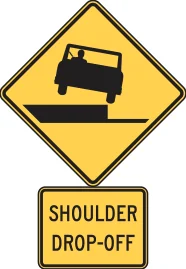
Shoulder drop-offBig drop to shoulder; if you leave it, slow, steer firmly
Handbook p. 35 ↗

More hazards (continued)

More hazards (continued)
SignMeaning / what to do
Grooved pavementGrooved for wet traction; motorcyclists use caution
Sharp curve (chevron)Road curves sharply: slow, keep right, don't pass
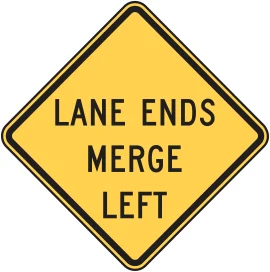
Lane ends, merge leftRight lane ends; right-lane drivers merge left
Stop aheadBe prepared for a stop sign ahead
Deer crossingSlow, stay alert, be ready to stop for animals
Object markersMark obstructions near the road and narrow bridge rails
Alignment markersShow the road's alignment as an aid to night driving
Handbook p. 35 ↗
Right lane ends
Lane ends, merge left
Shoulder drop-off
Shoulder drop-off
Ramp metered when flashing

Put it into practice

Driving over a bridge on a cold January morning, you pass a WATCH FOR ICE ON BRIDGE sign. Ease off the gas before the bridge, don't brake suddenly on it, and avoid sharp or sudden steering.

Check your understanding

Read the question, decide on an answer, then open it to check the explanation. These are Roadwise study questions based on the source handbook.

A warning sign shows the road ahead is covered with loose gravel. What should you do?
  1. Speed up slightly to keep traction
  2. Brake firmly and steer toward the shoulder
  3. Move onto the shoulder until the gravel ends
  4. Go slowly and avoid sudden braking or sharp turns

Answer: Go slowly and avoid sudden braking or sharp turns

On loose gravel, go slow enough to keep control and do not brake suddenly or make sharp turns.
Handbook p. 34 ↗
What is a "Soft Shoulder" warning sign telling you?
  1. Soft dirt beside the pavement can make you lose control
  2. The shoulder ahead is closed for road work
  3. The shoulder ahead may be used as a lane
  4. The pavement ahead has grooves for rain

Answer: Soft dirt beside the pavement can make you lose control

The dirt beside the pavement is soft; avoid running off the paved road or you may lose control.

Handbook p. 34 ↗
A warning sign says the bridge ahead may be icy. What should you do?
  1. Keep your speed so you cross quickly
  2. Slow down and avoid sudden braking or sharp moves
  3. Brake hard just before the bridge
  4. Change lanes on the bridge to find dry pavement

Answer: Slow down and avoid sudden braking or sharp moves

Slow down and avoid applying the brakes suddenly or making sharp or sudden movements on an icy bridge.

Handbook p. 34 ↗
A "Lane Ends" warning sign appears and you are driving in the right lane. What should you do?
  1. Merge into the left lane
  2. Stay in your lane; left-lane traffic must yield
  3. Stop at the end of the lane and wait
  4. Move onto the right shoulder

Answer: Merge into the left lane

When the lane ends ahead and you are in the right lane, you should merge into the left.

Handbook p. 35 ↗
Take the lesson checkpoint in the app

More in Signals, Signs & Markings