roadwise.Open study app

Texas driving lesson · Pedestrian & Bicycle Safety

Pedestrian laws & safety

A 4-minute lesson from the Texas course. Read the rules and examples, follow the handbook page references, and check your understanding before you move on.

Read time
4 minutes
Course unit
Pedestrian & Bicycle Safety
Checkpoint questions
6
Source pages
67

Drivers must pay special attention to people on foot, but pedestrians have rules too. Knowing when a pedestrian must yield, and when you must stop no matter what, helps you predict what walkers will do.

Pedestrian rules: crossing

  • Obey traffic signals unless a pedestrian control signal directs otherwise
  • Don't cross between two intersections (mid-street)
  • Crossing anywhere other than a crosswalk at an intersection: yield to all vehicles
  • Crossing where a pedestrian tunnel or overhead crossing is provided but not used: yield to all vehicles
  • At a crosswalk, keep right if possible
  • Wait on the curb, not in the street, until the signal is green or reads "Walk"
  • Don't suddenly walk or run into a vehicle's path
  • Look both ways before crossing and before stepping out from behind parked cars
Handbook p. 67 ↗

Pedestrian rules: walking

  • Use sidewalks when available; don't walk in the street
  • With no sidewalk, walk on the left side of the road and step off the pavement when a car approaches
  • At night, wear white or light clothing and/or carry a light or reflector
  • Be extra careful getting off a streetcar or bus
  • Get in and out of cars on the curb side when possible
  • Don't walk on a road while under the influence of or drinking alcohol
Handbook p. 67 ↗

Know the rule

Blind, partially blind, or disabled people may carry a white cane while walking. No one else may display a white cane on a public street or highway.

Handbook p. 67 ↗

Know the rule

No one may stand in the road to solicit a ride, contributions, or business, except a charitable contribution authorized by the local authority over that road.

Handbook p. 67 ↗

Know the rule

Local ordinances may require pedestrians to obey traffic control devices and forbid crossing in a business district or designated highway except in a crosswalk.

Handbook p. 67 ↗

Motorists must:

  • Slow down, use the horn if necessary, and be prepared to stop for a pedestrian crossing or trying to cross
  • Watch for pedestrians with an assistance animal or white cane, and take precautions not to endanger them
  • Watch for blind pedestrians at bus stops, intersections, business areas, and near schools for the blind
Handbook p. 67 ↗

Know the rule

If injury or danger to a pedestrian with a white cane or assistance animal can only be avoided by stopping, the driver must come to a full stop.

Handbook p. 67 ↗
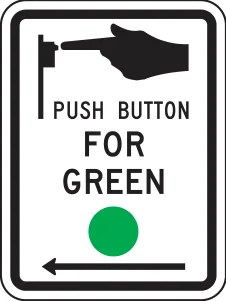
Push button pedestrian signal
Push button for green: pedestrian-activated signal

Put it into practice

A man with a white cane steps off the curb mid-block as you approach. He isn't in a crosswalk, but the cane means he may be blind. Slow down, be ready to stop, and come to a full stop if that's the only way to avoid danger.

Check your understanding

Read the question, decide on an answer, then open it to check the explanation. These are Roadwise study questions based on the source handbook.

A pedestrian crosses mid-block, not in a crosswalk. Who must yield?
  1. The vehicle must always yield to the pedestrian
  2. Neither has an obligation to yield
  3. The pedestrian must yield to all vehicles
  4. Whoever reaches the spot first

Answer: The pedestrian must yield to all vehicles

Crossing outside a crosswalk at an intersection, the pedestrian must yield to vehicles.
Handbook p. 67 ↗
Where there's no sidewalk, which side of the road should a pedestrian walk on?
  1. The right side, with the flow of traffic
  2. Either side, it doesn't matter
  3. Whichever side has more light
  4. The left side, facing oncoming traffic

Answer: The left side, facing oncoming traffic

Pedestrians should walk on the left, facing traffic, when there's no sidewalk.

Handbook p. 67 ↗
When must a driver bring the vehicle to a full stop to avoid endangering a pedestrian?
  1. When stopping is the only way to avoid danger
  2. Only when directly instructed by a police officer
  3. Only in a marked school zone
  4. Only when the pedestrian is in a crosswalk

Answer: When stopping is the only way to avoid danger

The driver must stop fully if that's the only way to avoid endangering the pedestrian.

Handbook p. 67 ↗
Who is permitted to carry a white cane on a public street?
  1. Anyone walking at night, for visibility
  2. The blind, partially blind, or disabled
  3. Only people who are fully blind
  4. Crossing guards near schools

Answer: The blind, partially blind, or disabled

The white cane is reserved for individuals who are blind, partially blind, or disabled.

Handbook p. 67 ↗
Where should a pedestrian get in and out of a car when possible?
  1. On the traffic side of the road
  2. Wherever is closest to their destination
  3. On the curb side of the road
  4. It doesn't matter which side

Answer: On the curb side of the road

Pedestrians should get in and out of cars on the curb side when possible.

Handbook p. 67 ↗
May a person stand in the road to solicit a ride or business?
  1. Yes, if done briefly
  2. Yes, during daylight hours only
  3. Yes, if wearing reflective clothing
  4. No, this is prohibited

Answer: No, this is prohibited

Standing in the road to solicit a ride, contributions, or business is not allowed (with narrow charitable exceptions).

Handbook p. 67 ↗
Take the lesson checkpoint in the app

More in Pedestrian & Bicycle Safety