roadwise.Open study app

Texas driving lesson · Pedestrian & Bicycle Safety

Bicycle equipment, shared lanes & safety

A 3-minute lesson from the Texas course. Read the rules and examples, follow the handbook page references, and check your understanding before you move on.

Read time
3 minutes
Course unit
Pedestrian & Bicycle Safety
Checkpoint questions
6
Source pages
68, 69

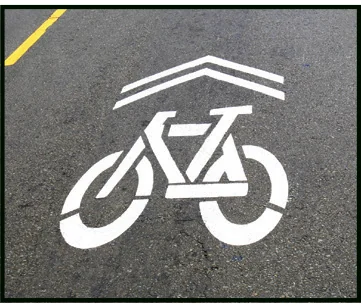
Bicycles must be able to stop and be seen. Shared lane markings show drivers and cyclists where bikes are likely to ride. And wet weather adds hazards for cyclists that drivers should anticipate.

A shared lane marking may be used to:

  • Help cyclists position themselves away from the opening doors of parked cars
  • Help cyclists position themselves in lanes too narrow to share side by side
  • Show where cyclists are likely to ride in the lane
  • Encourage motorists to pass cyclists safely
  • Reduce wrong-way bicycling
Handbook p. 68 ↗
Shared lane marking (sharrow)
Shared lane marking

Required bicycle equipment

  • A brake that can make the wheels skid on dry, level, clean pavement
  • At night: a front lamp with white light visible at least 500 feet ahead
  • At night: a red, DPS-approved rear reflector visible from 50 to 300 feet
  • Optional at night, in addition to the reflector: a red rear light visible from 500 feet
Handbook p. 69 ↗
500 ft

Minimum visibility of a bicycle's white front lamp at night

Handbook p. 69 ↗
50–300 ft

Visibility range required for a bicycle's red rear reflector

Handbook p. 69 ↗

Know the rule

Hearing-impaired riders may display a safety flag on the bicycle.

Handbook p. 69 ↗

Bicycle safety guidelines

  • You may be required by local law to wear a helmet
  • Slow down and use caution on pedestrian facilities
  • Don't weave in and out of parked cars
  • Move off the street to stop, park, or repair your bicycle
  • Choose routes that fit your skill and experience
  • Bicycles may be equipped with a mirror
  • Wear light-colored or reflective clothing
Handbook p. 69 ↗

Know the rule

In wet weather, manhole covers and painted stripes get slick, water can hide potholes, and motorists can see far less.

Handbook p. 69 ↗

Put it into practice

Driving at dusk, you see a small red glint ahead in your lane. It could be a bicycle's rear reflector, which only has to be visible from 50 to 300 feet. Slow down and give the cyclist room as you pass.

Check your understanding

Read the question, decide on an answer, then open it to check the explanation. These are Roadwise study questions based on the source handbook.

How far must a bicycle's front white light be visible at night?
  1. At least 100 feet
  2. At least 1,000 feet
  3. At least 500 feet
  4. At least 50 feet

Answer: At least 500 feet

A bicycle's front lamp must emit white light visible from at least 500 feet.
Handbook p. 69 ↗
What is the required visibility range for a bicycle's rear red reflector?
  1. 10 to 50 feet
  2. 300 to 600 feet
  3. 100 to 1,000 feet
  4. 50 to 300 feet

Answer: 50 to 300 feet

A bicycle's rear reflector must be visible from 50 to 300 feet.

Handbook p. 69 ↗
What equipment must every bicycle have to allow the rider to skid the wheels on dry, clean pavement?
  1. A brake
  2. A horn
  3. A rearview mirror
  4. A headlight only

Answer: A brake

Every bicycle must have a brake capable of skidding the wheels on dry, level, clean pavement.

Handbook p. 69 ↗
What is one purpose of a shared lane marking on the road?
  1. Marking an exclusive bus lane
  2. Indicating a pedestrian crossing
  3. Marking a lane closed to bicycles
  4. Helping cyclists avoid parked cars' opening doors

Answer: Helping cyclists avoid parked cars' opening doors

Shared lane markings help cyclists position laterally to avoid the door zone of parked cars.

Handbook p. 68 ↗
A bicycle ridden at night may add a red rear light to its reflector. From how far must that light be visible?
  1. 300 feet
  2. 500 feet
  3. 1,000 feet
  4. 200 feet

Answer: 500 feet

A red rear light visible from 500 feet may be used in addition to the rear reflector.

Handbook p. 69 ↗
Hearing-impaired bicycle riders may display a safety flag to alert others.
  1. True
  2. False

Answer: True

A safety flag can signal that a bicycle rider is hearing impaired.

Handbook p. 69 ↗
Take the lesson checkpoint in the app

More in Pedestrian & Bicycle Safety