roadwise.Open study app

Texas driving lesson · Special Driving Situations

Highway driving & highway hypnosis

A 4-minute lesson from the Texas course. Read the rules and examples, follow the handbook page references, and check your understanding before you move on.

Read time
4 minutes
Course unit
Special Driving Situations
Checkpoint questions
6
Source pages
53, 54

Freeways, toll roads, turnpikes and expressways are designed for maximum safety, but only if you use them properly. Plan your entrance, direction and exit before you go, and watch for highway hypnosis on long trips.

Highway

The width between the boundary lines of a publicly maintained way, any part of which is open to the public for vehicular travel.

Handbook p. 53 ↗

Know the rule

If you can't or don't want to drive at or above the minimum speed limit, don't use the highway.

Handbook p. 53 ↗

Entering the highway

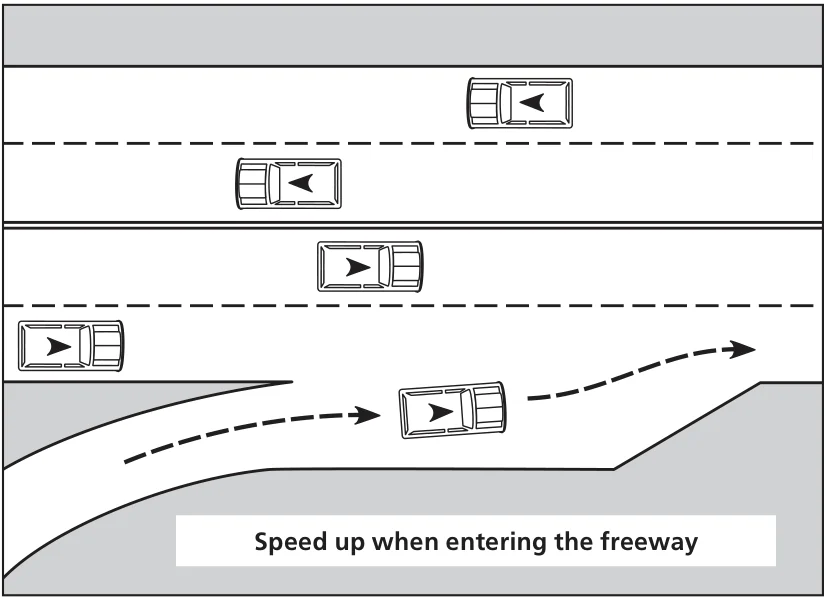
  • Yield the right-of-way to vehicles already on the highway
  • Enter the speed change lane, stay right, signal left, and when clear speed up to merge with traffic
Handbook p. 53 ↗
Entering a freeway
Speed up in the entrance lane to merge with freeway traffic

Choosing a lane

  • Right lane: driving at the minimum posted speed or below the normal flow
  • Middle or left lane: traveling faster than other traffic or passing
  • Leaving soon: move to the exit lane as early as possible
Handbook p. 53 ↗

Once in the proper lane

  • Stay in the middle of your lane and don't weave in and out of traffic
  • Keep a constant speed with traffic; don't speed up and slow down unnecessarily
  • Stay at least two seconds behind the vehicle ahead; in bad weather, at least four
  • Adjust your speed so others can enter the highway safely
  • In any lane except the right (slower) lane, be ready to move over so faster traffic can pass
Handbook p. 54 ↗

Know the rule

Move into the proper lane well before your exit; the heavier the traffic, the earlier. Exit signs are usually placed at least 1,000 yards ahead of the exit. Slow down on the exit ramp so you're within the new, lower limit when you leave it.

Handbook p. 54 ↗

Highway hypnosis

Drowsiness or unawareness brought on by reduced activity and the steady sounds of wind, engine and tire hum.

Handbook p. 54 ↗

Fight highway hypnosis

  • Stop at least every two hours or every 100 miles, even if you feel fine; walk around
  • Don't drive more than eight hours per day
  • Keep shifting your eyes: near and far, left and right; read signs; check your mirror
Handbook p. 54 ↗

Highway safety tips

  • Keep a window open for fresh air to stay alert
  • Wear good sunglasses on bright days, never at night
  • Stay out of other drivers' blind spots: stay behind or go around, don't follow to the side
  • Avoid cell phones; pull off or use a hands-free headset (under 18: no phone use, even hands-free)
Handbook p. 54 ↗

Put it into practice

You're 90 minutes into a road trip and have covered 100 miles. Even though you feel fine, it's time to stop: Texas recommends a break at least every two hours or every 100 miles. Get out and walk around before continuing.

Check your understanding

Read the question, decide on an answer, then open it to check the explanation. These are Roadwise study questions based on the source handbook.

When entering a highway, who must you yield to?
  1. Vehicles behind you on the entrance ramp
  2. No one; entering traffic always has priority
  3. Vehicles already on the highway
  4. Only vehicles in the far right lane

Answer: Vehicles already on the highway

You must yield the right-of-way to vehicles already on the highway when entering.
Handbook p. 53 ↗
Which lane should you use if you're driving at or below the normal flow of highway traffic?
  1. The far left lane
  2. Whichever lane has the least traffic
  3. The center lane exclusively
  4. The right lane

Answer: The right lane

Use the right lane to drive at the minimum posted speed or below the normal flow of traffic.

Handbook p. 53 ↗
About how far ahead of a freeway exit are exit signs usually posted?
  1. At least 1,000 yards
  2. About 100 yards
  3. About 3 miles
  4. At least 5,000 yards

Answer: At least 1,000 yards

Exit signs are usually placed at least 1,000 yards ahead of the exit.

Handbook p. 54 ↗
To fight highway hypnosis, how often should you stop on a long drive?
  1. At least every 2 hours or 100 miles
  2. At least every 6 hours or 500 miles
  3. At least every 4 hours or 200 miles
  4. Only when you feel drowsy

Answer: At least every 2 hours or 100 miles

Stop at least every two hours or every 100 miles to fight highway hypnosis.

Handbook p. 54 ↗
On a multi-lane highway, which lanes should be ready to move over for faster traffic?
  1. Every lane except the right, slower lane
  2. Only the leftmost lane
  3. Only the right lane
  4. Only lanes next to an on-ramp

Answer: Every lane except the right, slower lane

Vehicles in any lane except the right slow-traffic lane should be prepared to let faster traffic pass.

Handbook p. 54 ↗
When leaving the highway, when should you begin slowing down?
  1. Only after you've fully exited
  2. Before leaving the main travel lanes
  3. On the exit ramp
  4. At the first exit sign

Answer: On the exit ramp

Slow down on the exit ramp so you match the new, slower speed limit by the time you leave the highway.

Handbook p. 54 ↗
Take the lesson checkpoint in the app

More in Special Driving Situations