A 3-minute lesson from the Texas course. Read the rules and examples, follow the handbook page references, and check your understanding before you move on.
Motorcyclists have the same rights as other drivers, but drivers often don't see them. About half of all motorcycle crashes involve another vehicle, and riders are far more likely to die in a crash than car occupants.
35×
Motorcyclists are about 35 times more likely than passenger car occupants to die in a traffic crash
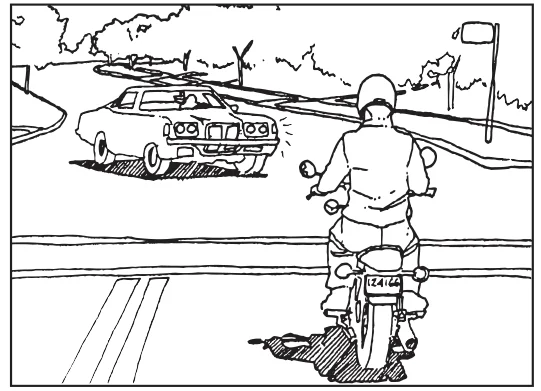
A car turning left in front of a motorcycle: the most common crash
Know the rule
Always take a second look for motorcycles before turning at an intersection, especially left turns, and check mirrors and blind spots before changing lanes. Signal even if you don't see anyone.
When stopping behind a motorcycle at intersections, signals or crossings, leave a full vehicle length. In dry conditions, motorcycles can stop more quickly than cars.
Texas's Motorcycle Operator Training and Safety program was created in 1983 and moved from DPS to TDLR in 2020; part of each motorcycle license fee supports it.
You're waiting to turn left and see a single headlight approaching. Judging a motorcycle's speed and distance is hard, so if you're unsure, wait. Let it pass before you turn.
Check your understanding
Read the question, decide on an answer, then open it to check the explanation. These are Roadwise study questions based on the source handbook.
How much following distance should you leave behind a motorcycle?
Four to six seconds
One to two seconds
Ten to twelve seconds
Two to three seconds
Answer: Four to six seconds
Allow at least four to six seconds of following distance behind a motorcycle.