Ice, roundabouts and floodwater each call for specific habits. The big ideas: on ice there is no "safe" speed; in a roundabout you yield and go counterclockwise; and water over the road means turn around.
Winter driving tips
| Tip | Why / how |
|---|---|
| Keep a safe interval | Many rear-end crashes on ice come from too little room |
| Reduce speed for conditions | No speed is "safe" on snow or ice; don't lock brakes |
| Keep windows clear | Clear snow and ice; check wipers and defroster |
| Watch for danger spots | Bridges may ice first; snow melts slower in shade |
| Get a feel for the road | Start slowly; test brakes gently once moving |
| Chains or snow tires | Chains work best, but neither allows normal speeds |
Know the rule
Locking your brakes on ice causes a loss of steering and control. Snow tires will slide on ice or packed snow.
Handbook p. 55 ↗Modern roundabout
A one-way, circular intersection where traffic flows counterclockwise around a center island, controlled by yield signs instead of traffic lights.
Handbook p. 55 ↗Potential conflict points: modern roundabout vs. traditional four-way signalized intersection
Handbook p. 55 ↗Average reduction in severe crashes at intersections converted to modern roundabouts
Handbook p. 56 ↗Driving a single-lane roundabout
- Slow down as you approach and observe any advisory speed signs
- Yield to traffic already in the circle
- Enter when there's an acceptable gap and travel counterclockwise
- Use your turn signal and turn right to exit
- Watch for bicyclists and pedestrians in crosswalks at entries and exits
Multi-lane roundabouts: also
- Use the advance lane-movement sign to choose the correct entry lane
- Do not change lanes while in the circle
Know the rule
In any roundabout, give room to large vehicles (semitrailers, buses, fire trucks) that need more than one lane. Pull over for emergency vehicles on approaches and exits, but never stop in the circle: clear it first, then pull over.
Handbook p. 56 ↗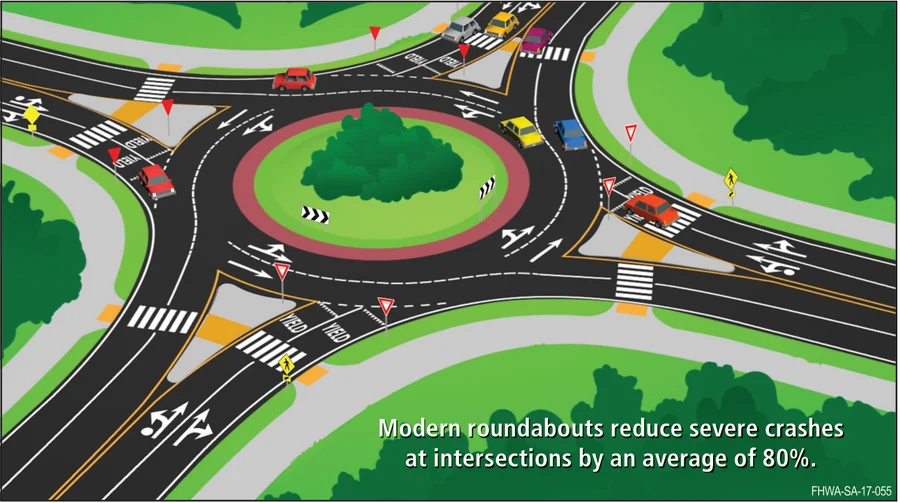
Flood facts
- Six inches of water reaches the bottom of most cars, causing loss of control and possible stalling
- Twelve inches of water will float many cars
- Two feet of rushing water will carry away pickups, SUVs and most other vehicles
- Water may hide a missing roadbed or bridge; roads can collapse even after water recedes
Know the rule
Nearly half of all flash flood deaths are vehicle-related. If your vehicle stalls in floodwater, get out quickly and move to higher ground. Better yet, when there's water on the road: Turn Around Don't Drown®.
Handbook p. 56 ↗Put it into practice
A low-water crossing on your route has a few inches of fast-moving water across it. Don't guess the depth: water can hide a washed-out road, and six inches can stall your car. Turn around and take another route.