roadwise.Open study app

Texas driving lesson · Special Driving Situations

Breakdowns, skids & vehicle emergencies

A 3-minute lesson from the Texas course. Read the rules and examples, follow the handbook page references, and check your understanding before you move on.

Read time
3 minutes
Course unit
Special Driving Situations
Checkpoint questions
6
Source pages
54, 55, 79, 81

One basic rule applies in every emergency: think before you act. Most car emergencies share the same first move: don't slam the brakes. Take your foot off the gas, steer, then brake gently.

If your vehicle breaks down

  • If you can't get the car off the road, get everyone out and off the road; use portable warning devices
  • Otherwise move off the pavement; a car with a flat or blowout can be driven slowly off the road
  • Turn on emergency warning lights (or taillights if you have none); at night also turn on inside lights
  • Tie a white cloth to the antenna or door handle; if you have none, raise the hood
Handbook p. 54 ↗

If you start to skid

  • Don't hit the brakes suddenly and hard; take your foot off the gas
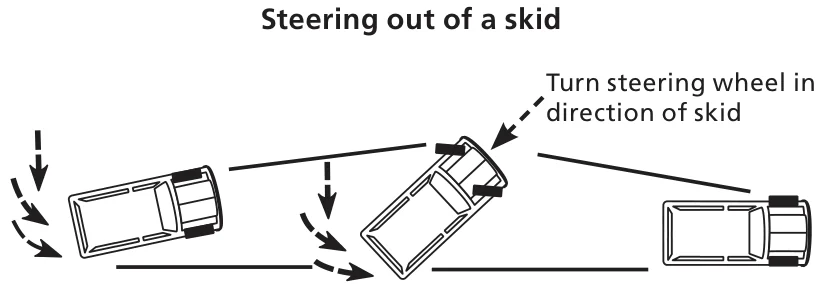
  • Turn the steering wheel in the direction of the skid; as you regain control, gently straighten the wheels
  • Prevent skids by slowing in poor road or weather conditions and replacing old or worn tires
Handbook p. 54 ↗
Steering out of a skid
Steering out of a skid: turn the wheel in the direction of the skid

Skid

When the tires lose part or all of their traction on the road surface.

Handbook p. 81 ↗

Hydroplaning

When a tire patch loses contact with the road by rising up on top of water.

Handbook p. 79 ↗

Know the rule

Brake failure: don't panic. Use your parking brake cautiously so you don't lock the brakes and skid, and shift to a lower gear.

Handbook p. 55 ↗

If you run off the pavement

  • Don't hit the brakes suddenly and hard; grip the wheel tightly and take your foot off the gas
  • Brake carefully and don't swing back onto the pavement
  • Wait until you've slowed, check traffic behind you, then carefully drive back on
Handbook p. 55 ↗

Flat tire or blowout

  • Don't hit the brakes suddenly and hard
  • Take your foot off the gas and gently apply the brakes
  • Steer straight ahead to a stop
Handbook p. 55 ↗

Know the rule

On a steep downhill, shift into a low gear to help slow the vehicle. Never coast in neutral, and with a standard transmission never coast with your foot on the clutch.

Handbook p. 55 ↗

Put it into practice

Your rear tires slide to the right on a wet curve. Lift off the gas, don't stomp the brake, and turn the steering wheel to the right, the direction of the skid. As the car straightens, gently return the wheel to center.

Check your understanding

Read the question, decide on an answer, then open it to check the explanation. These are Roadwise study questions based on the source handbook.

What is the first thing you should do if your car starts to skid?
  1. Slam on the brakes immediately
  2. Ease off the gas and steer into the skid
  3. Turn the wheel opposite the skid direction
  4. Speed up to regain traction

Answer: Ease off the gas and steer into the skid

Take your foot off the gas and steer in the direction of the skid to recover control.
Handbook p. 54 ↗
Your brakes suddenly fail while driving. What should you do?
  1. Turn off the engine immediately
  2. Shift into neutral and coast
  3. Use the parking brake cautiously and shift to a lower gear
  4. Pump the gas pedal repeatedly

Answer: Use the parking brake cautiously and shift to a lower gear

Apply the parking brake cautiously and downshift if your regular brakes fail.

Handbook p. 55 ↗
You get a blowout while driving. What's the correct response?
  1. Slam on the brakes and steer sharply to the shoulder
  2. Accelerate to maintain control
  3. Steer firmly onto the shoulder at speed
  4. Ease off the gas, brake gently, steer straight

Answer: Ease off the gas, brake gently, steer straight

In a blowout, ease off the gas, brake gently, and steer straight.

Handbook p. 55 ↗
When driving down a steep hill, what should you do instead of riding the brakes?
  1. Shift into a low gear
  2. Coast in neutral
  3. Shift into a higher gear
  4. Hold the clutch pedal down

Answer: Shift into a low gear

Shift into a low gear to help control your speed on a steep downgrade instead of riding the brakes.

Handbook p. 55 ↗
What should you do if your car breaks down and you can't get it off the road?
  1. Stay inside with seat belts fastened
  2. Stay inside and turn on the hazard lights
  3. Get everyone out of the car and off the road
  4. Walk for help, leaving passengers inside

Answer: Get everyone out of the car and off the road

If you can't move the car off the road, get everyone out and use portable warning devices.

Handbook p. 54 ↗
If you run off the pavement, steer back onto the road right away before slowing down.
  1. True
  2. False

Answer: False

Don't swing back onto the pavement; wait until your speed is reduced, check traffic, then drive back on carefully.

Handbook p. 55 ↗
Take the lesson checkpoint in the app

More in Special Driving Situations