South Dakota practice test
South Dakota permit practice test.
Get to know the format, try six study questions, and check the explanations before opening a full Roadwise practice test. This course’s simulation is based on the format described below.
- Questions
- 25
- Correct to pass
- 20
- Practice timer
- No timer
- Study question bank
- 686
The format in this course
South Dakota Knowledge Test
To pass this Roadwise simulation, answer at least 20 of 25 questions correctly. Answers and explanations appear after you finish. Unanswered questions count as incorrect.
This practice format uses one overall passing threshold, without a separately scored sign section.
This Roadwise practice format has no countdown, so you can take the time you need.
The SD Driver Handbook itself (p.65) shows only a 10-question, 3-choice self-check sample and does not state the official computer-based test's length or passing score. The official DPS site (dps.sd.gov/driver-licensing/south-dakota-licensing-information/driving-tests) could not be checked directly for these figures, so the 25-question / 80%-to-pass (20 correct) format is used here as the best-corroborated value, consistent across independent test-prep sources describing the DPS knowledge test. There is no evidence of a separately scored signs sub-section, so the practice test uses one combined score.
Try a few practice questions
Read the question, decide on an answer, then open it to check the explanation. These are Roadwise study questions based on the source handbook.
You just moved to South Dakota with a valid out-of-state non-commercial license. How long do you have to apply for a South Dakota license?
- 30 days
- 10 days
- 180 days
- 90 days
Answer: 90 days
Holders of a valid out-of-state non-commercial license must apply for a South Dakota license within 90 days of establishing residency.
Handbook p. 5 ↗When checking tread depth with a penny, what does it mean if you can see all of Lincoln's head?
- The tire needs to be rotated
- The tire pressure is too low
- The tire is too worn to keep using
- The tire has plenty of tread left
Answer: The tire is too worn to keep using
If you can see all of Lincoln's head when the penny is placed in the tread, the tire is too worn and must be replaced.
Handbook p. 20 ↗At an all-way stop, if two drivers arrive at the same time, who should yield?
- Yield to the driver on your right
- The driver going straight goes first
- The driver turning left goes first
- Yield to the driver on your left
Answer: Yield to the driver on your right
You should yield to the driver on your right at an all-way stop if you both arrive at the same time.
Handbook p. 28 ↗How far before an intersection must you signal a turn or lane change?
- At least 20 feet
- At least 300 feet
- At least 500 feet
- At least 100 feet
Answer: At least 100 feet
Drivers must signal at least 100 feet from an intersection before turning or changing lanes.
Handbook p. 46 ↗If an oncoming driver fails to dim their high beams and it continues to blind you, what should you do?
- Stop in your lane until they pass
- Look toward the right side of the road until they pass
- Switch your own high beams on
- Look directly at their lights to judge distance
Answer: Look toward the right side of the road until they pass
If a driver won't dim their lights, look toward the right edge of the road to avoid being blinded, using it to stay on course.
Handbook p. 52 ↗What does this sign mean?
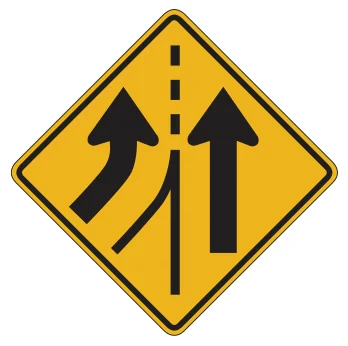
- Warns the road curves right ahead, with an advisory speed of 25 mph.
- Warns of a crossing used by both pedestrians and cyclists.
- Warns that water may be covering the road ahead.
- An additional lane begins ahead without merging.
Answer: An additional lane begins ahead without merging.
Added lane: An additional lane begins ahead without merging. Continue in your lane; no need to merge for the new lane.
Handbook p. 30 ↗What to study next
The practice question pool spans the course. Use the topics below to read the rules behind an answer, then return to practice.
8 lessons
Your License
Documents, permits, testing, renewal, points and insurance
Explore5 lessons
Be in Shape to Drive
Vision, fatigue, distraction, alcohol, drugs and health
Explore6 lessons
Before You Drive
Vehicle checks, clear view, seats, belts, child safety and loads
Explore2 lessons
Basic Driving
Starting, steering, stopping, speed and backing
Explore7 lessons
Rules of the Road
Right-of-way, signals, signs and pavement markings
Explore8 lessons
General Driving
Turns, intersections, interchanges, parking, passing and stops
Explore8 lessons
Safe Driving Tips
Searching, speed, space cushions and communicating
Explore4 lessons
Emergencies and Crashes
Avoiding crashes, malfunctions, the crash scene and reporting
Explore7 lessons
Sharing the Road
Pedestrians, cyclists, motorcycles, trucks and emergency vehicles
Explore4 lessons
Special Driving Situations
Night, work zones, winter and rural roads
Explore