roadwise.Open study app

South Dakota driving lesson · General Driving

Turns, turnabouts and U-turns

A 4-minute lesson from the South Dakota course. Read the rules and examples, follow the handbook page references, and check your understanding before you move on.

Read time
4 minutes
Course unit
General Driving
Checkpoint questions
6
Source pages
35, 36

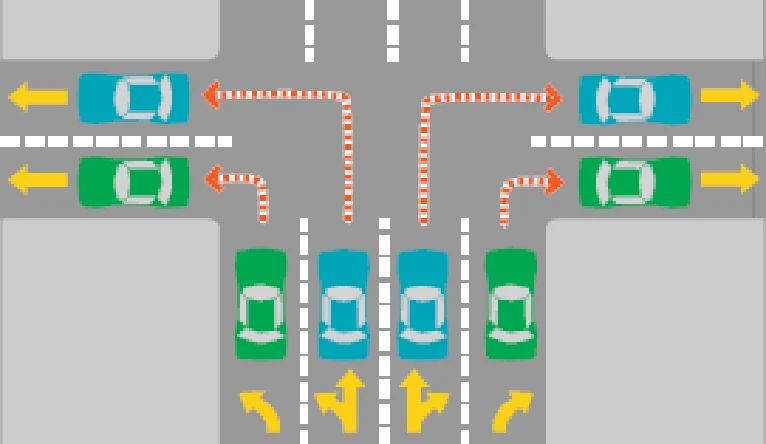
Good turns start early: search, signal, choose the right spot in your lane, and look through the turn. When you need to reverse direction, pick the turnabout that fits the street.

Every turn:

  • Search all corners for traffic controls, pedestrians and other vehicles; signal
  • Enter and keep to the lane closest to the direction you want to go
  • Look through the turn to the farthest point along your intended path
  • Accelerate smoothly, make sure the signal cancels, and check traffic behind
Handbook p. 35 ↗

Know the rule

Right turns: always turn from the right-most portion of the lane, and avoid swinging wide to the left first.

Handbook p. 35 ↗

Know the rule

Left turns: always turn from the left-most portion of the lane, and yield to oncoming traffic.

Handbook p. 35 ↗

Know the rule

With multiple turn lanes, identify and enter the lane you'll turn from, and stay in it until the turn is complete.

Handbook p. 35 ↗
Three-point turnabout (Y-turn)
Turning from the correct lane position

Two-point turnabout

Using a street, alley or driveway to reverse direction when you can't drive around the block: back into it (reverse) or pull into it and back out (forward).

Handbook p. 35 ↗

Reverse two-point turnabout:

  • Signal right; stop and check traffic to the sides and rear
  • Back up until your rear bumper reaches the near edge of the driveway
  • Back slowly, steering all the way to the right
  • As the vehicle enters the driveway, straighten the wheels and stop
  • Shift to drive, check both ways, signal and turn left into the proper lane
Handbook p. 35 ↗

Know the rule

Forward two-point turnabout: signal left, turn into the driveway as near the right side as possible, stop when the rear clears the curb, then signal right and back out, turning the wheel quickly all the way right.

Handbook p. 35 ↗

Know the rule

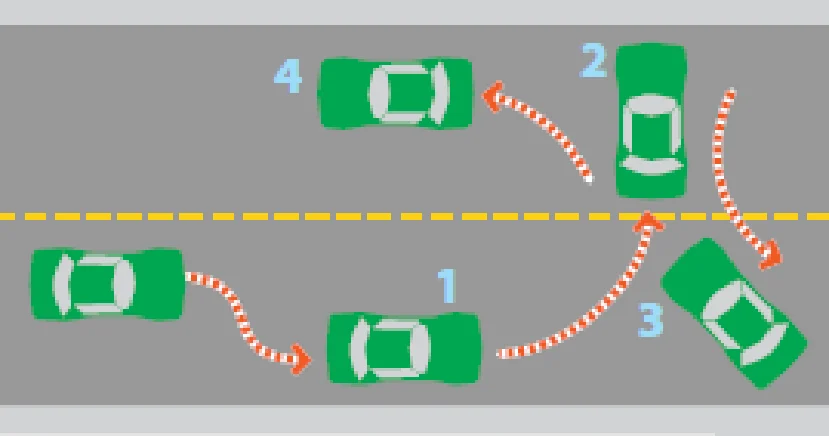
Use a three-point turnabout (Y-turn) only on a two-lane road that is too narrow for a U-turn when you can't go around the block: pull right, turn hard left across, back up turning hard right, then drive forward turning hard left.

Handbook p. 35 ↗
Three-point turn (turnabout)
Three-point turnabout

Never make a U-turn:

  • Where an officer is controlling traffic, unless the officer tells you to
  • Mid-block in a business district, or mid-block on a through highway in a residential district
  • Where signs prohibit it
  • On a curve or near a hill crest of an undivided road if others can't see you within 500 feet
  • Anywhere it can't be done safely without interfering with other traffic
Handbook p. 36 ↗

Know the rule

Exception: on a divided street or highway, a mid-block U-turn may be made at a legal opening or crossover.

Handbook p. 36 ↗

Put it into practice

On a narrow two-lane residential street you pass your friend's house. There's no driveway handy and you can't go around the block, so a three-point turn fits. Check mirrors, traffic and blind spots before each of the three moves.

Check your understanding

Read the question, decide on an answer, then open it to check the explanation. These are Roadwise study questions based on the source handbook.

When making a right turn, from which part of the lane should you turn?
  1. The center of the lane
  2. The left-most portion of the lane
  3. After swinging wide to the left
  4. The right-most portion of the lane

Answer: The right-most portion of the lane

Always turn right from the right-most portion of the lane, avoiding a wide swing to the left first.
Handbook p. 35 ↗
When making a left turn, from which part of the lane should you turn?
  1. The center of the lane
  2. The right-most portion of the lane
  3. The left-most portion of the lane
  4. After swinging wide to the right

Answer: The left-most portion of the lane

Always turn left from the left-most portion of the lane.

Handbook p. 35 ↗
When multiple lanes are available for turning, what should you do once you enter your chosen lane?
  1. Stay in that lane until the turn is completed
  2. Switch lanes mid-turn if traffic allows
  3. Move to the outer lane immediately
  4. Signal a lane change during the turn

Answer: Stay in that lane until the turn is completed

Identify and enter the correct turning lane, then stay in it until the turn is completed.

Handbook p. 35 ↗
On an undivided highway, a U-turn is prohibited on a curve or near the crest of a grade unless what condition is met?
  1. It is being made at an intersection with a stop sign
  2. There is no oncoming traffic at that moment
  3. The driver signals for at least 10 seconds first
  4. Others can see the vehicle from 500 feet away

Answer: Others can see the vehicle from 500 feet away

U-turns are prohibited on curves or near a grade crest where the vehicle can't be seen from 500 feet away in any direction.

Handbook p. 36 ↗
Where is a U-turn generally prohibited in a business or residential district?
  1. At a legal opening in a divided street
  2. Only on divided highways
  3. Only at four-way intersections
  4. Mid-block on a through street or highway

Answer: Mid-block on a through street or highway

U-turns are prohibited mid-block in a business district, or mid-block on a through highway in a residential district (with some exceptions).

Handbook p. 36 ↗
In a Three-Point Turnabout (Y-Turn), what type of roadway should this maneuver be used on?
  1. A one-lane alley
  2. Any multi-lane divided highway
  3. A narrow two-lane roadway
  4. A one-way street only

Answer: A narrow two-lane roadway

The three-point turnabout should only be used on a two-lane roadway when it's too narrow to make a U-turn.

Handbook p. 35 ↗
Take the lesson checkpoint in the app

More in General Driving