A 3-minute lesson from the South Dakota course. Read the rules and examples, follow the handbook page references, and check your understanding before you move on.
Interchanges connect highways without stopping traffic. Knowing how cloverleafs and diverging diamonds work, plus the interstate's few firm rules, keeps you from getting surprised.
Know the rule
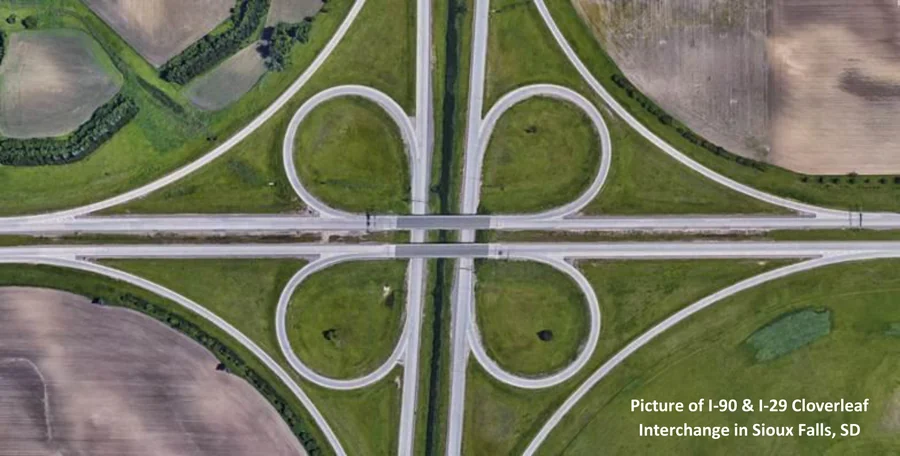
At cloverleaf interchanges, always pay attention to traffic trying to enter or exit the highway or interstate.
Cloverleafs have fallen out of favor because of weaving areas, the short stretches between loop ramps where entering and exiting traffic cross paths, and loop ramps that need much lower speeds.
I-90 and I-29 cloverleaf interchange in Sioux Falls
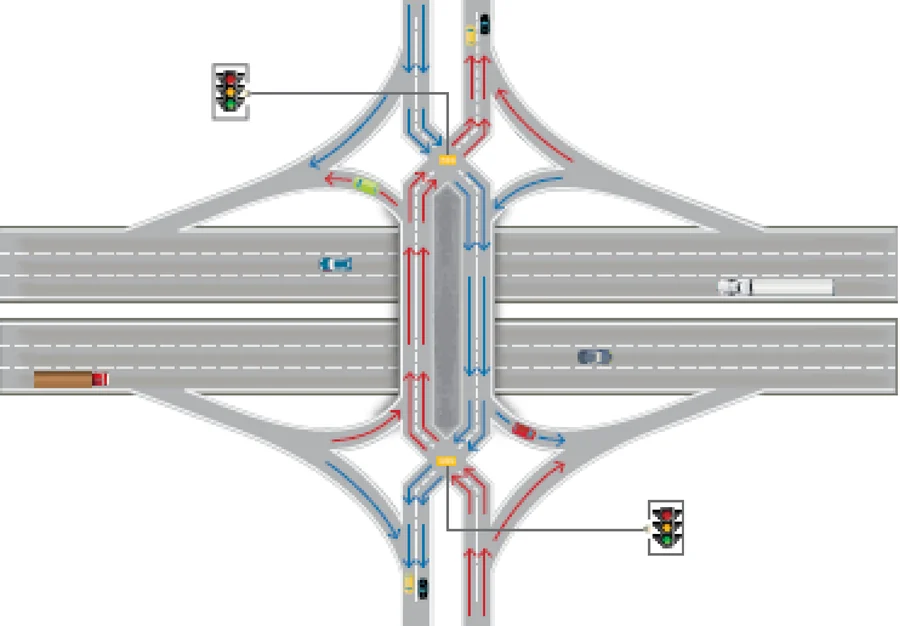
Diverging Diamond Interchange (DDI)
An interchange designed to guide drivers intuitively; shown to increase capacity and safety, reduce congestion, and minimize the cost of new infrastructure.
You realize you just passed your exit on I-29. Don't slow down, back up on the shoulder, or cut across the median. Continue to the next exit and turn around there.
Check your understanding
Read the question, decide on an answer, then open it to check the explanation. These are Roadwise study questions based on the source handbook.
What is a common issue with cloverleaf interchanges that newer interchange designs try to avoid?
Too few lanes for trucks
Lack of exit signage
Excessive use of traffic signals
Weaving traffic in short ramp sections
Answer: Weaving traffic in short ramp sections
Cloverleaf interchanges create weaving areas where traffic entering and exiting the freeway conflict on short ramp sections.