roadwise.Open study app

South Dakota driving lesson · General Driving

School buses and parking rules

A 3-minute lesson from the South Dakota course. Read the rules and examples, follow the handbook page references, and check your understanding before you move on.

Read time
3 minutes
Course unit
General Driving
Checkpoint questions
6
Source pages
40

Two situations come with firm rules: school buses loading children, and where and how you leave your car. On a hill, the direction of your wheels decides where a rolling car goes.

Know the rule

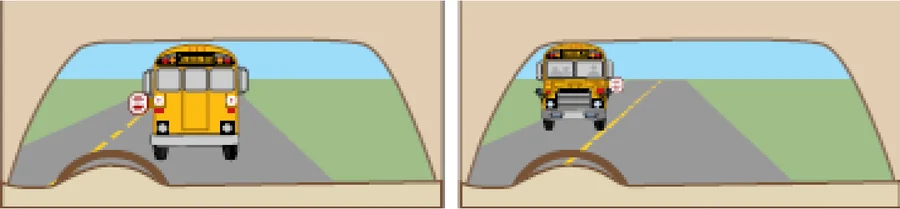
Always stop for a school bus with red lights flashing or its stop arm extended, unless the roadway is separated by a physical barrier.

Handbook p. 40 ↗

Know the rule

After the red lights stop flashing and the stop arm is no longer visible, proceed slowly, watching for children.

Handbook p. 40 ↗
School bus stop on divided highway
School bus stopped with red lights flashing

Know the rule

Park in a designated area when possible, as far from traffic as you can, and as close to the curb as possible if there is one, where you're visible from both directions.

Handbook p. 40 ↗

Know the rule

Always set the parking brake and leave the vehicle in park (automatic) or lowest gear (manual). In cold weather you may leave the parking brake off if it could freeze in the "on" position.

Handbook p. 40 ↗

Parking on a rural highway:

  • Leave at least 15 feet of road width for other traffic to pass
  • Your vehicle must be visible for at least 500 feet in either direction
  • Parking lights and taillights must be on if it's dark
Handbook p. 40 ↗

Know the rule

Get out on the curb side if possible; if not, check traffic before opening the street-side door and shut it quickly. Never leave the key in a parked vehicle, and lock the doors.

Handbook p. 40 ↗

Parking on a hill

Parking on a hill
SituationTurn front wheels
Uphill with a curbSharply to the left
Uphill without a curbSharply to the right
Downhill, with or without a curbSharply to the right
Handbook p. 40 ↗

Know the rule

Then set the emergency brake and shift to park; with a manual, use reverse facing downhill or the lowest gear facing uphill. If the vehicle rolls, it rolls away from traffic.

Handbook p. 40 ↗
Parking on a hill (uphill with curb)
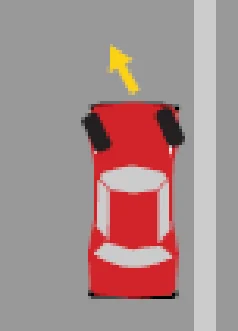
Uphill with a curb: wheels turned left
Parking on a hill (downhill)
Downhill: wheels turned right

Put it into practice

You park facing uphill next to a curb. Turn the front wheels sharply left, set the parking brake, and shift to park. If the car ever rolled back, the tire would catch against the curb instead of rolling into traffic.

Check your understanding

Read the question, decide on an answer, then open it to check the explanation. These are Roadwise study questions based on the source handbook.

When must you stop for a school bus with its red lights flashing or stop arm extended?
  1. Only if you are behind the bus
  2. Only if children are visible outside the bus
  3. Only on two-lane roads
  4. Always, unless a physical barrier divides the road

Answer: Always, unless a physical barrier divides the road

You must always stop for a school bus with flashing red lights or an extended stop arm, unless separated by a physical barrier.
Handbook p. 40 ↗
After a school bus's red lights stop flashing and the stop arm is retracted, what should you do?
  1. Proceed at normal speed immediately
  2. Wait an additional 30 seconds before moving
  3. Wait until the bus drives away
  4. Proceed slowly, watching for children

Answer: Proceed slowly, watching for children

After the lights stop flashing and the stop arm is no longer visible, proceed slowly while watching for children.

Handbook p. 40 ↗
When parking on a rural highway, how much road width must remain for other traffic to pass?
  1. At least 25 feet
  2. At least 15 feet
  3. At least 10 feet
  4. At least 5 feet

Answer: At least 15 feet

If parked on a rural highway, there must be at least 15 feet of road width remaining for other traffic to pass.

Handbook p. 40 ↗
When parked on a rural highway, how far must the vehicle be visible in either direction?
  1. 1,000 feet
  2. 200 feet
  3. 500 feet
  4. 100 feet

Answer: 500 feet

The vehicle must be visible for at least 500 feet in either direction when parked on a rural highway.

Handbook p. 40 ↗
When parking uphill on a street with a curb, which way should you turn your front wheels?
  1. Sharply to the right, toward the curb
  2. Straight ahead
  3. Slightly right, parallel to the curb
  4. Sharply to the left, away from the curb

Answer: Sharply to the left, away from the curb

Facing uphill with a curb, turn the wheels sharply left so that if the vehicle rolls back, the front tire stops against the curb.

Handbook p. 40 ↗
When parking downhill, or uphill with no curb, which way should you turn your front wheels?
  1. Keep them straight
  2. Sharply to the left
  3. Straight, with the parking brake set
  4. Sharply to the right

Answer: Sharply to the right

Turn the wheels sharply right when facing downhill, or uphill without a curb, so the vehicle rolls away from traffic.

Handbook p. 40 ↗
Take the lesson checkpoint in the app

More in General Driving