roadwise.Open study app

South Dakota driving lesson · General Driving

Angle, perpendicular and parallel parking

A 3-minute lesson from the South Dakota course. Read the rules and examples, follow the handbook page references, and check your understanding before you move on.

Read time
3 minutes
Course unit
General Driving
Checkpoint questions
4
Source pages
41, 49

Parking maneuvers are slow but full of blind areas. Follow a set sequence, keep watching traffic, pedestrians and fixed objects throughout, and finish centered and close to the curb.

Entering an angle or perpendicular space:

  • Identify the space and check traffic
  • Signal your intentions
  • Move forward slowly, turning the wheel, until you reach the middle of the space
  • Center the vehicle in the space
  • Move to the front of the space, stop, and secure the vehicle
Handbook p. 41 ↗
Parallel parking diagram
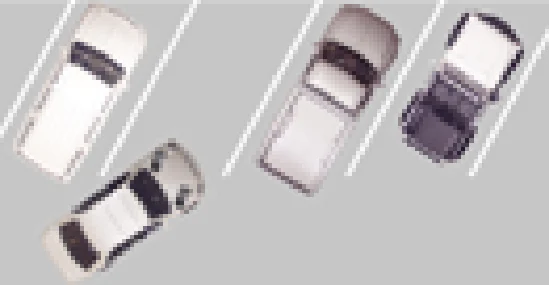
Angle parking

Exiting an angle or perpendicular space:

  • Check for traffic in all directions
  • Back straight until your front bumper clears the vehicle beside you
  • Turn the wheel sharply toward where the rear should go
  • When clear of the space, stop and shift to drive
  • Accelerate smoothly, steering to straighten the wheels
Handbook p. 41 ↗

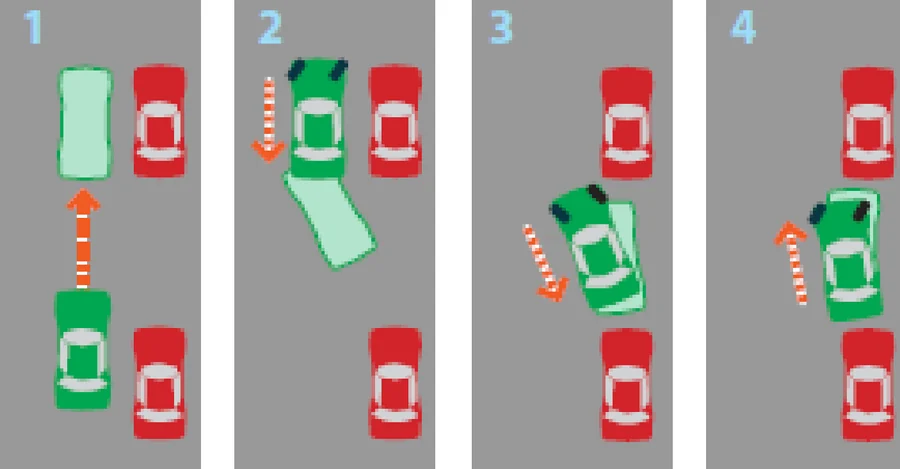
Parallel parking:

  • 1. Check mirrors, signal, and stop even with the car ahead, about 2 feet from it
  • 2. Wheels right, back slowly; straighten as your front door passes its back bumper
  • 3. When clear of that car, wheels sharply left; back slowly toward the car behind
  • 4. Wheels right, pull to the center of the space, then straighten (unless on a hill)
Handbook p. 41 ↗
Parallel parking steps
12 inches

Finish parallel parking within this distance of the curb or road edge

Handbook p. 41 ↗
2 feet

Minimum space to leave from the parked vehicles around you

Handbook p. 41 ↗

Know the rule

If traffic is coming from behind when you want to parallel park, signal, pull next to the space, and let vehicles behind pass before parking.

Handbook p. 49 ↗

Know the rule

To resume travel, turn on your signal, check mirrors and blind spots, and pull out when it's safe.

Handbook p. 41 ↗

Put it into practice

Halfway into a parallel park, a pedestrian steps off the curb behind your car. Stop and wait; you must watch traffic, pedestrians and fixed objects through every step, then finish the maneuver once they're clear.

Check your understanding

Read the question, decide on an answer, then open it to check the explanation. These are Roadwise study questions based on the source handbook.

When finishing a parallel park, about how close to the curb should the vehicle be?
  1. Exactly touching the curb
  2. Within 12 inches
  3. Within 3 feet
  4. Within 6 inches

Answer: Within 12 inches

When the parallel parking maneuver is finished, the vehicle should be within 12 inches of the curb.
Handbook p. 41 ↗
When exiting a perpendicular or angle parking space, what should you check first?
  1. Only the mirror on your exit side
  2. Only the vehicle parked beside you
  3. Only the space directly behind you
  4. Traffic in all directions

Answer: Traffic in all directions

When exiting a perpendicular or angle space, check for traffic in all directions before moving.

Handbook p. 41 ↗
When you begin parallel parking, you stop even with the vehicle in the space ahead. About how far from it should you be?
  1. About 12 inches
  2. About 4 feet
  3. About 2 feet
  4. About 6 feet

Answer: About 2 feet

Stop even with the vehicle in the parking space ahead and about 2 feet away from it before backing.

Handbook p. 41 ↗
When you finish parallel parking, your vehicle should be at least 2 feet away from the parked vehicles.
  1. True
  2. False

Answer: True

A finished parallel park leaves the vehicle within 12 inches of the curb and at least 2 feet from the parked vehicles.

Handbook p. 41 ↗
Take the lesson checkpoint in the app

More in General Driving