roadwise.Open study app

South Dakota driving lesson · General Driving

Intersections and roundabouts

A 3-minute lesson from the South Dakota course. Read the rules and examples, follow the handbook page references, and check your understanding before you move on.

Read time
3 minutes
Course unit
General Driving
Checkpoint questions
6
Source pages
36, 37

Intersections are where paths cross, so don't count on others to obey signals or give you room. Roundabouts keep everyone moving one way and sharply cut the most serious crashes.

At every intersection, slow down and search for:

  • Traffic control devices
  • Oncoming and cross traffic
  • Pedestrians and bicyclists
  • The roadway conditions
  • Areas of limited visibility
Handbook p. 36 ↗

Know the rule

After stopping, look left, then right, then left again before entering. When the light turns green, don't move immediately; make sure the path is clear and you have a big enough gap.

Handbook p. 36 ↗

Know the rule

Don't turn into a lane just because an approaching vehicle's turn signal is on; the driver may plan to turn after passing you or forgot to cancel it.

Handbook p. 36 ↗

Know the rule

Roundabouts move traffic one way, counterclockwise. Compared with other intersection controls they reduce fatal crashes about 90%, injury crashes about 75%, and all crashes about 35%.

Handbook p. 36 ↗

Truck apron

A paved area on the inside of a roundabout for the rear wheels of large trucks when turning (off-tracking). Cars, SUVs and pickups must not use it.

Handbook p. 36 ↗
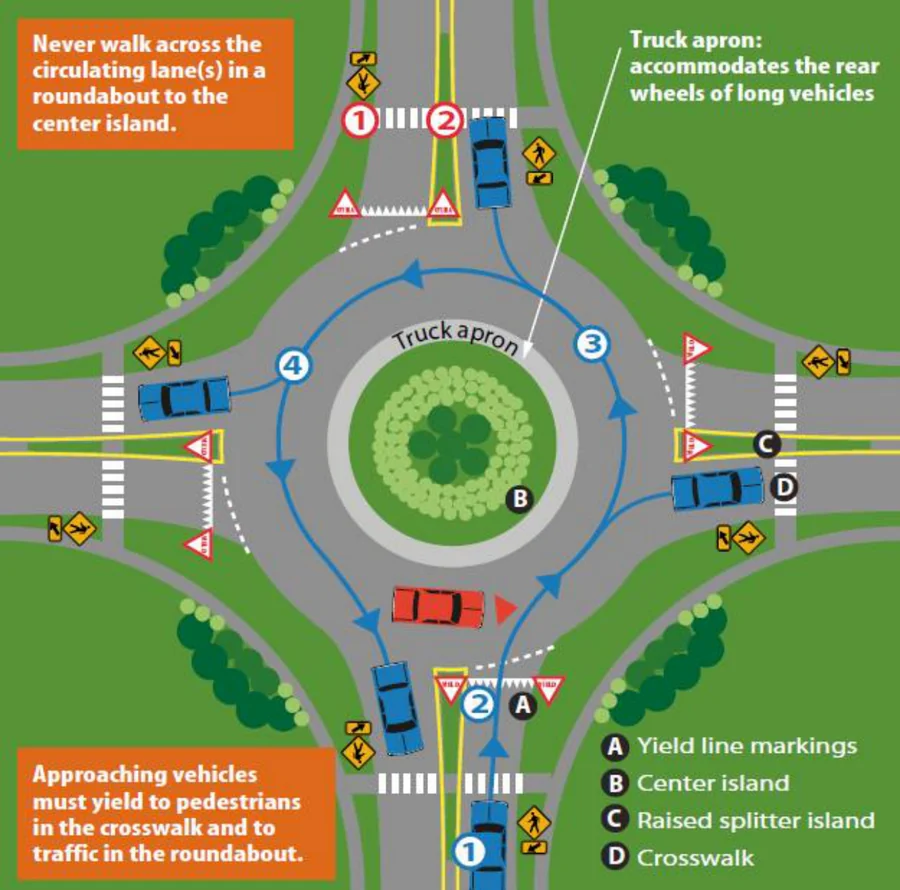
Roundabout diagram
Roundabout with truck apron

Driving a roundabout:

  • 1. Slow down and obey traffic signs
  • 2. Yield to pedestrians and bicyclists
  • 3. Yield to traffic on your left already in the roundabout
  • 4. Enter when there is a safe gap
  • 5. Keep your speed low inside
  • 6. Turn on your right signal as you approach your exit
  • 7. Yield to pedestrians and bicycles when exiting
Handbook p. 37 ↗

Emergency vehicles and roundabouts:

  • Always yield to emergency vehicles
  • Not yet in the roundabout: pull over and let them pass
  • Already inside: continue to your exit, then pull over
  • Avoid stopping in the roundabout
Handbook p. 37 ↗

Know the rule

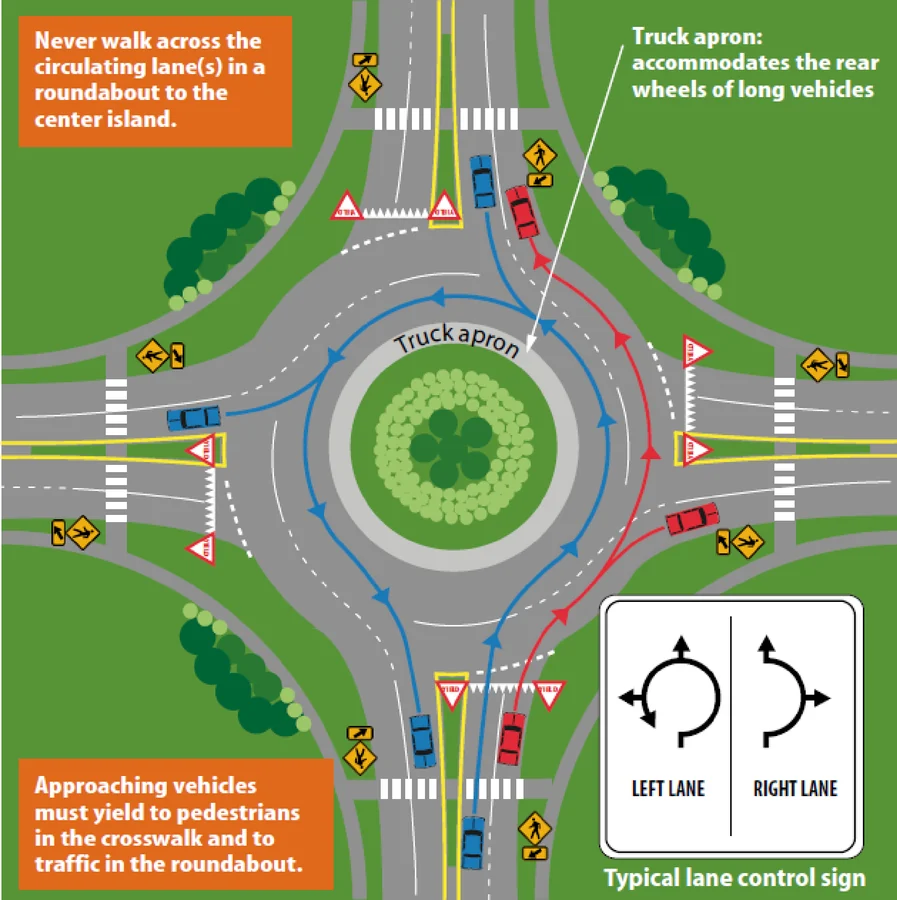
In a roundabout with two or more lanes, choose your lane before entering using the black-and-white signs and white pavement arrows: generally the left lane to turn left, the right lane to turn right; for straight ahead, follow the signs.

Handbook p. 37 ↗
Roundabout diagram (multi-lane)
Two-lane roundabout and lane-use sign

Put it into practice

You're circling a roundabout when a siren sounds behind you. Don't stop inside. Continue to your exit, leave the roundabout, then pull over and let the ambulance pass.

Check your understanding

Read the question, decide on an answer, then open it to check the explanation. These are Roadwise study questions based on the source handbook.

What is the recommended order for checking traffic before entering an intersection?
  1. Look left, then right, then left again
  2. Look straight ahead only
  3. Look behind first, then ahead
  4. Look right, then left only

Answer: Look left, then right, then left again

It is recommended to look left, then right, then left again before entering an intersection.
Handbook p. 36 ↗
In a roundabout, traffic generally flows in which direction?
  1. Counterclockwise, one-way
  2. Either direction depending on lane
  3. Clockwise, one-way
  4. Two-way in each lane

Answer: Counterclockwise, one-way

Roundabouts keep traffic moving one-way in a counterclockwise direction, reducing conflict points.

Handbook p. 36 ↗
Compared to standard intersections, roundabouts reduce fatal crashes by about how much?
  1. About 60%
  2. About 10%
  3. About 35%
  4. About 90%

Answer: About 90%

Roundabouts reduce fatal crashes about 90%, injury crashes about 75%, and overall crashes about 35%.

Handbook p. 36 ↗
When entering a roundabout, which vehicles must you yield to?
  1. Traffic entering from the opposite side
  2. Traffic already in the roundabout, to your left
  3. Traffic waiting at the next entry
  4. No one; entering traffic has the right-of-way

Answer: Traffic already in the roundabout, to your left

You must yield to traffic on your left that is already in the roundabout before entering.

Handbook p. 37 ↗
What is a truck apron in a roundabout designed for?
  1. Pickups and SUVs that need extra room
  2. Cars passing slower traffic
  3. Emergency vehicles only
  4. Large trucks' rear wheels when turning

Answer: Large trucks' rear wheels when turning

A truck apron is a paved area for the rear wheels of large trucks off-tracking; cars and SUVs should not use it.

Handbook p. 36 ↗
If you have already entered a roundabout and an emergency vehicle approaches, what should you do?
  1. Stop at the next entry point
  2. Stop immediately inside the roundabout
  3. Speed up to clear the roundabout faster than normal
  4. Continue to your exit, then pull over to let it pass

Answer: Continue to your exit, then pull over to let it pass

If already in the roundabout, continue to your exit, then pull over and allow the emergency vehicle to pass.

Handbook p. 37 ↗
Take the lesson checkpoint in the app

More in General Driving