Roadwise States South Dakota Driving lessons Avoiding a crash South Dakota driving lesson · Emergencies and Crashes
Avoiding a crash A 3-minute lesson from the South Dakota course. Read the rules and examples, follow the handbook page references, and check your understanding before you move on.
Read time 3 minutes
Course unit Emergencies and Crashes
Checkpoint questions 6
Source pages 54 Every driver eventually faces an emergency, and all drivers are responsible for preventing crashes. You have three ways to avoid a crash or lessen it: braking, steering, or accelerating.
Three options to avoid a crash: Braking Steering (swerving) Accelerating Handbook p. 54 ↗ Braking with ABS (anti-lock brakes): Press the brake pedal as hard as you can and keep the pressure on ABS works only while you keep pressing the pedal A vibrating pedal and clicking noise are normal You can still steer the vehicle Handbook p. 54 ↗ Know the rule
ABS lets you stop without skidding and keep steering control. If your vehicle has no ABS, follow the owner's manual for the proper braking method.
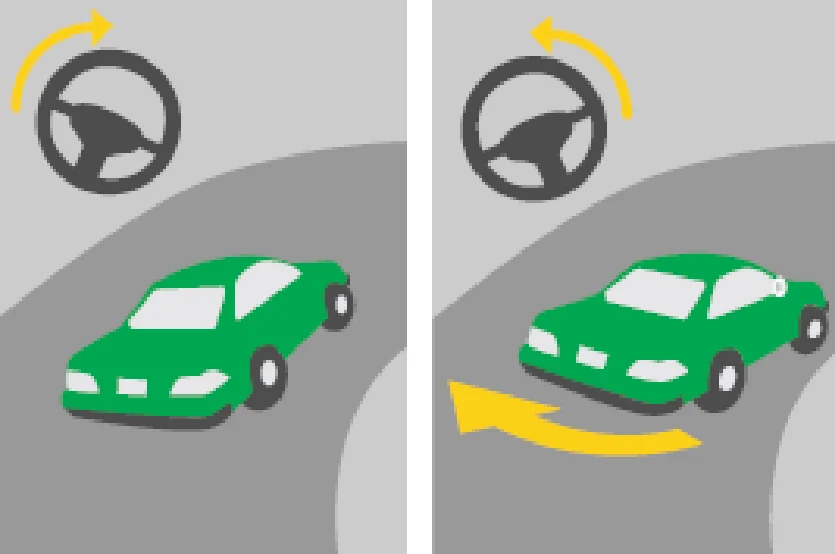
Handbook p. 54 ↗ Steering quickly around a problem: Have a good grip with both hands on the wheel Steer in the direction you want to go, avoiding other traffic Once clear, steer the opposite way to straighten out, gain control and start slowing Handbook p. 54 ↗ Know the rule
Accelerating may be necessary when another vehicle is about to hit you from behind or from the side.
Handbook p. 54 ↗ Know the rule
Skids happen when you drive too fast for conditions, stop too suddenly, or the tires can no longer grip. If you skid, release the brake or accelerator and look where you want to go.
Handbook p. 54 ↗ In a skid, look and steer where you want to go Know the rule
Drop-offs: if your wheels leave the pavement, avoid panic steering back right away. Slow down gradually and, when safe, turn back onto the pavement.
Handbook p. 54 ↗ Put it into practice
Your right wheels drop off the pavement edge onto the gravel. Don't jerk the wheel back. Ease off the gas, slow down gradually, and steer back onto the road when it's safe.
A useful reminder ABS: press hard, keep pressing, and steer.
Check your understanding Read the question, decide on an answer, then open it to check the explanation. These are Roadwise study questions based on the source handbook.
What are the three basic options a driver has to avoid a crash? Braking, signaling, or reversing Accelerating, signaling, or honking Steering, honking, or reversing Braking, steering, or accelerating Answer: Braking, steering, or accelerating
The three options to avoid a crash or reduce its impact are braking, steering, or accelerating.
Handbook p. 54 ↗ When using anti-lock brakes (ABS) in an emergency stop, what should you do? Release the brake the instant you feel it vibrate Press hard on the pedal and keep applying steady pressure Shift to neutral before braking Pump the brake pedal repeatedly and firmly Answer: Press hard on the pedal and keep applying steady pressure
With ABS, press the brake pedal as hard as you can and keep applying pressure; the system will pulse on its own.
Handbook p. 54 ↗ What is a vibrating brake pedal or clicking noise while braking hard usually a sign of? A brake failure Worn-out brake pads Normal ABS operation Wheels about to lock up Answer: Normal ABS operation
A vibrating pedal or clicking noise while braking hard is a normal sign that the ABS is working.
Handbook p. 54 ↗ When quickly steering around a problem to avoid a crash, what should you do once you've cleared it? Keep the wheel turned and brake Brake hard immediately without steering back Continue steering in the same direction Steer the opposite way to straighten out Answer: Steer the opposite way to straighten out
After clearing the problem, steer in the opposite direction to straighten the vehicle and regain control.
Handbook p. 54 ↗ If the vehicle begins to skid, what is the first thing you should do? Release pressure from the brake or accelerator Shift into a lower gear immediately Apply the parking brake Turn the wheel sharply away from the skid Answer: Release pressure from the brake or accelerator
When a skid begins, release pressure from the brake or accelerator and look where you want to go.
Handbook p. 54 ↗ If your wheels leave the paved surface onto an uneven drop-off, what should you avoid doing? Keeping a firm grip on the wheel Checking your mirrors before returning Slowing down gradually before returning Panic steering back onto the pavement Answer: Panic steering back onto the pavement
Avoid panic steering back onto the pavement; instead slow down gradually and then turn back onto the road when safe.
Handbook p. 54 ↗ Previous lesson Breakdowns, blind spots and signaling Next lesson Vehicle malfunctions More in Emergencies and Crashes About the source Roadwise’s South Dakota course uses the driver handbook edition supplied with this study pack. This lesson cites source pages 54. The linked PDF is a third-party mirror of the handbook, rather than a government-hosted page.
Open the handbook source PDF · View the source edition
For current application requirements, fees, appointments, and the format that applies to your age or license type, check South Dakota’s DPS. Roadwise provides study material and does not issue permits or licenses.