Roadwise States South Dakota Driving lessons Vehicle malfunctions South Dakota driving lesson · Emergencies and Crashes
Vehicle malfunctions A 3-minute lesson from the South Dakota course. Read the rules and examples, follow the handbook page references, and check your understanding before you move on.
Read time 3 minutes
Course unit Emergencies and Crashes
Checkpoint questions 6
Source pages 52, 55 Following your maintenance schedule greatly reduces the chance of a breakdown, but parts can still fail on the road. Each failure has its own safe response.
Know the rule
A brake warning light means the brakes aren't working properly; don't drive the vehicle.
Handbook p. 55 ↗ If the brakes fail while driving: Use the parking brake: pull the handle or push the pedal slowly so the rear wheels don't lock Be ready to release it if the vehicle starts to skid If that doesn't work, turn off the engine and find a safe place off the road to stop Don't keep driving without working brakes Handbook p. 55 ↗ Know the rule
Blowouts: a front tire blowout pulls the vehicle sharply toward the blown tire; a rear blowout makes it wobble, shake and pull some toward that side.
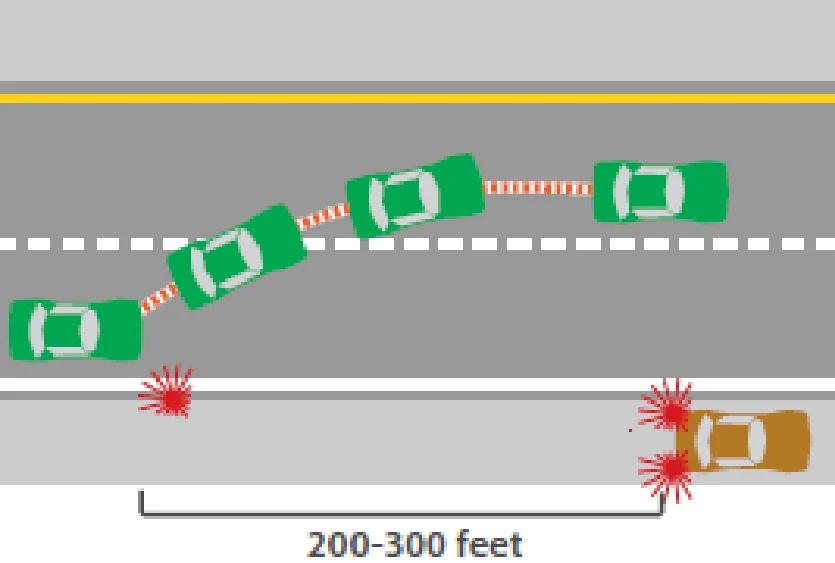
Handbook p. 55 ↗ After a blowout or sudden flat: Grip the wheel firmly and keep the vehicle going straight Take your foot off the accelerator and slow down gradually Don't brake; let the car slow itself, or brake gently if necessary Pull off the road in a safe place and turn on your flashers Have the tire changed and replaced Handbook p. 55 ↗ If the engine shuts off: Keep a strong grip; the wheel is harder to turn, but it still turns Look for an escape path; brake with steady pressure, not hard, and pull off Stop and try to restart; if you can't, raise the hood, use flashers, call for help Handbook p. 55 ↗ If the accelerator sticks: Turn off the engine Shift to neutral and look for an escape path Steer smoothly, brake gently, and pull off the road Have the pedal repaired before driving again Handbook p. 55 ↗ 200-300 feet How far behind a broken-down vehicle to place emergency flares
Handbook p. 55 ↗ Flares placed 200-300 feet behind a disabled vehicle If your headlights go out: Try the headlight switch a few times If that fails, use emergency flashers, turn signals or fog lights Pull off the road as soon as possible Handbook p. 55 ↗ Put it into practice
At highway speed your front-left tire blows and the car yanks left. Hold the wheel firmly and keep it straight, lift your foot off the gas, and let the car slow itself. Once slow, pull onto the shoulder and turn on your flashers.
Check your understanding Read the question, decide on an answer, then open it to check the explanation. These are Roadwise study questions based on the source handbook.
If your brakes fail while driving, what should you try first? Turn off the engine immediately Use the parking brake slowly Pump the brakes hard Shift into neutral and coast Answer: Use the parking brake slowly
If brakes fail, use the parking brake slowly (handle or pedal) so you don't lock the rear wheels and cause a skid.
Handbook p. 55 ↗ If a front tire suddenly blows out, what happens to the vehicle? It pulls sharply in the direction of the blowout It has no noticeable handling change It wobbles but tracks straight It stops abruptly on its own Answer: It pulls sharply in the direction of the blowout
A front tire blowout causes the vehicle to pull sharply in the direction of the blowout.
Handbook p. 55 ↗ After a tire blowout, what should you do with the brakes? Brake as hard as possible immediately Brake firmly to stop on the road Pump the brakes rapidly Avoid hard braking; slow gently if needed Answer: Avoid hard braking; slow gently if needed
After a blowout, do not brake hard; allow the vehicle to slow by itself or brake gently if necessary.
Handbook p. 55 ↗ If the engine shuts off while driving, what should you do about the steering wheel? Keep a strong grip; it still turns Let go; it cannot be turned Steer with one hand to save effort Turn it as little as possible Answer: Keep a strong grip; it still turns
If the engine shuts off, the steering wheel becomes harder to turn without power assist, but you can still turn it.
Handbook p. 55 ↗ If the accelerator sticks and the vehicle won't slow down, what is the first step? Pump the brakes hard Shift into a higher gear Pump the accelerator repeatedly Turn off the engine Answer: Turn off the engine
For a stuck accelerator, first turn off the engine, then shift to neutral and look for an escape path.
Handbook p. 55 ↗ If your vehicle breaks down on the highway, about how far behind it should you place emergency flares? 50 to 75 feet 1,000 feet 10 to 20 feet 200 to 300 feet Answer: 200 to 300 feet
Place emergency flares about 200 to 300 feet behind the vehicle to give other drivers time to change lanes.
Handbook p. 55 ↗ Previous lesson Avoiding a crash Next lesson At the crash scene More in Emergencies and Crashes About the source Roadwise’s South Dakota course uses the driver handbook edition supplied with this study pack. This lesson cites source pages 52, 55. The linked PDF is a third-party mirror of the handbook, rather than a government-hosted page.
Open the handbook source PDF · View the source edition
For current application requirements, fees, appointments, and the format that applies to your age or license type, check South Dakota’s DPS. Roadwise provides study material and does not issue permits or licenses.