roadwise.Open study app

South Dakota driving lesson · Safe Driving Tips

Breakdowns, blind spots and signaling

A 3-minute lesson from the South Dakota course. Read the rules and examples, follow the handbook page references, and check your understanding before you move on.

Read time
3 minutes
Course unit
Safe Driving Tips
Checkpoint questions
5
Source pages
52, 53

Communicating also means making a stalled car visible, staying where other drivers can see you, and signaling every change of direction or speed at the right time.

If you have vehicle trouble and must stop:

  • Get the vehicle off the road and away from traffic if possible
  • Turn on your 4-way emergency flashers
  • If you can't get off, stop where others can see you: not just over a hill or around a curve
  • Stand off the road; use flares or other warning devices
  • Never stand in the roadway, or change a tire if it puts you in a traffic lane
  • Raise the hood or tie a white cloth to the antenna, side mirror or door handle
Handbook p. 52 ↗

Know the rule

Stay out of other vehicles' blind spots, the areas on either side and slightly behind them. Speed up or drop back, and when passing, get through the blind spot quickly.

Handbook p. 53 ↗
20 ft ahead / 200 ft behind

Truck No-Zone: a car can vanish up to 20 feet in front of the cab, alongside, and up to 200 feet behind

Handbook p. 53 ↗

Know the rule

If you can't see the truck or bus driver in their side mirror, they can't see you. Never stay alongside or right behind a large vehicle.

Handbook p. 53 ↗

Know the rule

Signal before changing lanes, turning, merging or parking, and before starting and completing a pass, even when no one seems to be around.

Handbook p. 53 ↗

Know the rule

Signal 100 feet before the turn, but not too early: if there are streets, driveways or entrances before your turn, wait until you've passed them. Afterward, make sure the signal shuts off.

Handbook p. 53 ↗

Know the rule

If you'll stop or slow where others may not expect it, quickly tap the brake pedal 3 or 4 times.

Handbook p. 53 ↗

Signal when you slow down:

  • To turn off a road that has no separate turn or exit lanes
  • To park or turn just before an intersection
  • To avoid something in the road, or for stopped traffic a driver behind can't see
Handbook p. 53 ↗

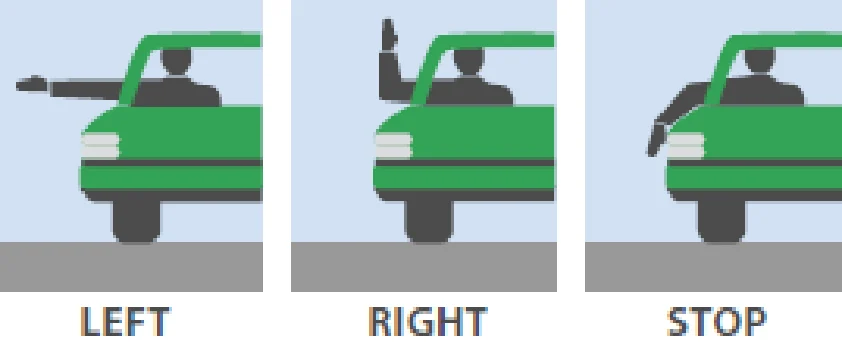
Hand and arm signals

Hand and arm signals
SignalArm position
Left turnHand pointing straight out
Right turnHand pointing up
Stop or slow downHand pointing down
Handbook p. 53 ↗

Know the rule

Hand signals help when bright sunlight hides turn signals, or on antique vehicles (made before July 1, 1958) that may lack turn signals.

Handbook p. 53 ↗
Hand signals (left, right, stop)
Hand signals: left, right and stop

Put it into practice

You plan to turn right into the second driveway past a side street. Wait until you've passed the side street to signal; a driver waiting there could think you're turning in front of them and pull into your path.

Check your understanding

Read the question, decide on an answer, then open it to check the explanation. These are Roadwise study questions based on the source handbook.

If your vehicle breaks down and you must stop, what is one recommended way to signal an emergency?
  1. Sound the horn continuously
  2. Turn on your high beams
  3. Raise the hood or tie on a white cloth
  4. Leave your low beam headlights on only

Answer: Raise the hood or tie on a white cloth

Raising the hood or tying a white cloth to the antenna, mirror, or door handle signals an emergency to others.
Handbook p. 52 ↗
When should you signal a turn?
  1. Only when other vehicles are visible nearby
  2. Only when merging onto a freeway
  3. Every time you change direction
  4. Only when turning at intersections

Answer: Every time you change direction

You should get into the habit of signaling every time you change direction, even when you don't see anyone else around.

Handbook p. 53 ↗
You should signal your turn as early as possible, well before you begin slowing down, even if it passes several driveways first.
  1. True
  2. False

Answer: False

Signaling too early can confuse other drivers; wait until you've passed intervening streets or driveways before signaling.

Handbook p. 53 ↗
What is the standard hand-and-arm signal for a left turn?
  1. Hand waving side to side
  2. Hand pointing up
  3. Hand pointing straight out
  4. Hand pointing down

Answer: Hand pointing straight out

The standard hand signal for a left turn is the hand and arm pointing straight out.

Handbook p. 53 ↗
What is the standard hand-and-arm signal for slowing or stopping?
  1. A closed fist
  2. Hand pointing up
  3. Hand pointing down
  4. Hand pointing straight out

Answer: Hand pointing down

The standard hand signal for stopping or slowing down is the hand pointing down.

Handbook p. 53 ↗
Take the lesson checkpoint in the app

More in Safe Driving Tips