roadwise.Open study app

South Dakota driving lesson · Safe Driving Tips

Headlights and the horn

A 3-minute lesson from the South Dakota course. Read the rules and examples, follow the handbook page references, and check your understanding before you move on.

Read time
3 minutes
Course unit
Safe Driving Tips
Checkpoint questions
6
Source pages
51, 52

Other road users can only avoid you if they know you're there. Headlights and the horn are your main tools, used at the right times and never to vent frustration.

Know the rule

Turn on your headlights whenever you have trouble seeing others, when it begins to get dark, and on rainy, snowy or foggy days. A good rule: if your wipers are on, turn on your headlights.

Handbook p. 51 ↗

Know the rule

Turn on headlights when driving away from a rising or setting sun, so oncoming drivers facing the glare can see you. Parking lights are for parked vehicles only; never drive with only parking lights on.

Handbook p. 51 ↗

High and low beams

High and low beams
SituationUse
No oncoming vehiclesHigh beams (see twice as far)
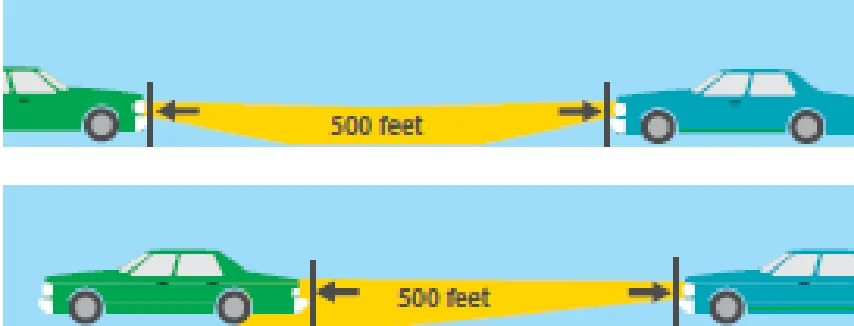
Within 500 feet of an oncoming vehicleDim to low beams
Closer than 500 feet behind a vehicleLow beams
Heavy trafficLow beams
Fog, snow or hard rainLow beams, plus fog lights if equipped
Handbook p. 52 ↗

Know the rule

Use high beams on unfamiliar roads, in construction areas, or where people may be along the road, as long as no one is coming.

Handbook p. 52 ↗

Know the rule

If an oncoming driver doesn't dim, flash your high beams. If they still don't, look toward the right side of the road until they pass.

Handbook p. 52 ↗

Know the rule

Daytime running lights help others see you by day but don't replace headlights at night or in fog, rain or snow.

Handbook p. 52 ↗

Give a light tap on the horn when:

  • A pedestrian or bicyclist appears to be moving into your lane
  • A driver starts to turn into your lane as you pass
  • A driver isn't paying attention or may have trouble seeing you
  • You can't see ahead: steep hill, sharp curve, or leaving a narrow alley
Handbook p. 52 ↗

Give a SHARP BLAST when:

  • Another vehicle is in danger of hitting you
  • You've lost control and are moving toward someone
Handbook p. 52 ↗

Don't use the horn:

  • To urge someone to drive faster or get out of the way
  • To tell other drivers about an error
  • To greet a friend
  • Around blind pedestrians
  • Around animal-drawn vehicles or animals being herded
Handbook p. 52 ↗

Know the rule

Pedestrians and bicyclists crossing at an intersection have the right-of-way; don't honk at them, yield.

Handbook p. 52 ↗
Turn signal distance (500 feet)
Dim your high beams within 500 feet

Put it into practice

At dusk on a rural highway, a car approaches with its high beams on. You flash yours once. They still don't dim, so you look toward the right edge of the road and steer by it until they pass.

Check your understanding

Read the question, decide on an answer, then open it to check the explanation. These are Roadwise study questions based on the source handbook.

When should you dim your high beams for an oncoming vehicle?
  1. Within about 100 feet
  2. Within about 1,000 feet
  3. Within about 500 feet
  4. Only if the other driver flashes first

Answer: Within about 500 feet

Dim the high beams whenever you come within 500 feet (about one block) of an oncoming vehicle.
Handbook p. 52 ↗
When should you use low beams instead of high beams behind another vehicle?
  1. When closer than 500 feet behind it
  2. When closer than 100 feet behind it
  3. When closer than 1,000 feet behind it
  4. When closer than 200 feet behind it

Answer: When closer than 500 feet behind it

Use low beams when you are closer than 500 feet behind another vehicle, or in heavy traffic.

Handbook p. 52 ↗
What are parking lights meant to be used for?
  1. Driving at dusk
  2. Parked vehicles only
  3. Driving in light fog
  4. Signaling a turn

Answer: Parked vehicles only

Parking lights are for parked vehicles only and should not be used while driving.

Handbook p. 51 ↗
When should you give the horn a light tap rather than a sharp blast?
  1. When you have lost control of the vehicle
  2. When approaching an emergency scene
  3. When a pedestrian or cyclist may enter your lane
  4. When another vehicle is about to hit you

Answer: When a pedestrian or cyclist may enter your lane

A light tap is appropriate when there's no immediate danger but you want to alert someone who may be moving into your lane.

Handbook p. 52 ↗
Why should you avoid using the horn around animal-drawn vehicles or animals being herded?
  1. It won't be heard over the animals
  2. Horns are banned on rural roads
  3. It may scare the animal and cause a crash
  4. It signals the rider to leave the road

Answer: It may scare the animal and cause a crash

The horn should not be used near animal-drawn vehicles or herded animals because it may scare the animal and cause a crash.

Handbook p. 62 ↗
High beams let you see about three times as far as low beams.
  1. True
  2. False

Answer: False

High beams let you see twice as far as low beams.

Handbook p. 52 ↗
Take the lesson checkpoint in the app

More in Safe Driving Tips