A 3-minute lesson from the South Dakota course. Read the rules and examples, follow the handbook page references, and check your understanding before you move on.
Safe speed isn't just the posted limit; it's the speed that fits the road, the weather and the traffic. The faster you go, the more time and distance you need to stop.
Know the rule
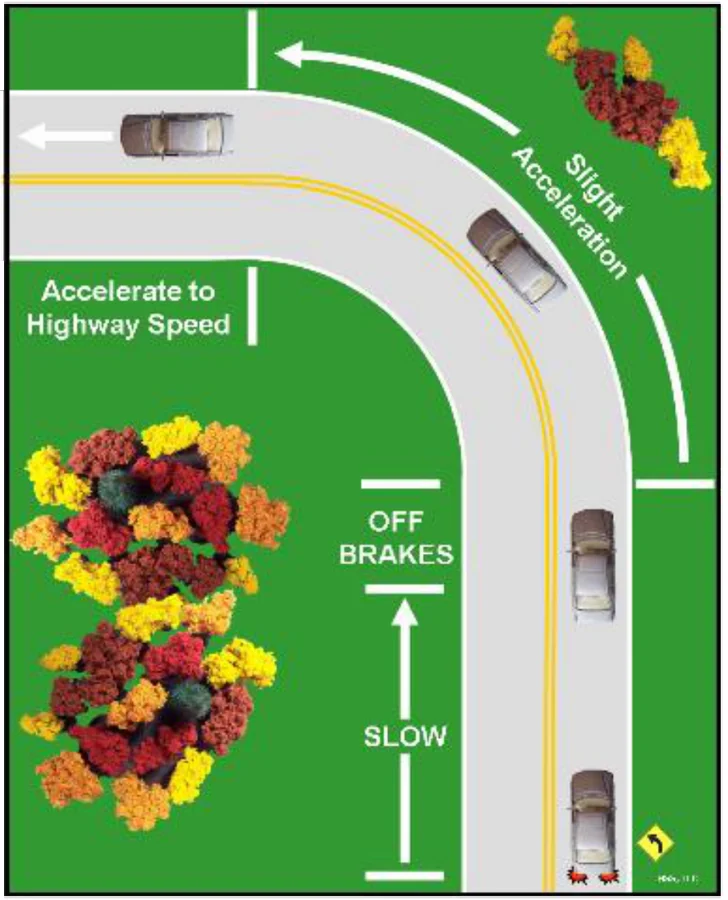
Curves: slow to a safe speed before entering, one that allows slight and constant acceleration through the curve. Slow more when traction is poor, when following others, or when you can't see the end of the curve.
Brake before the curve, accelerate gently through it
Know the rule
Slippery roads: reduce speed at the first sign of rain, snow, sleet or ice. Tires grip less, so stopping takes longer and turning without skidding is harder.
Rain starts on the highway and water pools in the ruts. Ease off the gas right away, because slowing down is the best way to avoid hydroplaning. If the road ahead is flooded, turn around and find another route.
Check your understanding
Read the question, decide on an answer, then open it to check the explanation. These are Roadwise study questions based on the source handbook.
What is the average perception time for an alert driver, according to the handbook?
3 to 4 seconds
2 seconds
1/4 second
3/4 second to 1 second
Answer: 3/4 second to 1 second
The average perception time for an alert driver is 3/4 second to 1 second.