A 3-minute lesson from the South Dakota course. Read the rules and examples, follow the handbook page references, and check your understanding before you move on.
Right-of-way rules decide who goes first at intersections and merges. They never hand anyone the right-of-way automatically; you must read the situation and yield when it calls for it.
Know the rule
No one should assume they automatically have the right-of-way; the situation and circumstances at the intersection must always be considered.
Only the first vehicle in a funeral procession must obey traffic signs and signals, and all vehicles in it must have headlights on. Don't cut into or interfere with a funeral procession.
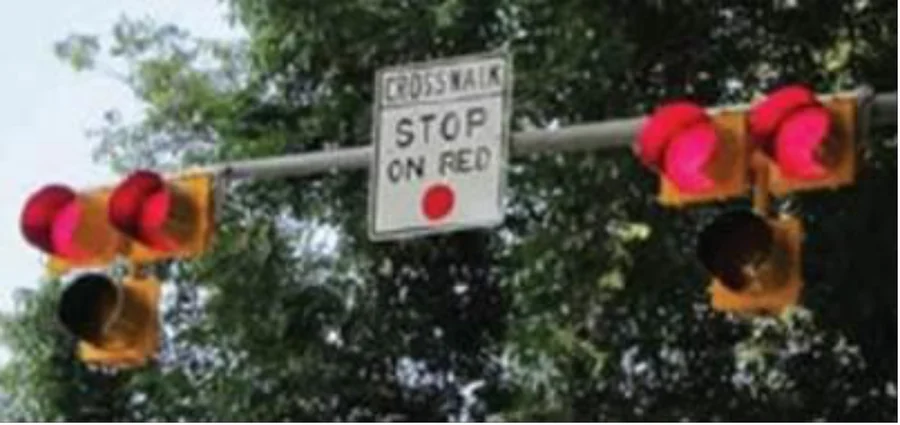
A signal for midblock or uncontrolled crossings: two red lenses above one yellow. It stays dark until a pedestrian pushes the button, then runs yellow to red to stop traffic.
When a PHB is activated, its steady and flashing lights direct drivers to slow and stop while pedestrians get a WALK signal; once the pedestrian has crossed, the beacon goes dark again.
You and another car arrive at a four-way stop at the same moment, and it's on your right. Yield and let it go first. If it had arrived before you, it would go first no matter which side it was on.
Check your understanding
Read the question, decide on an answer, then open it to check the explanation. These are Roadwise study questions based on the source handbook.
At an all-way stop, if two drivers arrive at the same time, who should yield?
Yield to the driver on your right
The driver going straight goes first
The driver turning left goes first
Yield to the driver on your left
Answer: Yield to the driver on your right
You should yield to the driver on your right at an all-way stop if you both arrive at the same time.