roadwise.Open study app

South Dakota driving lesson · Special Driving Situations

Night driving

A 3-minute lesson from the South Dakota course. Read the rules and examples, follow the handbook page references, and check your understanding before you move on.

Read time
3 minutes
Course unit
Special Driving Situations
Checkpoint questions
6
Source pages
52, 63

Driving at night is more difficult and hazardous than daytime driving, because you can see only as far as your headlights reach. Using your beams correctly, protecting your eyes from glare, and leaving more space make up for it.

Night driving tips:

  • Use high beams whenever there are no oncoming vehicles; they let you see twice as far
  • Dim your high beams for approaching traffic, and use low beams when following
  • In fog, rain or snow use low beams; high beams cause glare (fog lights help if equipped)
  • Don't look directly into oncoming headlights; if blinded, look toward the right side of the road
  • Search well ahead of your headlight beams for dark shapes on the road
  • Glance right and left now and then to find the pavement edge and side hazards
Handbook p. 63 ↗

Know the rule

Don't wear sunglasses or colored lenses at night or on an overcast day; tinted lenses reduce vision.

Handbook p. 63 ↗

Extra following distance at night

Extra following distance at night
ConditionAdd to your following distance
Night drivingAt least 1 extra second
Unfamiliar road at nightAt least 2 extra seconds
Handbook p. 63 ↗

Know the rule

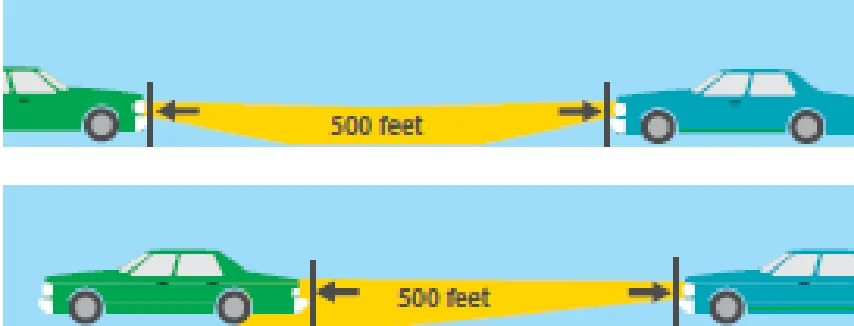
Dim your high beams whenever you come within 500 feet of an oncoming vehicle, and use low beams when closer than 500 feet behind another vehicle.

Handbook p. 52 ↗
Turn signal distance (500 feet)
Dim high beams within 500 feet

Put it into practice

Driving an unfamiliar county road at night, you're following a pickup. Instead of the usual 4 seconds, leave at least 6 (two extra seconds for an unfamiliar road at night), and stay on low beams because you're following.

Check your understanding

Read the question, decide on an answer, then open it to check the explanation. These are Roadwise study questions based on the source handbook.

If an oncoming driver fails to dim their high beams and it continues to blind you, what should you do?
  1. Stop in your lane until they pass
  2. Look toward the right side of the road until they pass
  3. Switch your own high beams on
  4. Look directly at their lights to judge distance

Answer: Look toward the right side of the road until they pass

If a driver won't dim their lights, look toward the right edge of the road to avoid being blinded, using it to stay on course.
Handbook p. 52 ↗
At night, how much should you increase your following distance compared to daytime driving?
  1. At least one additional second
  2. No change is needed at night
  3. Double it to 8 seconds
  4. At least 10 additional seconds

Answer: At least one additional second

Increase following distance by at least one additional second for night driving conditions.

Handbook p. 63 ↗
On an unfamiliar roadway at night, how many additional seconds of following distance should you add?
  1. At least five additional seconds
  2. Half a second
  3. No additional distance is needed
  4. At least two additional seconds

Answer: At least two additional seconds

Add at least two additional seconds of following distance for unfamiliar roadways at night.

Handbook p. 63 ↗
Besides at night, when does the handbook say not to wear sunglasses or colored lenses while driving?
  1. When driving into a low sun
  2. On snow-covered roads
  3. On an overcast day
  4. On interstate highways

Answer: On an overcast day

Do not wear sunglasses or colored lenses when driving at night or on an overcast day; tinted or colored lenses reduce vision.

Handbook p. 63 ↗
At night, you should look directly at the headlights of oncoming vehicles to judge how far away they are.
  1. True
  2. False

Answer: False

Avoid looking directly into oncoming headlights; keep your eyes searching the road ahead and look toward the right side if blinded.

Handbook p. 63 ↗
Besides looking straight ahead at night, what should you occasionally do to spot hazards near the roadway?
  1. Check the rearview mirror continuously
  2. Glance right and left for the pavement edge
  3. Watch only for other vehicles' taillights
  4. Look only at your own headlight beams

Answer: Glance right and left for the pavement edge

Glance occasionally to the right and left to determine the pavement edge and any hazards from the sides.

Handbook p. 63 ↗
Take the lesson checkpoint in the app

More in Special Driving Situations