roadwise.Open study app

South Dakota driving lesson · Sharing the Road

Slow-moving vehicles, farm equipment and horses

A 2-minute lesson from the South Dakota course. Read the rules and examples, follow the handbook page references, and check your understanding before you move on.

Read time
2 minutes
Course unit
Sharing the Road
Checkpoint questions
5
Source pages
62

Rural roads carry tractors, combines, buggies and riders. They move slowly, their operators may not hear you, and they may turn with little warning.

Know the rule

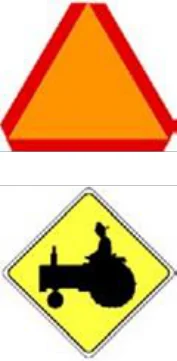
A fluorescent or reflective orange-and-red triangle on the rear of animal-drawn vehicles, farm equipment or construction equipment means the vehicle travels less than 25 mph.

Handbook p. 62 ↗
Slow-moving vehicle emblem
Slow-moving vehicle emblem and farm machinery sign

Know the rule

Use caution when approaching a slow-moving vehicle, and be sure it's safe before you pass.

Handbook p. 62 ↗

Know the rule

Watch for tractors, combines and other farm equipment moving across the road and traveling on state highways. Pass with caution: the operator cannot hear approaching vehicles.

Handbook p. 62 ↗

Know the rule

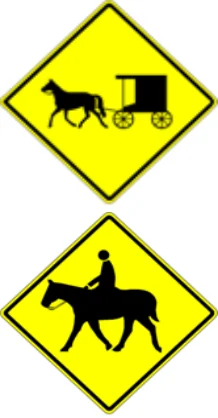
Animal-drawn vehicles and horseback riders have the same rights to use the road as motor vehicles and must follow the same rules of the road.

Handbook p. 62 ↗

Know the rule

Pass them with caution, and don't use the horn or rev the engine; it may scare the horse and cause a crash. They can be heavily damaged, and occupants injured, if hit.

Handbook p. 62 ↗

Know the rule

Anticipate left turns by animal-drawn vehicles into fields and driveways. Warning signs are posted where you're likely to meet them.

Handbook p. 62 ↗
Horse-drawn vehicle
Horse-drawn vehicle and horseback rider warning signs

Put it into practice

You come up behind a horse-drawn buggy on a two-lane road. Slow down and stay quiet (no horn, no revving), watch for a left turn into a field or driveway, and pass with caution only when it's safe.

Check your understanding

Read the question, decide on an answer, then open it to check the explanation. These are Roadwise study questions based on the source handbook.

Where does the handbook say to be especially alert for slow-moving vehicles?
  1. On interstate highways
  2. In downtown business districts
  3. In rural areas
  4. In school zones

Answer: In rural areas

Be alert for slow-moving vehicles, especially in rural areas, where farm equipment and animal-drawn vehicles share the road.
Handbook p. 62 ↗
Why can't farm machinery operators always react to traffic?
  1. Their view is blocked by crops
  2. They are not required to use signals
  3. Farm equipment can't leave the road
  4. They often can't hear approaching vehicles

Answer: They often can't hear approaching vehicles

Operators of farm machinery cannot hear approaching vehicles, so pass with extra caution.

Handbook p. 62 ↗
Why should you avoid using your horn or revving your engine near a horse-drawn vehicle?
  1. It may scare the horse and cause a crash
  2. It is illegal on rural roads
  3. The driver may think you want to pass
  4. It signals the driver to pull over

Answer: It may scare the horse and cause a crash

Using the horn or revving the engine near animal-drawn vehicles may scare the horse and cause a crash.

Handbook p. 62 ↗
What should you anticipate from animal-drawn vehicles in rural areas?
  1. Frequent stops to rest the horses
  2. Passing you on the right
  3. Possible left turns into fields and driveways
  4. Driving on the left shoulder

Answer: Possible left turns into fields and driveways

Anticipate left turns made by animal-drawn vehicles into fields and driveways to avoid crashes.

Handbook p. 62 ↗
Animal-drawn vehicles and horseback riders have the same rights to use the road as a motor vehicle.
  1. True
  2. False

Answer: True

Animal-drawn vehicles and horseback riders have the same rights to the road and must follow the same rules.

Handbook p. 62 ↗
Take the lesson checkpoint in the app

More in Sharing the Road