Emergency vehicles, the move-over law and police stops
A 3-minute lesson from the South Dakota course. Read the rules and examples, follow the handbook page references, and check your understanding before you move on.
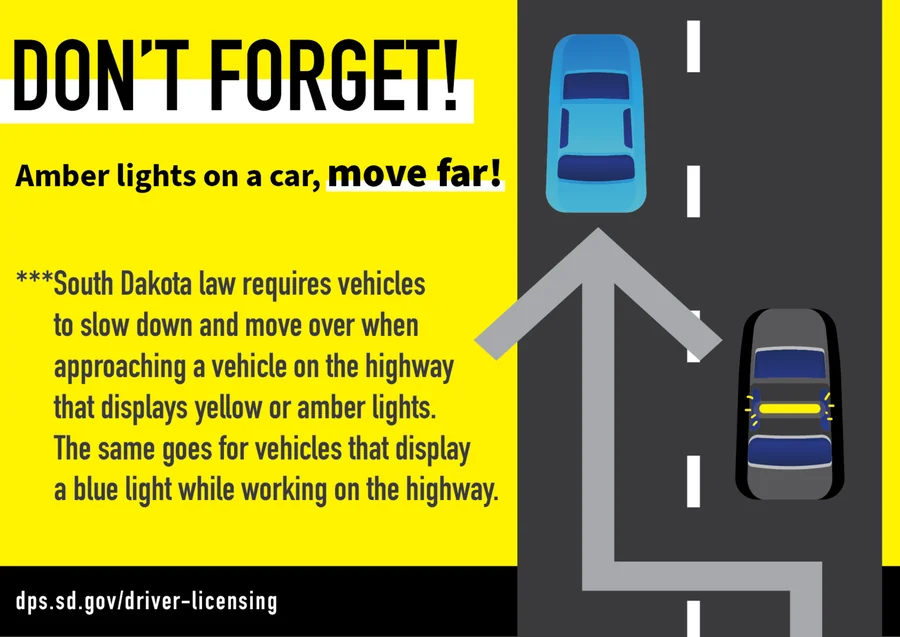
South Dakota's move-over law protects everyone stopped at the roadside, from police cars to tow trucks. What you must do depends on the color of the lights and the number of lanes.
Know the rule
When an emergency vehicle approaches with flashing lights and siren on, yield by pulling over to the edge of the road so it can pass. Avoid blocking intersections.
Stopped emergency vehicle using red lights: drivers from any direction must come to a complete stop before reaching it, then proceed with caution only when safe, unless directed otherwise.
On a two-lane highway posted at 65 mph, you see a tow truck with amber lights on the shoulder. At least 300 feet before it, slow to 45 mph or less and pass with caution.
Check your understanding
Read the question, decide on an answer, then open it to check the explanation. These are Roadwise study questions based on the source handbook.
When an emergency vehicle approaches with lights and sirens on, what must you do?
Yield the right-of-way and pull to the edge of the road
Speed up to clear the intersection first
Continue driving normally if you are already at a green light
Stop immediately, wherever you are
Answer: Yield the right-of-way and pull to the edge of the road
You must yield to an emergency vehicle with lights and sirens on by pulling over to the edge of the road.
What must you do when approaching a stopped emergency vehicle that is using red visual signals?
Slow to 20 mph below the posted limit
Come to a complete stop before reaching it
Change lanes and keep your speed
Slow to 5 mph and pass on the left
Answer: Come to a complete stop before reaching it
Drivers approaching from any direction must stop completely before reaching a stopped emergency vehicle using red lights, then proceed with caution when safe.