roadwise.Open study app

South Dakota driving lesson · Sharing the Road

Trucks and buses: turns, merging and bus hazards

A 3-minute lesson from the South Dakota course. Read the rules and examples, follow the handbook page references, and check your understanding before you move on.

Read time
3 minutes
Course unit
Sharing the Road
Checkpoint questions
5
Source pages
60, 61

Big vehicles need extra room to turn and merge, and buses bring hazards of their own: frequent stops, people running for them, and tail swing.

Know the rule

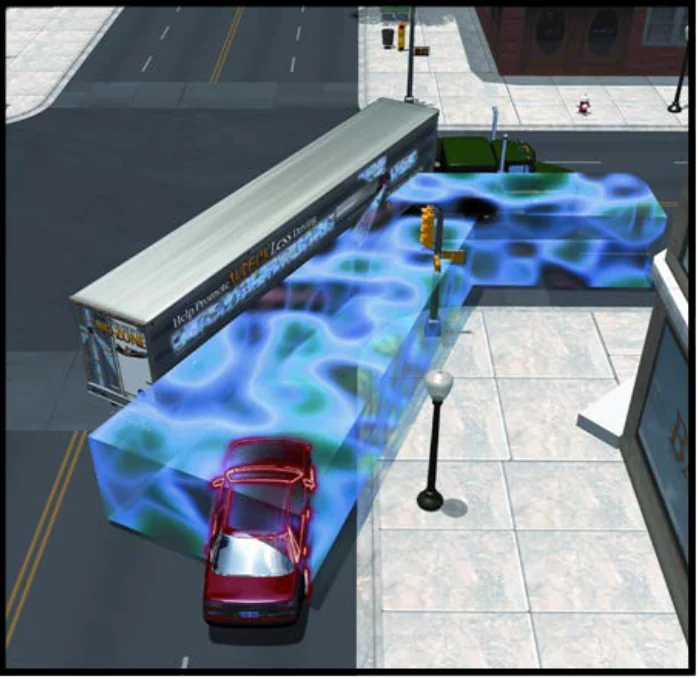
A truck or bus turning right may swing wide to the left first to clear the curb. Don't squeeze between it and the curb; wait until it has completed its turn.

Handbook p. 60 ↗
Truck no-zone blind spot
A truck swinging wide for a right turn

Keep in mind:

  • Meeting an oncoming truck: keep far right to avoid a side-swipe and wind turbulence
  • Unsure of an oncoming truck's speed? Don't turn left in its path
  • Always stop behind stop lines; they give large vehicles room to turn
  • Don't cut off a truck to reach an exit, turn, or single-lane construction zone
Handbook p. 60 ↗

Know the rule

Merge at the speed of traffic, and never merge in front of a truck or bus and then slow down. Keeping a steady speed lets trucks entering the freeway merge without stopping.

Handbook p. 60 ↗

Know the rule

Never park on a runaway truck ramp or its entrance; it's illegal. Smoke coming from a truck's or bus's brakes may signal a runaway: get out of the way and don't get in front of it.

Handbook p. 61 ↗

Know the rule

In construction areas, don't suddenly pull in front of a truck or bus and stop abruptly.

Handbook p. 61 ↗

Know the rule

If you see an inter-city bus ahead, move to another lane before it stops. Pass a parked bus with care: it may pull out, and people may run in front of it or run to catch it.

Handbook p. 61 ↗
3 feet

Approximate tail swing of an articulated bus; leave room for it

Handbook p. 61 ↗

The bigger they are:

  • The bigger their blind spots
  • The more room they need to maneuver
  • The longer it takes them to stop
  • The longer it takes them to accelerate
  • The longer it takes to pass them
  • The more likely you'll be the loser in a collision
Handbook p. 61 ↗

Put it into practice

A semi signals right at a corner and swings wide to the left. Stay behind it. Don't pull into the gap by the curb, or you'll be squeezed as it completes the turn.

Check your understanding

Read the question, decide on an answer, then open it to check the explanation. These are Roadwise study questions based on the source handbook.

When a truck or bus makes a right turn, why might it first swing wide to the left?
  1. To clear the curb or an obstruction
  2. To signal its intention more clearly
  3. To check its mirrors for bicycles
  4. To let faster traffic pass on the right first

Answer: To clear the curb or an obstruction

Trucks and buses sometimes swing wide left before a right turn to safely clear the curb or another obstruction.
Handbook p. 60 ↗
About how far can tail swing extend on an articulated bus?
  1. Approximately 10 feet
  2. Approximately 1 foot
  3. Approximately 20 feet
  4. Approximately 3 feet

Answer: Approximately 3 feet

Tail swing on articulated buses is approximately 3 feet, so drivers should allow extra room behind them.

Handbook p. 61 ↗
What should you do if you see smoke coming from a truck or bus's brakes?
  1. Stay close behind to warn others
  2. Speed up and pass in front of it
  3. Get out of the way; stay out of its path
  4. Flash your lights to warn the driver

Answer: Get out of the way; stay out of its path

Smoke from the brakes can indicate a runaway truck or bus; get out of the way and don't get in front of it.

Handbook p. 61 ↗
You should never park on a runaway truck ramp or even its entrance.
  1. True
  2. False

Answer: True

Parking on a runaway truck ramp or its entrance is illegal and could deny a driver the chance to survive.

Handbook p. 61 ↗
What should you do if you see a bus ahead that is likely to make a stop?
  1. Move to another lane before it stops
  2. Pass it on the right shoulder
  3. Pull directly behind it and wait
  4. Follow closely so you can pass quickly

Answer: Move to another lane before it stops

If you see a bus ahead of you, move to another lane of traffic before the bus stops, to avoid getting stuck behind it.

Handbook p. 61 ↗
Take the lesson checkpoint in the app

More in Sharing the Road