A 3-minute lesson from the South Dakota course. Read the rules and examples, follow the handbook page references, and check your understanding before you move on.
Trucks and buses are bigger and less maneuverable, need longer to stop and accelerate, and have much larger blind spots than cars. More than 250,000 crashes between cars and commercial vehicles happen each year.
250,000+
Crashes between cars and commercial vehicles each year
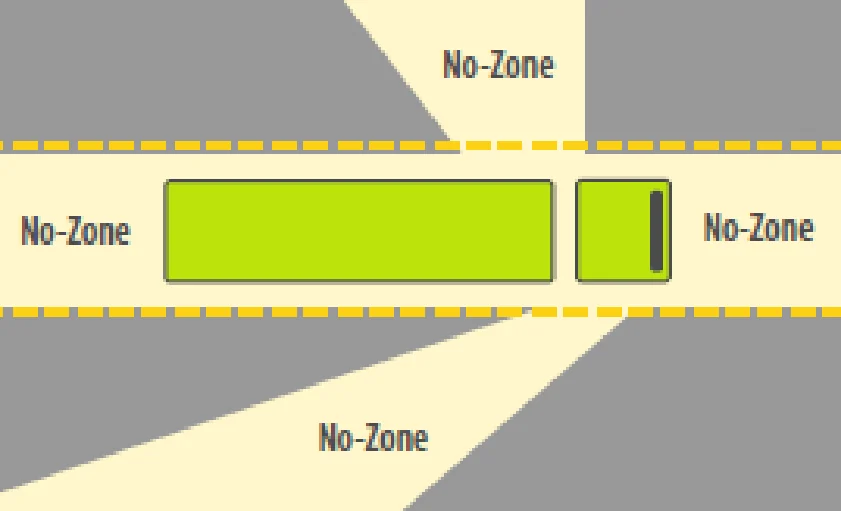
The areas around trucks and buses where cars disappear into blind spots, or are so close they restrict the driver's ability to stop or maneuver safely.
Side No-Zones are big on both sides; the right-side blind spot starts behind the cab and can extend the length of the truck. If you can't see the driver's face in the side mirror, the driver can't see you. Don't ride alongside longer than needed.
Front No-Zone: don't enter the road or change lanes in front of a large vehicle. After passing, see its whole front in your rearview mirror before pulling in, and keep your speed.
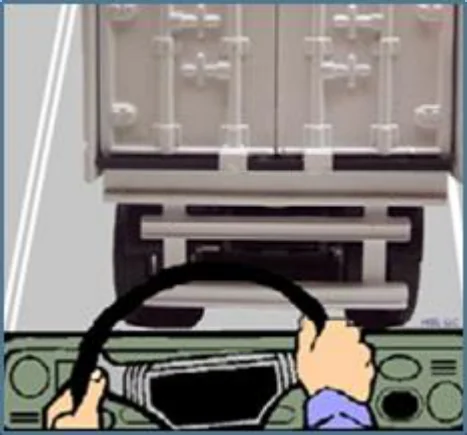
Rear No-Zone: the blind spot directly behind can extend up to 200 feet. Don't follow closely, and position your car where the driver can see it in the side mirrors.
On steep hills large vehicles slow to about 35 mph and use the right lane. Avoid the right lane on hills and near truck weigh stations, where trucks re-enter faster traffic.
Truck No-Zones: front, sides and rearToo close behind a truck: you can't see ahead and it can't see you
Put it into practice
You're cruising beside a semi's right side, just behind the cab. That's its biggest blind spot. Either pass steadily or drop back until you can see the driver's face in their side mirror.
Check your understanding
Read the question, decide on an answer, then open it to check the explanation. These are Roadwise study questions based on the source handbook.
The handbook's Large Trucks and Buses overview (p.59) says a loaded truck at 55 mph on a clear, dry road needs at least how far to stop?
500 feet
158 feet
100 feet
290 feet
Answer: 290 feet
The p.59 overview gives a minimum of 290 feet for a loaded truck at 55 mph (the p.60 No-Zone section cites 335 feet under ideal conditions).