roadwise.Open study app

South Dakota driving lesson · Special Driving Situations

Winter driving

A 3-minute lesson from the South Dakota course. Read the rules and examples, follow the handbook page references, and check your understanding before you move on.

Read time
3 minutes
Course unit
Special Driving Situations
Checkpoint questions
6
Source pages
64

Each year numerous snowstorms drop several inches of snow on South Dakota. Winter driving calls for slower speeds, gentle inputs, extra planning, and plenty of room for snowplows.

Know the rule

"First is worst": in the season's first storm most drivers have forgotten their winter skills, driving too fast and stopping too quickly. Go slowly, increase following distance, drive defensively.

Handbook p. 64 ↗

Know the rule

Drive well below the posted speed limit; posted limits are intended for summer months on dry pavement. Avoid sudden sharp turns, and brake lightly by gently pumping the brakes.

Handbook p. 64 ↗

Know the rule

Plan on trips taking extra time: leave earlier, consider an alternate route, and stay home if conditions are too bad.

Handbook p. 64 ↗

Know the rule

Never use cruise control on slippery roads.

Handbook p. 64 ↗

Know the rule

Turn on your headlights, and avoid high beams during a night storm to prevent glare. Wear your seatbelt.

Handbook p. 64 ↗
200 feet

Stay at least this far behind a snowplow with red or amber lights on, on roads posted 35 mph or more

Handbook p. 64 ↗

Know the rule

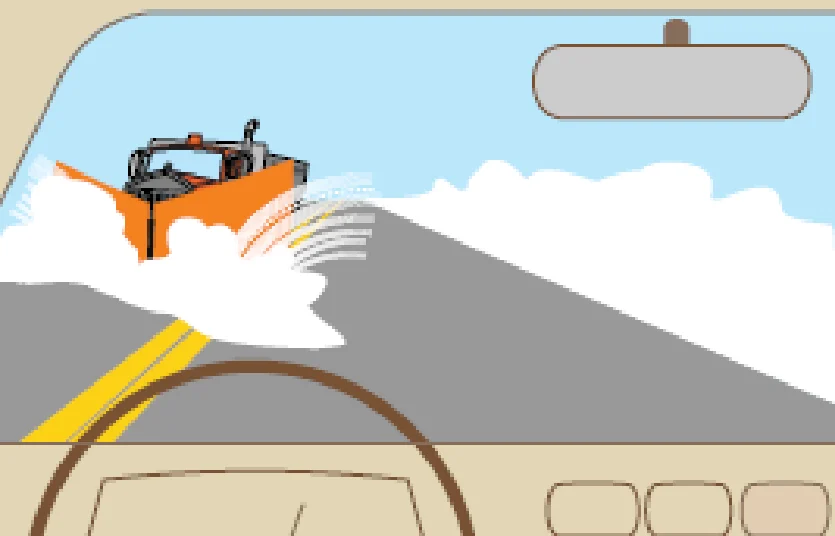
Snowplows are wide, often work very close to the center line, and throw up clouds of snow that cut visibility. Slow down and give them as much room as possible.

Handbook p. 64 ↗

Know the rule

If you travel on a closed road and get stuck, emergency services may not reach you quickly, and you could be ticketed and held accountable for rescue costs.

Handbook p. 64 ↗
Winter mountain driving conditions
Give snowplows room

Put it into practice

You're following a plow with its amber lights on along a 55 mph highway, about 100 feet back, with snow flying. Drop back to at least 200 feet; that's the law on roads posted 35 mph or more.

Check your understanding

Read the question, decide on an answer, then open it to check the explanation. These are Roadwise study questions based on the source handbook.

On roads posted 35 mph or more, how far behind a snowplow with its red or amber lights on must you stay?
  1. At least 200 feet
  2. At least 50 feet
  3. At least 100 feet
  4. At least 500 feet

Answer: At least 200 feet

On roads posted 35 mph or more, the law requires staying at least 200 feet behind a snowplow with its lights on.
Handbook p. 64 ↗
What braking technique is recommended for winter driving on slippery roads?
  1. Light braking by gently pumping the brakes
  2. Firm, steady pressure until stopped
  3. Downshifting instead of braking
  4. Hard, firm braking to stop quickly

Answer: Light braking by gently pumping the brakes

Use light braking by gently pumping the brakes when driving in winter conditions.

Handbook p. 64 ↗
Why does the handbook warn that 'first is worst' regarding the first snowstorm of the season?
  1. Most drivers have forgotten their winter skills
  2. Tires are least effective early in the season
  3. The first storm always has the heaviest snowfall
  4. Road crews are unprepared for the first storm only

Answer: Most drivers have forgotten their winter skills

In the first storm of the season, most drivers have forgotten their safe winter skills and may drive too fast.

Handbook p. 64 ↗
What does the handbook's winter driving advice say about cruise control?
  1. Use it only below 45 mph in snow
  2. Never use it on slippery roads
  3. Use it to hold a steady speed on ice
  4. Set it 10 mph under the posted limit

Answer: Never use it on slippery roads

Under 'Use your head, use your feet' the handbook says: never use cruise control on slippery roads.

Handbook p. 64 ↗
Posted speed limits are intended for summer months on dry pavement, so you should drive well below them in winter.
  1. True
  2. False

Answer: True

The handbook notes posted limits are intended for summer, dry-pavement conditions, so drive well below them in winter.

Handbook p. 64 ↗
If you get stuck on a closed road during a snowstorm, you could be ticketed and held responsible for rescue costs.
  1. True
  2. False

Answer: True

Travelling on a closed road and getting stuck can result in a ticket and responsibility for rescue-related costs.

Handbook p. 64 ↗
Take the lesson checkpoint in the app

More in Special Driving Situations