roadwise.Open study app

Massachusetts driving lesson · Signs, Signals & Pavement Markings

Special Lanes, Crosswalks & Islands

A 4-minute lesson from the Massachusetts course. Read the rules and examples, follow the handbook page references, and check your understanding before you move on.

Read time
4 minutes
Course unit
Signs, Signals & Pavement Markings
Checkpoint questions
6
Source pages
98, 99, 100

Beyond lane lines, painted words, symbols and colors guide you: lanes for buses, carpools and bikes, colored pavement, stop and yield lines, crosswalks and traffic islands.

Know the rule

Words or symbols painted on the road guide, warn or regulate drivers, often together with signs and signals. White arrows show lane directions or restrictions.

Handbook p. 98 ↗

Know the rule

A white diamond symbol means a special lane restriction, such as "high occupancy vehicle (HOV) only" or "bus only."

Handbook p. 99 ↗

Shared Lane Marking (sharrow)

A marking that shows bicyclists where to ride in a lane shared with cars, clear of opening doors. When you see one, look for bicyclists and leave them enough space when passing.

Handbook p. 99 ↗
Shared lane marking (sharrow)

Know the rule

Bicycle lanes are five feet wide and typically marked with solid white lines, symbols and signs. Motor vehicles may drive in them only when turning onto or off the road; look carefully for bicyclists and cross with care.

Handbook p. 99 ↗

Know the rule

Advisory bicycle lanes, dashed on one or both sides, are used on streets too narrow for a full bike lane. Motor vehicles may use that space when necessary but must always yield to bicyclists first.

Handbook p. 99 ↗

Know the rule

Green pavement marks areas where cars and bicycles may conflict: look for bicyclists before crossing it, and don't stop on green pavement at a red light.

Handbook p. 99 ↗

Know the rule

Red pavement marks travel lanes or station stops for public transit: buses, streetcars, trolleys, light-rail trains and rapid transit.

Handbook p. 99 ↗

Know the rule

A solid white STOP line may be painted where there's a stop sign or signal. A YIELD line, a row of painted triangles, may be painted where there's a yield sign.

Handbook p. 99 ↗

Know the rule

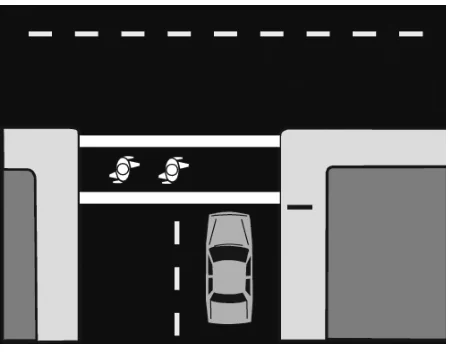
A crosswalk is a pair of white lines (sometimes with diagonal or vertical lines between) or other distinct markings guiding pedestrians across. Besides intersections, you'll find them near bus stops, schools, trail crossings and busy areas.

Handbook p. 100 ↗

Know the rule

You must stop behind stop lines, yield lines and crosswalk lines when a stop or yield sign, a traffic signal, or a pedestrian in the crosswalk requires it.

Handbook p. 100 ↗
Shared lane marking (sharrow) on roadway (diagram)
Stop behind the crosswalk lines

Channelizing island

A traffic island or pavement marking that guides traffic along certain paths. You may not drive over or park on one unless a police officer directs you to.

Handbook p. 100 ↗

Crossing guards depend on you. Watch for:

  • White painted crosswalks and pedestrian crossing signs
  • Brightly colored, highly reflective vests
  • Hand-held STOP paddles held up as they walk into the street
Handbook p. 100 ↗

Put it into practice

You're turning right into a driveway across a bike lane. You may enter the bike lane only to make the turn, and first you must look carefully for bicyclists and cross with care.

Check your understanding

Read the question, decide on an answer, then open it to check the explanation. These are Roadwise study questions based on the source handbook.

How wide is a standard marked bicycle lane in Massachusetts?

  1. Three feet
  2. Five feet
  3. Eight feet
  4. Ten feet

Answer: Five feet

Bicycle lanes are typically five feet wide.

Handbook p. 99 ↗
What is the purpose of Shared Lane Markings (sharrows)?
  1. To mark a bus-only lane
  2. To indicate a pedestrian crossing
  3. Guide cyclists' lane position
  4. To show where trucks may park

Answer: Guide cyclists' lane position

Sharrows help bicyclists avoid car doors and position correctly in a shared lane.

Handbook p. 99 ↗
What does green pavement typically indicate at an intersection?
  1. A bus-only travel lane
  2. A permanent no-parking zone
  3. A school crossing area
  4. Where cars and bikes may conflict

Answer: Where cars and bikes may conflict

Green pavement marks areas of potential road-sharing conflict between vehicles and bicycles.

Handbook p. 99 ↗
An advisory bicycle lane is a full, dedicated lane that cars may never enter.
  1. True
  2. False

Answer: False

Advisory bicycle lanes allow motor vehicles to use the space when necessary but they must yield to bicyclists.

Handbook p. 99 ↗
What does a white diamond symbol painted in a traffic lane mean?
  1. A merge point for entering traffic
  2. A railroad crossing just ahead
  3. A special restriction, like HOV only
  4. A shared lane for bicyclists

Answer: A special restriction, like HOV only

A white diamond marks a special lane restriction such as high occupancy vehicle (HOV) only or bus only.

Handbook p. 99 ↗
When may you drive over or park on a channelizing island?
  1. When traffic ahead is backed up
  2. When turning left from a side street
  3. When directed by a police officer
  4. When it is painted, not raised

Answer: When directed by a police officer

You cannot drive over or park on any channelizing island unless directed to by a police officer.

Handbook p. 100 ↗
Take the lesson checkpoint in the app

More in Signs, Signals & Pavement Markings