roadwise.Open study app

Massachusetts driving lesson · Signs, Signals & Pavement Markings

Traffic Signals

A 3-minute lesson from the Massachusetts course. Read the rules and examples, follow the handbook page references, and check your understanding before you move on.

Read time
3 minutes
Course unit
Signs, Signals & Pavement Markings
Checkpoint questions
6
Source pages
88, 89, 90

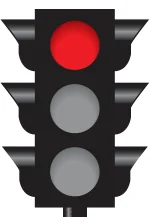
Traffic signals control vehicles and pedestrians, usually at intersections. Most are three round lights: red on top, yellow in the middle, green on the bottom. You'll also see arrows, flashing lights, and signals with 4 or 5 sections.

Steady red circle
Steady red circle

Know the rule

Steady red circle: stop, and don't go until the light turns green. You may turn right on red only after a complete stop and yielding to pedestrians and vehicles in your path, and not where a NO TURN ON RED sign is posted.

Handbook p. 89 ↗

Know the rule

You may turn left on a red light only when turning from a one-way street onto another one-way street, after stopping and yielding to pedestrians and other vehicles.

Handbook p. 89 ↗

Know the rule

Steady red arrow: same meaning as a steady red circle, but only for vehicles going in the arrow's direction. The same turn-on-red rules apply in Massachusetts; other states may have different laws.

Handbook p. 89 ↗
Flashing red light
Flashing red circle

Know the rule

Flashing red circle: same as a STOP sign. Stop completely before the white stop line or crosswalk; if there are none, stop where you can see traffic both ways. Then obey the right-of-way rules and go when safe.

Handbook p. 89 ↗

Know the rule

Steady yellow circle: the signal is changing from green to red. You must stop if it is safe. If you are already stopped at the intersection or stop line, you may not proceed.

Handbook p. 89 ↗

Know the rule

Flashing yellow circle: a warning. Proceed with caution, stay alert, and look both ways when crossing the intersection.

Handbook p. 89 ↗
Flashing yellow arrow

Know the rule

Flashing yellow arrow: you may turn in the arrow's direction while oncoming traffic has a green light, but only when there's an adequate gap in oncoming traffic and no pedestrians in your path.

Handbook p. 89 ↗

Know the rule

Steady green circle: go, but first yield to vehicles, bicycles or pedestrians in the road. Enter only if you have room to get completely through; never block an intersection. Turning left on green, yield to oncoming traffic.

Handbook p. 89 ↗

Know the rule

Green arrow: a "protected" turn in the arrow's direction. Pedestrians and oncoming vehicles should be stopped by red lights.

Handbook p. 90 ↗

Know the rule

Signals that aren't working will flash red or yellow: follow the rules for flashing lights. If signals are completely dark, proceed as though there is a stop sign in all directions.

Handbook p. 90 ↗

Put it into practice

You're stopped at a red light on a one-way street, waiting to turn left onto another one-way street. After a complete stop and yielding to pedestrians and traffic, you may turn left on red, the same way you'd turn right.

Check your understanding

Read the question, decide on an answer, then open it to check the explanation. These are Roadwise study questions based on the source handbook.

When is it legal to turn left on a red light in Massachusetts?
  1. From a one-way street onto another one-way street
  2. From any two-way street
  3. Only outside city limits
  4. Never, under any circumstances

Answer: From a one-way street onto another one-way street

Left turns on red are legal only from a one-way street onto another one-way street.
Handbook p. 89 ↗
What does a flashing red traffic light mean?
  1. Proceed with caution, no stop needed
  2. The same as a stop sign
  3. Stop only if cross traffic is present
  4. Yield only, no full stop required

Answer: The same as a stop sign

A flashing red circle means the same as a stop sign: come to a complete stop, then proceed when safe.

Handbook p. 89 ↗
What does a flashing yellow circle mean?
  1. Stop completely, then proceed
  2. The signal is about to turn red
  3. Proceed with caution
  4. Yield only to pedestrians

Answer: Proceed with caution

A flashing yellow circle is a warning to proceed with caution.

Handbook p. 89 ↗
What does a flashing yellow arrow allow you to do?
  1. Turn only after a full stop
  2. Proceed straight through only
  3. Stop and wait for a green arrow
  4. Turn with caution when there's a safe gap

Answer: Turn with caution when there's a safe gap

A flashing yellow arrow allows a cautious turn when oncoming traffic has a green light but there's an adequate gap.

Handbook p. 89 ↗
What should you do if you approach an intersection where the traffic signals are completely dark (not working at all)?
  1. Treat it as a four-way stop
  2. Treat it as a flashing yellow
  3. Wait for a police officer before proceeding
  4. Yield only to traffic on your right

Answer: Treat it as a four-way stop

If signals are blacked out, proceed cautiously as though there's a stop sign in all directions.

Handbook p. 90 ↗
What must you do at a steady yellow circle if you're not yet in the intersection and can stop safely?
  1. Accelerate through
  2. Stop
  3. Proceed with caution, no stop needed
  4. Yield, then continue through

Answer: Stop

A steady yellow circle means you must stop if it's safe to do so.

Handbook p. 89 ↗
Take the lesson checkpoint in the app

More in Signs, Signals & Pavement Markings