roadwise.Open study app

Massachusetts driving lesson · Signs, Signals & Pavement Markings

Lane Lines

A 3-minute lesson from the Massachusetts course. Read the rules and examples, follow the handbook page references, and check your understanding before you move on.

Read time
3 minutes
Course unit
Signs, Signals & Pavement Markings
Checkpoint questions
6
Source pages
97, 98

Painted lines keep traffic in order. The color tells you direction (white: same direction; yellow: opposite directions), and the pattern tells you whether you may cross (broken: with care; solid: generally no).

Know the rule

Lines may be solid or broken (long dashes), single or double. A solid white or yellow line that turns into a dotted line (short dashes) continues through an intersection or highway interchange. Unless turning, exiting or changing lanes, stay between lane lines.

Handbook p. 97 ↗

Know the rule

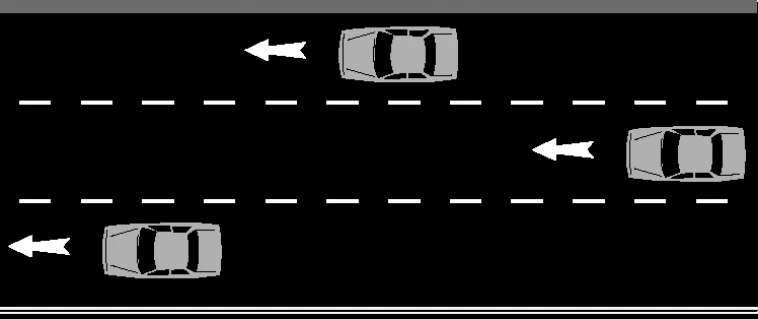
Broken white lines separate lanes of traffic traveling in the same direction. Once you have signaled and it's safe, you may cross one to change lanes.

Handbook p. 97 ↗
One-way road (both lanes same direction)
Broken white lines separate lanes moving the same direction

Know the rule

A solid white line marks the right edge of the roadway or separates same-direction lanes, including bicycle lanes. Don't cross it unless you need to avoid danger.

Handbook p. 98 ↗

Know the rule

A double solid white line separates two same-direction lanes. Crossing it is not allowed.

Handbook p. 98 ↗

Know the rule

Yellow lines separate traffic moving in opposite directions. A single yellow line may also mark the left edge of the pavement on divided highways and one-way streets.

Handbook p. 98 ↗

Know the rule

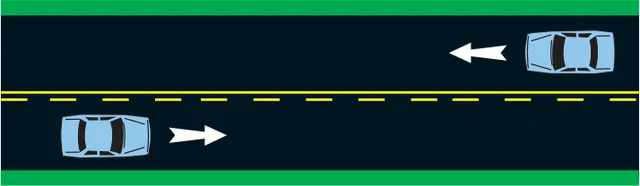
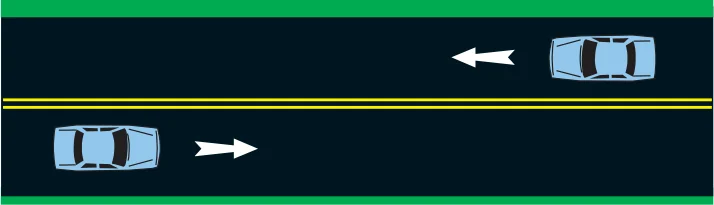
A broken yellow line: stay to the right of it unless you're passing; you may cross it temporarily to pass when safe.

Handbook p. 98 ↗
Solid yellow center line (two-way road)
One solid and one broken yellow line

Know the rule

One solid and one broken yellow line: if the solid line is closer to you, you cannot cross. If the broken line is closer to you, you may cross only to pass another vehicle when it is safe.

Handbook p. 98 ↗
Broken yellow center line (two-way road, variant)
Double solid yellow lines

Know the rule

Two solid yellow lines prohibit crossing to pass another vehicle. You may cross them only to turn left, when it's safe.

Handbook p. 98 ↗
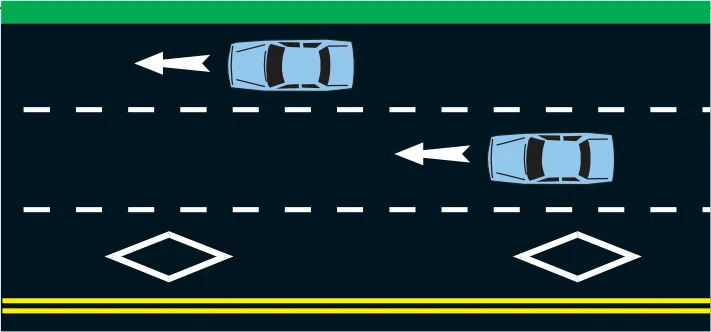
Two-way left turn lane markings (diamond symbols)
The far left lane marked with white diamonds is reserved for HOVs (carpools) or buses

Put it into practice

On a two-lane road you're stuck behind a slow truck. The solid yellow line is on your side and the broken line is on the oncoming side. You may not cross to pass; wait until the broken line is on your side and it's safe.

Check your understanding

Read the question, decide on an answer, then open it to check the explanation. These are Roadwise study questions based on the source handbook.

What does a white line on the pavement generally separate?
  1. Lanes of traffic moving in opposite directions
  2. Lanes of traffic moving in the same direction
  3. A bicycle lane from a bus lane only
  4. A parking lane from a bike lane only

Answer: Lanes of traffic moving in the same direction

White lines separate lanes of traffic traveling in the same direction.
Handbook p. 97 ↗
What does a yellow line on the pavement generally separate?
  1. Lanes of traffic moving in the same direction
  2. A turn lane from a through lane only
  3. Lanes of traffic moving in opposite directions
  4. A shoulder from a parking lane only

Answer: Lanes of traffic moving in opposite directions

Yellow lines separate lanes of traffic moving in opposite directions.

Handbook p. 98 ↗
Can you legally cross a double solid white line?
  1. Yes, any time it's safe
  2. Yes, but only to pass
  3. Yes, but only on a highway
  4. No, crossing it is not allowed

Answer: No, crossing it is not allowed

Crossing a double solid white line is not allowed.

Handbook p. 98 ↗
On a two-way road with one solid and one broken yellow line, when can you legally cross?
  1. Only when the broken line is on your side
  2. Any time, regardless of which line is closer
  3. Only when the solid line is closer to you
  4. Never, regardless of which line is closer

Answer: Only when the broken line is on your side

You may only cross to pass when the broken line is on your side; if the solid line is closer to you, you cannot cross.

Handbook p. 98 ↗
What does a single white line along the right side of the road typically mark?
  1. A bus-only lane
  2. The center of the road
  3. The right edge of the pavement
  4. A pedestrian crossing

Answer: The right edge of the pavement

Single white lines may mark the right edge of the pavement.

Handbook p. 97 ↗
A broken white line allows you to cross into the next lane after signaling, when it's safe.
  1. True
  2. False

Answer: True

Broken white lines allow lane changes once signaled and safe.

Handbook p. 97 ↗
Take the lesson checkpoint in the app

More in Signs, Signals & Pavement Markings