Indiana practice test
Indiana permit practice test.
Get to know the format, try six study questions, and check the explanations before opening a full Roadwise practice test. This course’s simulation is based on the format described below.
- Questions
- 50
- Correct to pass
- 41
- Practice timer
- No timer
- Study question bank
- 776
The format in this course
Indiana Knowledge Exam
To pass this Roadwise simulation, answer at least 41 of 50 questions correctly and meet each scored section’s threshold. Answers and explanations appear after you finish. Unanswered questions count as incorrect.
| Section | Questions | Correct needed |
|---|---|---|
| Traffic signs | 16 | 13 |
| Traffic laws & safe driving | 34 | 28 |
This Roadwise practice format has no countdown, so you can take the time you need.
The handbook and the official BMV knowledge-exam page both confirm the exam has two separately-scored components (road signs; traffic laws and safe driving) each requiring 80% or higher correct, but neither publishes the exact question count. The 50-question / 16-sign / 34-law breakdown is the best-corroborated figure found (a driving-tests.org practice-test summary); minimum correct-answer counts here are computed as the minimum whole-number score that clears 80% (13/16 = 81.25%, 28/34 = 82.35%), since the source's own per-section 'miss counts' were inconsistent with the stated 80% rule.
Try a few practice questions
Read the question, decide on an answer, then open it to check the explanation. These are Roadwise study questions based on the source handbook.
How long does a new Indiana resident have to obtain an Indiana driver's license?
- 30 days
- 90 days
- 60 days
- 180 days
Answer: 60 days
When you become an Indiana resident, you have 60 days to obtain a new Indiana driver's license.
Handbook p. 7 ↗How many points are assessed for driving 16–25 mph over the speed limit?
- 4 points
- 2 points
- 6 points
- 8 points
Answer: 4 points
Speeding 16 to 25 mph over the limit carries 4 points.
Handbook p. 26 ↗If two vehicles arrive at an all-way stop at the same time, who yields?
- Whichever vehicle is larger yields
- The left driver yields to the right
- The driver on the right yields to the left
- The driver going straight yields
Answer: The left driver yields to the right
If you arrive at the same time as another driver, the vehicle on the left shall yield the right-of-way.
Handbook p. 44 ↗Why is stopping and turning more difficult on loose gravel roads?
- Gravel causes brakes to overheat
- Gravel wears tire tread down quickly
- Traction is reduced, which can cause skidding
- Gravel roads have steeper crowns
Answer: Traction is reduced, which can cause skidding
Stopping and turning is more difficult on loose gravel because your traction is reduced.
Handbook p. 51 ↗When should a driver NOT move their vehicle after an accident?
- If there is injury, death, entrapment, or hazmat
- If it blocks only one lane of traffic
- If the damage looks minor
- If the other driver has no insurance
Answer: If there is injury, death, entrapment, or hazmat
The driver should not move the vehicle if it involves hazardous materials transport or results in injury, death, or entrapment.
Handbook p. 63 ↗What does this sign mean?
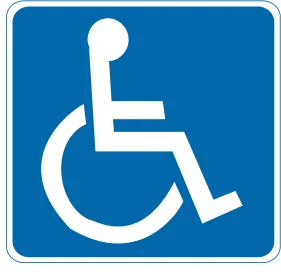
- A hospital is located nearby.
- Indicates the facility is accessible to people with disabilities.
- Indicates lodging (a hotel or motel) is available nearby.
- Indicates food services are available nearby.
Answer: Indicates the facility is accessible to people with disabilities.
Accessible facility: Indicates the facility is accessible to people with disabilities. Use to identify accessible services or restrooms.
Handbook p. 38 ↗What to study next
The practice question pool spans the course. Use the topics below to read the rules behind an answer, then return to practice.
8 lessons
Getting Your Credential
Real ID, permits, exams, licenses, and probationary rules
Explore8 lessons
Endorsements, Renewals & Documents
Restriction codes, motorcycles, MDCs, for-hire, renewals, and required documents
Explore5 lessons
Points, Suspensions & Insurance
Violation points, insurance, OWI, HTV status, and reinstatement
Explore6 lessons
Traffic Signs & Signals
Colors, shapes, sign types, and what each signal means
Explore6 lessons
Safe Vehicle Operation
Lanes, turns, right of way, speed, stopping, and vehicle care
Explore5 lessons
Weather, Night & Driver Condition
Bad weather, darkness, fatigue, distraction, and teen risks
Explore5 lessons
Rural Roads, Interstates & Railroads
Open roads, interstates, work zones, and crossings
Explore6 lessons
Sharing the Road
Trucks, emergency vehicles, buses, motorcycles, bicycles, and more
Explore4 lessons
Parking, Pedestrians & Vehicle Safety
Parking, pedestrians, seat belts, and equipment
Explore6 lessons
Accidents & Emergencies
What to do when something goes wrong
Explore