Roadwise States Indiana Driving lessons Lane markings, lane changes & passing Indiana driving lesson · Safe Vehicle Operation
Lane markings, lane changes & passing A 3-minute lesson from the Indiana course. Read the rules and examples, follow the handbook page references, and check your understanding before you move on.
Read time 3 minutes
Course unit Safe Vehicle Operation
Checkpoint questions 6
Source pages 42, 43 Pavement lines tell you who is beside you and when you may cross. Yellow lines separate opposite directions and white lines separate lanes going your way. Passing is where these rules matter most.
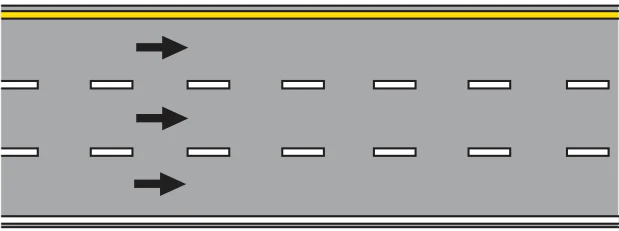
Two-lane roads: solid yellow, and broken yellow with a one-direction no-passing zone Three lanes separated by broken white lines Know the rule
Most roads with more than two lanes use broken white lines to separate the lanes.
Handbook p. 42 ↗ Know the rule
Change only one lane at a time and signal before turning or changing lanes. Don't weave between lanes. On highways, slower vehicles use the right lane; the left lane is for faster or passing vehicles.
Handbook p. 42 ↗ Changing lanes, step by step: Make sure there is no traffic ahead of you in the lane you want Check your mirrors for vehicles preparing to pass you Briefly turn your head to check your blind spot and room in the next lane Use your turn signal Move smoothly into the new lane Handbook p. 42 ↗ Passing, step by step: Make sure the passing lane is clear of traffic Check behind and to your left that no one is trying to pass you Signal your intention to change lanes Move over, accelerate, and keep going until you see the passed vehicle in your rearview mirror Signal before returning to your original lane Handbook p. 43 ↗ 100 feet When passing, you must be back on the right side no less than this far before any oncoming vehicle
Handbook p. 43 ↗ Passing is illegal when: A solid yellow line is on your side of the center line A yellow pennant No Passing Zone sign (left side) or white rectangular Do Not Pass sign (right side) is posted You're on or approaching a curve You're approaching the crest of a hill or grade You're within 100 feet of an intersection, railroad crossing, bridge, viaduct, or tunnel Handbook p. 43 ↗ Know the rule
When another vehicle passes you on the left, let it pass safely and don't increase your speed.
Handbook p. 43 ↗ Put it into practice
You're behind a slow truck on a two-lane road with a broken yellow line on your side, but a bridge is 80 feet ahead. Don't pass. Passing is illegal within 100 feet of a bridge.
A useful reminder Yellow = opposite directions, white = same direction. Solid means stay put; broken means you may cross when safe.
Check your understanding Read the question, decide on an answer, then open it to check the explanation. These are Roadwise study questions based on the source handbook.
What do yellow lane markings separate? Traffic lanes going in the same direction A bike lane separated from a travel lane A parking lane separated from a travel lane Traffic lanes going in opposite directions Answer: Traffic lanes going in opposite directions
Yellow lane markings separate multiple lanes of traffic going in opposite directions.
Handbook p. 42 ↗ What do white lane markings separate? Traffic lanes going in the same direction Traffic lanes going in opposite directions A bus lane separated from a bike lane A shoulder separated from the roadway Answer: Traffic lanes going in the same direction
White lane markings separate multiple lanes of traffic going in the same direction.
Handbook p. 42 ↗ When may you cross a broken yellow line? When approaching the crest of a hill To pass another vehicle safely Within 100 feet of an intersection On a curve if no one is oncoming Answer: To pass another vehicle safely
You may cross a broken yellow line to pass another vehicle when it is safe.
Handbook p. 42 ↗ When you pass another vehicle, how far before an oncoming vehicle must you return to your lane? No less than 50 feet No less than 200 feet No less than 100 feet No less than 25 feet Answer: No less than 100 feet
You must return to the right side of the road no less than 100 feet before an oncoming vehicle.
Handbook p. 43 ↗ Passing is prohibited within 100 feet of which of these? A driveway, parking lot, or alley A gas station or rest area entrance An intersection, railroad crossing, or bridge A mailbox, fire hydrant, or parked car Answer: An intersection, railroad crossing, or bridge
Passing is illegal within 100 feet of an intersection, railroad crossing, bridge, viaduct, or tunnel.
Handbook p. 43 ↗ What should you do if another vehicle is passing you on the left? Speed up so that it cannot pass you Let it pass safely without speeding up Brake hard to let it by quickly Flash your high beams at the driver Answer: Let it pass safely without speeding up
If being passed, allow the other vehicle to pass safely and do not increase your speed.
Handbook p. 43 ↗ Previous lesson Stop lines, yield signs & special signals Next lesson Turning, signals & U-turns More in Safe Vehicle Operation About the source Roadwise’s Indiana course uses the driver handbook edition supplied with this study pack. This lesson cites source pages 42, 43. The linked PDF is a third-party mirror of the handbook, rather than a government-hosted page.
Open the handbook source PDF · View the source edition
For current application requirements, fees, appointments, and the format that applies to your age or license type, check Indiana’s BMV. Roadwise provides study material and does not issue permits or licenses.