roadwise.Open study app

Indiana driving lesson · Traffic Signs & Signals

Stop lines, yield signs & special signals

A 3-minute lesson from the Indiana course. Read the rules and examples, follow the handbook page references, and check your understanding before you move on.

Read time
3 minutes
Course unit
Traffic Signs & Signals
Checkpoint questions
6
Source pages
40, 41

Where you stop matters, and some signals aren't meant for you at all. Bicycle and transit signals control only their own lanes, and pedestrian signals and beacons tell you when walkers have the road.

Know the rule

At a red light or stop sign, stop at the solid white stop line. With no stop line, stop perpendicular to the stop sign or before the crosswalk on your side; with no crosswalk, stop before entering the intersection.

Handbook p. 40 ↗

Know the rule

A yield sign means slow down and be ready to stop fully for a vehicle or pedestrian with the right of way. That vehicle should not have to brake to avoid hitting you.

Handbook p. 40 ↗

Know the rule

Before entering a street from an alley or driveway, stop and yield the right of way to other vehicles.

Handbook p. 40 ↗

Know the rule

A motorcycle or MDC stuck at a red light that won't change may go through after a complete stop of at least two minutes, using due caution. This does not apply to autocycles.

Handbook p. 40 ↗
2 minutes

Complete stop needed before a motorcycle, MDC, or bicycle may go through a stuck steady red

Handbook p. 40 ↗

Know the rule

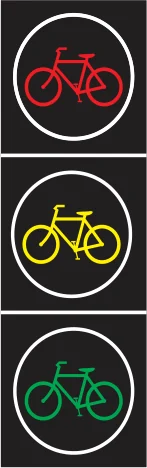
A signal showing only bicycle symbols controls a bike lane or separate bike path and applies only to bicyclists: red means stop, yellow means right-of-way ending, green means go.

Handbook p. 40 ↗
Bicycle signal (red/yellow/green)
Bicycle signal

Know the rule

A person may make a left turn from a designated left-turn lane on a one-way street onto another one-way street with the flow of traffic.

Handbook p. 40 ↗

Know the rule

Signals showing white rectangular bars control a bus or transit lane and apply only to bus or transit operators.

Handbook p. 40 ↗

Know the rule

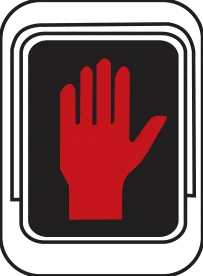
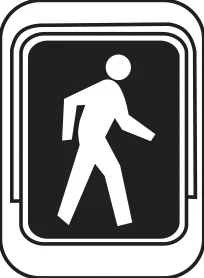
WALK or a walking person means pedestrians may cross; DON'T WALK or a raised hand means don't. Flashing means crossing time is ending. Some crossings have a push button to activate WALK.

Handbook p. 41 ↗
Pedestrian walk signal
Walk signal
Pedestrian don't walk signal
Don't Walk signal

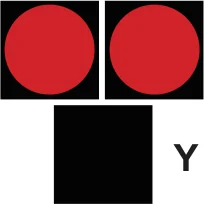
Pedestrian hybrid beacon (often at mid-block crosswalks):

  • 1. Dark until a pedestrian activates it
  • 2. Flashing yellow: drivers clear the crossing
  • 3. Steady yellow: your right of way is ending
  • 4. Two steady red lights while the pedestrian crosses
  • 5. Alternating flashing red: go if the crossing is clear of pedestrians
  • 6. Dark again until activated
Handbook p. 41 ↗
Pedestrian hybrid beacon - steady red
Hybrid beacon: steady red

Put it into practice

At a mid-block crosswalk, a beacon over the road shows two steady red lights. Stop and stay stopped while the pedestrian crosses. When the reds begin flashing, you may go once the crossing is clear.

Check your understanding

Read the question, decide on an answer, then open it to check the explanation. These are Roadwise study questions based on the source handbook.

What does a flashing 'DON'T WALK' signal tell pedestrians?
  1. It is now safe to begin crossing
  2. The walk signal is about to begin
  3. The time to cross is ending
  4. Vehicles must stop right away

Answer: The time to cross is ending

The flashing words or symbol alert pedestrians that the time to safely cross the street is ending.
Handbook p. 41 ↗
What is the first stage of a pedestrian hybrid beacon before it is activated?
  1. Flashing yellow, warning drivers
  2. Steady red, stopping traffic
  3. Flashing red, allowing traffic through
  4. Dark, until a pedestrian activates it

Answer: Dark, until a pedestrian activates it

The pedestrian hybrid beacon is dark unless it has been activated by a pedestrian.

Handbook p. 41 ↗
Who does a signal displaying only bicycle symbols apply to?
  1. Bicyclists in the bike lane
  2. Every vehicle in that lane
  3. Pedestrians crossing nearby
  4. Buses and transit vehicles

Answer: Bicyclists in the bike lane

A signal displaying only bicycle symbols controls a bike lane and applies only to bicyclists.

Handbook p. 40 ↗
Who does a signal displaying white rectangular bars apply to?
  1. Bicyclists in the bike lane
  2. Bus or transit operators
  3. Every vehicle on the road
  4. Pedestrians at the crosswalk

Answer: Bus or transit operators

A signal with white rectangular bars controls a bus or transit lane and applies only to those operators.

Handbook p. 40 ↗
A motorcycle, MDC, or bicycle rider stuck at a red light that won't change may proceed after a complete stop of at least how long?
  1. At least 30 seconds
  2. At least five minutes
  3. At least two minutes
  4. At least one minute

Answer: At least two minutes

A rider stuck at a steady red that fails to change may proceed after a complete stop of at least two minutes, using due caution.

Handbook p. 40 ↗
Where must you stop if there is no stop line or crosswalk at a red light?
  1. Before entering the intersection
  2. Under the traffic signal
  3. At the far side of the intersection
  4. Partway into the intersection for a view

Answer: Before entering the intersection

If there is no crosswalk, you should come to a complete stop before entering the intersection.

Handbook p. 40 ↗
Take the lesson checkpoint in the app

More in Traffic Signs & Signals