roadwise.Open study app

Indiana driving lesson · Traffic Signs & Signals

Traffic signals & turning on red

A 4-minute lesson from the Indiana course. Read the rules and examples, follow the handbook page references, and check your understanding before you move on.

Read time
4 minutes
Course unit
Traffic Signs & Signals
Checkpoint questions
6
Source pages
38, 39, 40

Signals decide who has the right of way at an intersection. Learn what every steady light, flashing light, and arrow means, and what to do when a signal is dark.

Steady signals

Steady signals
SignalMeaning
GreenGo: you have the right of way if the intersection is clear
Steady yellowGreen has ended; your right of way is ending
RedStop: don't enter until green and the intersection is clear
Handbook p. 38 ↗

Know the rule

With a steady yellow, if you're approaching the intersection and too close to stop safely, you may complete your movement. On red, traffic from other directions has the right of way.

Handbook p. 38 ↗

Know the rule

Facing a green arrow (shown with a red or green light), you have the right of way to turn as long as the intersection is clear.

Handbook p. 39 ↗

Know the rule

Facing a green light without an arrow, you may turn when clear but must yield to all oncoming traffic. Only one vehicle at a time may move into the intersection to turn left.

Handbook p. 39 ↗

Know the rule

A flashing yellow arrow means you may turn only after yielding to pedestrians and oncoming traffic. A steady yellow light or arrow means your right of way is ending.

Handbook p. 39 ↗
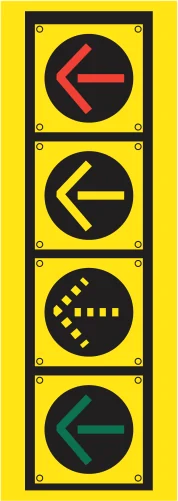
Left-turn signal head (red/yellow/flashing/green arrows)
Turn signal with flashing yellow arrow

Know the rule

Facing a red light or arrow, your right of way has ended. If you're already in the middle of the intersection, you may turn once oncoming traffic has stopped.

Handbook p. 39 ↗

To turn right on red (when permitted):

  • Come to a full stop
  • Check that no vehicles or pedestrians are in, or about to enter, your path
  • Check that there is no No Turn on Red sign
  • Use the correct lane
Handbook p. 39 ↗

Know the rule

You may turn left on red only from a one-way street onto a one-way street, after the same full stop and checks.

Handbook p. 39 ↗

Know the rule

A flashing yellow light (no arrow) means slow down and use caution. Cross traffic must yield to you, but when turning left you must yield to oncoming traffic and pedestrians.

Handbook p. 39 ↗

Rectangular rapid flashing beacon

A yellow flashing light at a crosswalk that flashes only when activated by a pedestrian.

Handbook p. 39 ↗

Know the rule

A flashing red light equals a stop sign: stop completely, then proceed with caution. Where all traffic stops, yield to vehicles already in or stopped before you. If you arrive together, the vehicle on the left yields.

Handbook p. 39 ↗
Flashing/steady red beacon (school zone/crosswalk)
Flashing red signal

At a non-operating signal, stop first, then yield to:

  • Cross traffic that has already entered the intersection
  • Any vehicle that stopped before you and is entering
  • Any vehicle that arrived at the same time as you and is on your right
  • Any pedestrians
Handbook p. 40 ↗

Put it into practice

You're stopped at a red light on a one-way street and want to turn left onto another one-way street. Stop fully, check for pedestrians and traffic, make sure no No Turn on Red sign is posted, and use the correct lane before turning.

Check your understanding

Read the question, decide on an answer, then open it to check the explanation. These are Roadwise study questions based on the source handbook.

What should you do if you are facing a steady yellow light and are too close to stop safely?
  1. Brake hard and stop wherever you are
  2. Finish crossing the intersection
  3. Stop inside the crosswalk
  4. Speed up to beat the red light

Answer: Finish crossing the intersection

If you are too close to the intersection to stop safely on yellow, you may complete your movement.

Handbook p. 38 ↗
What must you do at a yellow flashing arrow for a turning movement?
  1. Come to a complete stop, then wait for green
  2. Turn immediately, without yielding to anyone
  3. Yield to pedestrians and oncoming traffic
  4. Wait for a steady green arrow to appear

Answer: Yield to pedestrians and oncoming traffic

A yellow flashing turn arrow means you may proceed with the turn only after yielding right of way.

Handbook p. 39 ↗
How should you treat a red flashing light at an intersection?
  1. Like a yield sign, slowing but not stopping
  2. Like a flashing yellow, using caution
  3. Like a green light once cross traffic clears
  4. Like a stop sign, then proceed with caution

Answer: Like a stop sign, then proceed with caution

A red flashing light is equivalent to a stop sign, requiring a complete stop before proceeding.

Handbook p. 39 ↗
At an intersection with a non-operating traffic signal, what should you do first?
  1. Stop before entering the intersection
  2. Slow down, but you need not stop
  3. Proceed if no cross traffic is visible
  4. Stop and wait for the signal to turn green

Answer: Stop before entering the intersection

If approaching an intersection with a non-operating signal, you should stop before entering.

Handbook p. 40 ↗
When may you legally turn left on a red light in Indiana?
  1. From a two-way street onto a one-way street
  2. Only when a police officer waves you through
  3. One-way street onto another one-way street
  4. Only under a flashing yellow turn arrow

Answer: One-way street onto another one-way street

You may turn left through a red light or arrow only if turning from a one-way street onto a one-way street.

Handbook p. 39 ↗
When facing a green light without an arrow and wanting to turn, what must you do?
  1. Turn first, since green gives you priority
  2. Wait for a green arrow before turning
  3. Turn only after the light turns yellow
  4. Yield to oncoming traffic before turning

Answer: Yield to oncoming traffic before turning

If facing a green light without an arrow, you may turn as long as the intersection is clear, yielding to oncoming traffic.

Handbook p. 39 ↗
Take the lesson checkpoint in the app

More in Traffic Signs & Signals