roadwise.Open study app

Indiana driving lesson · Parking, Pedestrians & Vehicle Safety

Parking, reversing & accessible spaces

A 3-minute lesson from the Indiana course. Read the rules and examples, follow the handbook page references, and check your understanding before you move on.

Read time
3 minutes
Course unit
Parking, Pedestrians & Vehicle Safety
Checkpoint questions
6
Source pages
59, 60

Parking takes careful control at low speed and a clear idea of where you may not stop. Indiana's manual walks you through parallel parking step by step.

Parallel parking into a space with cars in front and behind:

  • 1. Signal your intention to park
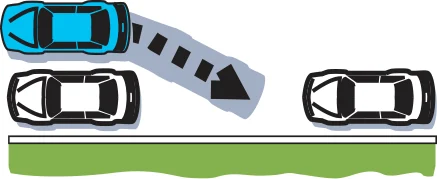
  • 2. Pull up parallel to the car in front of the space, at least two feet away, rear bumpers aligned
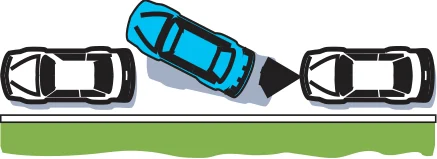
  • 3. Back slowly until your front is even with its front door; turn sharply right to a 45-degree angle
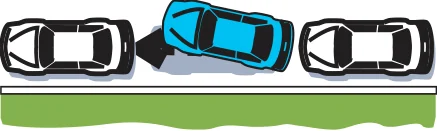
  • 4. When your front passes its rear, turn the wheel sharply left, then gradually, while backing in
  • 5. Straighten your wheels and pull forward in the space
Handbook p. 59 ↗
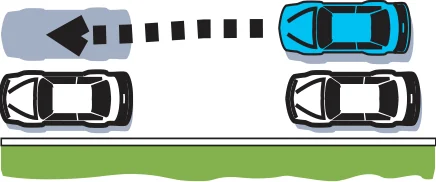
Backing out of a parking space - Figure A
Figure A: line up parallel, rear bumpers even
Backing out of a parking space (diagram)
Figure B: back in at a 45-degree angle
Backing out of a parking space - Figure B
Figure C: turn left while backing in
Backing out of a parking space - Figure C
Figure D: straighten and pull forward
2 feet

Minimum gap from the parked car beside you as you set up to parallel park

Handbook p. 59 ↗

Which way to turn your wheels when parked

Which way to turn your wheels when parked
ParkingTurn your wheels
Facing downhillToward the curb
Facing uphillAway from the curb
No curbAway from the street
Handbook p. 59 ↗

Know the rule

Use your turn signal when pulling out of a parking space into traffic. When backing out, look both ways and double-check for cars and pedestrians.

Handbook p. 59 ↗

Know the rule

To reverse, turn your body to the right and look through the back window. Never rely only on the rearview mirror, go slowly, and never back into an intersection to turn around.

Handbook p. 59 ↗

Parking is prohibited:

  • On highways, unless indicated otherwise
  • Within intersections or on pedestrian crosswalks
  • On sidewalks or in front of any driveway
  • Within 15 feet of a fire hydrant, or in fire lanes
  • On bridges or other elevated structures, or in a tunnel
  • Next to yellow curbs
  • Beside another parked vehicle
  • In spaces reserved for people with disabilities, unless you have a valid placard
  • In the diagonally striped area next to accessible parking spaces
Handbook p. 59 ↗
15 feet

No parking within this distance of a fire hydrant

Handbook p. 59 ↗

Know the rule

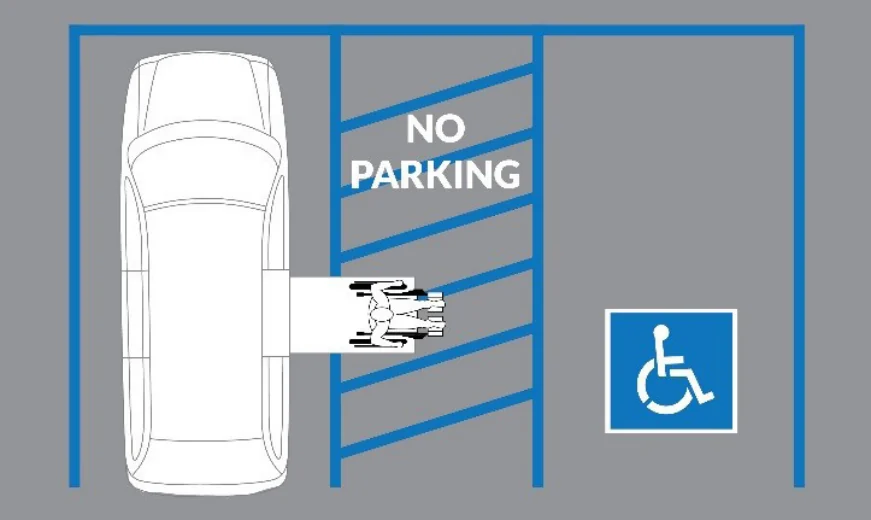
Accessible spaces are marked with a sign and pavement markings. The striped area beside them lets wheelchair users transfer and accessible vehicles deploy ramps. Parking there is prohibited even with a valid placard.

Handbook p. 60 ↗
Accessible parking space with access aisle
Striped access aisle beside an accessible space

Put it into practice

You parallel park facing downhill on a street with a curb. Turn your front wheels toward the curb. When you leave, signal, then look both ways and double-check for cars and pedestrians before pulling out.

Check your understanding

Read the question, decide on an answer, then open it to check the explanation. These are Roadwise study questions based on the source handbook.

How close to a fire hydrant is parking prohibited?
  1. Within 5 feet
  2. Within 25 feet
  3. Within 15 feet
  4. Within 30 feet

Answer: Within 15 feet

Parking is prohibited within 15 feet of a fire hydrant or in fire lanes.
Handbook p. 59 ↗
Where is parking prohibited in Indiana?
  1. Along a residential street curb
  2. Within an intersection or on a crosswalk
  3. Next to a white curb
  4. 25 feet from a fire hydrant

Answer: Within an intersection or on a crosswalk

Parking is prohibited within intersections or on pedestrian crosswalks.

Handbook p. 59 ↗
Is parking in the diagonally striped area next to accessible parking allowed with a valid placard?
  1. Yes, with a valid placard
  2. No, it is prohibited even with a valid placard
  3. Yes, but only for the first 15 minutes
  4. Yes, if no wheelchair user is nearby

Answer: No, it is prohibited even with a valid placard

Parking in the diagonally striped area next to an accessible space is prohibited even with a valid placard.

Handbook p. 60 ↗
When parking facing downhill, which way should you turn your wheels?
  1. Away from the curb
  2. Straight ahead
  3. It does not matter
  4. Toward the curb

Answer: Toward the curb

When you park facing downhill, turn your vehicle's wheels toward the curb.

Handbook p. 59 ↗
When parking facing uphill with a curb present, which way should you turn your wheels?
  1. Away from the curb
  2. Toward the curb
  3. Straight ahead
  4. It does not matter

Answer: Away from the curb

When you park facing uphill, turn your vehicle's wheels away from the curb.

Handbook p. 59 ↗
Besides near fire hydrants, where else is parking prohibited?
  1. On bridges or other elevated structures
  2. In front of a private residence
  3. Next to a white curb
  4. On a one-way street

Answer: On bridges or other elevated structures

Parking is prohibited on bridges or other elevated structures, such as on a highway or a tunnel.

Handbook p. 59 ↗
Take the lesson checkpoint in the app

More in Parking, Pedestrians & Vehicle Safety