A 4-minute lesson from the Indiana course. Read the rules and examples, follow the handbook page references, and check your understanding before you move on.
Every vehicle needs working safety equipment, and trucks and buses have extra lighting rules. If you break down, warning devices protect you and other drivers.
Equipment your car should have
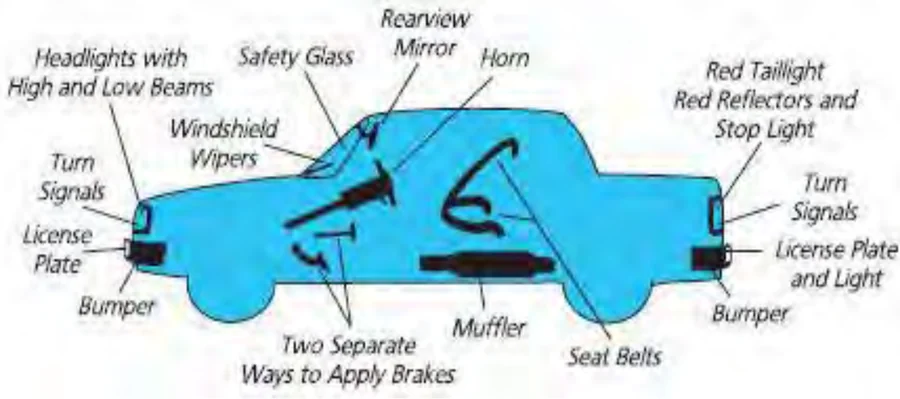
Your car should have (per the manual's diagram):
Headlights with high and low beams
Turn signals, red taillights, reflectors, stop lights, and a license plate light
Safety glass, windshield wipers, and a rearview mirror
Every bus, truck, and tractor-trailer must have a switch that flashes both front and both rear turn signals at the same time, working with the ignition on or off.
When headlights aren't needed, use reflective triangles or red flags instead of flares, reflectors, or lanterns. No flare is then required on the traffic side.
Your car breaks down at night about 300 feet past a hilltop. Turn on your hazard lights and place a warning device at least 500 feet from your car, so drivers coming over the hill have time to react.
Check your understanding
Read the question, decide on an answer, then open it to check the explanation. These are Roadwise study questions based on the source handbook.
What must a load extending more than four feet beyond a vehicle's rear display?
An orange flag at any time of day
A white flag displayed day and night
Amber flashing lamps on the load
A visible red lamp or flag marking the extension
Answer: A visible red lamp or flag marking the extension
Loads extending more than four feet beyond the rear must display a red lamp between sunset and sunrise and a red flag between sunrise and sunset.
In the daytime, how far in front of and behind a disabled car should its two red flags be placed?
About 50 feet
About 500 feet
About 100 feet
About 200 feet
Answer: About 100 feet
In the daytime, drivers of disabled cars must display two red flags, one approximately 100 feet in front of the car and one approximately 100 feet behind it.