District of Columbia practice test
District of Columbia permit practice test.
Get to know the format, try six study questions, and check the explanations before opening a full Roadwise practice test. This course’s simulation is based on the format described below.
- Questions
- 25
- Correct to pass
- 20
- Practice timer
- 60 minutes
- Study question bank
- 644
The format in this course
DC DMV Knowledge Test (Class D, non-commercial)
To pass this Roadwise simulation, answer at least 20 of 25 questions correctly. Answers and explanations appear after you finish. Unanswered questions count as incorrect.
This practice format uses one overall passing threshold, without a separately scored sign section.
The practice simulation uses a 60-minute countdown. The test clock continues while you are away from the session.
DC DMV's own site (dmv.dc.gov/service/knowledge-tests) confirms time limits by license type but not question counts, so the question counts and minimum passing scores here come from the best-corroborated third-party prep source, driving-tests.org. Applicants aged 16-20 (GRAD program) take a 30-question test with 24 correct required and a 75-minute limit instead; both versions require 80%. No section is scored separately.
Try a few practice questions
Read the question, decide on an answer, then open it to check the explanation. These are Roadwise study questions based on the source handbook.
How soon after moving to the District of Columbia must a new resident obtain a DC driver license?
- Within 30 days
- Within 90 days
- Within 60 days
- Within 6 months
Answer: Within 60 days
Anyone who moves to DC and drives on public roads must get a DC license within 60 days of moving.
Handbook p. 11 ↗How long is a DC driver license suspended for accumulating 10 or 11 points?
- 30 days
- 90 days
- 60 days
- 6 months
Answer: 90 days
A driver with 10 or 11 points loses driving privileges for 90 days.
Handbook p. 19 ↗What should you do when entering an interstate from a short entrance ramp with no acceleration lane?
- Speed up only after finding a gap
- Enter the right lane, then speed up
- Use the shoulder to build up speed
- Enter slowly and let traffic adjust
Answer: Speed up only after finding a gap
With no acceleration lane, you should find a gap in traffic before speeding up to merge safely.
Handbook p. 30 ↗Is it legal to pass on the right in the District of Columbia?
- No, passing on the right is always illegal
- Yes, on one-way roads and 4+ lane highways
- Only on two-lane rural roads
- Only if the vehicle ahead has hazards on
Answer: Yes, on one-way roads and 4+ lane highways
DC law allows passing on the right on one-way roads with room for multiple lines of traffic and on 4+ lane highways.
Handbook p. 41 ↗Before proceeding on a steady green signal, what must you check first?
- That the car beside you has moved
- That no vehicle is behind you
- That the light has been green 3 seconds
- That other vehicles have cleared the intersection
Answer: That other vehicles have cleared the intersection
Even on green, proceed with caution only after confirming other vehicles have cleared the intersection.
Handbook p. 50 ↗What does this sign mean?
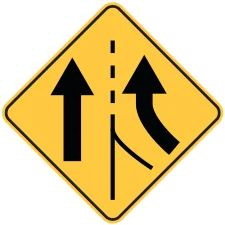
- Marks a railroad quiet zone where trains do not sound horns.
- Warns that the bridge surface can freeze before the road does.
- Warns that an additional lane is being added to the roadway.
- The left lane ends ahead and traffic must merge.
Answer: Warns that an additional lane is being added to the roadway.
Added lane: Warns that an additional lane is being added to the roadway. Stay alert for merging traffic entering the new lane.
Handbook p. 54 ↗What to study next
The practice question pool spans the course. Use the topics below to read the rules behind an answer, then return to practice.
4 lessons
Getting Your DC License
Who can apply, the knowledge test, vision screening and the road skills test
Explore5 lessons
License Types & the GRAD Program
Learner permit, provisional license, full license, curfews and GRAD penalties
Explore4 lessons
Points, Violations & Your Record
Points, suspensions, impaired driving, crash duties and everyday legal duties
Explore8 lessons
Safe Driving Fundamentals
Being fit to drive, aggression, following distance, distraction, fatigue and everyday handling
Explore6 lessons
Weather & Emergency Situations
Rain, flooding, snow and ice, fog, night driving and vehicle emergencies
Explore4 lessons
Highway & Roundabout Driving
Entering and leaving interstates, passing, stopping on highways and roundabouts
Explore7 lessons
Sharing the Road
Vision Zero, pedestrians, bicyclists, crossing beacons, trucks, school vehicles, motorcycles, buses and streetcars
Explore3 lessons
Right-of-Way & Intersections
Who goes first, emergency vehicles and officers, and pedestrians at crosswalks
Explore6 lessons
Driving Rules: Turns, Passing & Lights
Signals, passing, no-passing zones, turns, U-turns and headlights
Explore3 lessons
Parking & Stopping Rules
Parallel and hill parking, required stops, and where you may not stop, stand or park
Explore4 lessons
Speed, Safety Equipment & Work Zones
Speed limits, safety zones and equipment rules, seat belts and air bags, and work zones
Explore8 lessons
Signs, Signals & Pavement Markings
Traffic and lane-use signals, sign colors and shapes, regulatory and warning signs, route markers and markings
Explore