Roadwise States District of Columbia Driving lessons Speed limits & speed signs District of Columbia driving lesson · Speed, Safety Equipment & Work Zones
Speed limits & speed signs A 3-minute lesson from the District of Columbia course. Read the rules and examples, follow the handbook page references, and check your understanding before you move on.
Read time 3 minutes
Course unit Speed, Safety Equipment & Work Zones
Checkpoint questions 6
Source pages 46, 53, 54 DC has both a general speed rule (drive at a speed reasonable for conditions) and specific speed limits. You must obey both. DC's default city limit is low, so learn the numbers.
Know the rule
Never drive faster than is reasonable for existing conditions and hazards. Always control your speed to avoid colliding with any person, vehicle or other conveyance on or entering the road.
Handbook p. 46 ↗ Know the rule
Don't drive so slowly that you impede the normal, reasonable movement of traffic, unless a lower speed is needed for safety or to comply with the law.
Handbook p. 46 ↗ Know the rule
Never exceed the posted speed limit. Up to the limit, it's safest to drive at the average speed of traffic; the more you depart from it, faster or slower, the greater your crash risk.
Handbook p. 46 ↗ Why speed matters: Death is eight times more probable in a crash at 60 mph than at 20 mph Head-on impact speed is the sum of both speeds: two cars at 50 mph = 100 mph Hitting a solid object at 60 mph equals falling off a 10-story building More crashes are caused by other factors, but speed increases the severity of damage and injury Handbook p. 46 ↗ Know the rule
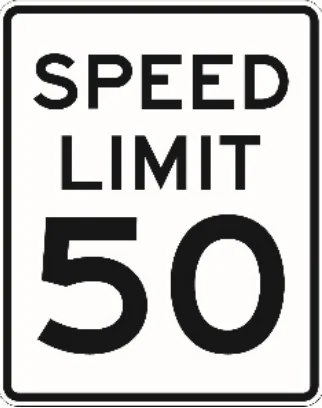
Speed limit signs have black letters and numerals on a white rectangular background and show the legal limit.
Handbook p. 46 ↗ Speed limit sign Know the rule
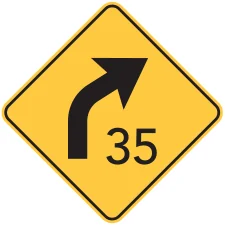
Advisory speed signs are black on yellow or orange, often under a warning sign. They don't have the force of law, but if you exceed one and crash, you may be found to have violated the general speed restriction and ticketed.
Handbook p. 46 ↗ Warning sign with advisory speed Put it into practice
You're on a DC side street with no speed sign. The limit is 20 mph. Turning into an alley drops it to 15 mph, and so does a school zone.
A useful reminder DC city streets default to 20 mph, and alleys and school zones to 15 mph.
Check your understanding Read the question, decide on an answer, then open it to check the explanation. These are Roadwise study questions based on the source handbook.
What is the default speed limit on District of Columbia city streets unless otherwise posted? 15 mph 25 mph 20 mph 30 mph Answer: 20 mph
The default speed limit on DC city streets is 20 mph unless a different limit is posted.
Handbook p. 46 ↗ What is the default speed limit in a DC alley? 10 mph 20 mph 25 mph 15 mph Answer: 15 mph
DC alleys have a default speed limit of 15 mph.
Handbook p. 46 ↗ What is the default speed limit in a DC school zone? 15 mph 10 mph 20 mph 25 mph Answer: 15 mph
School zones in DC have a default speed limit of 15 mph.
Handbook p. 46 ↗ What is the speed range on DC's interstate highways? 45-65 mph 30-55 mph 65-85 mph 55-75 mph Answer: 55-75 mph
Interstate highways in DC carry posted speed limits ranging from 55 to 75 mph.
Handbook p. 46 ↗ According to the handbook, how much more probable is death in a crash at 60 mph compared to 20 mph? Eight times more probable Twice as probable Four times more probable Sixteen times more probable Answer: Eight times more probable
The handbook states death is eight times more probable in a 60 mph crash than a 20 mph crash.
Handbook p. 46 ↗ Does an advisory (recommended) speed sign carry the force of law? Yes, it is fully enforceable like a posted limit No, and it has no legal relevance at all Yes, but only for commercial vehicles No, but exceeding it still risks a ticket Answer: No, but exceeding it still risks a ticket
Advisory speed signs are not legally binding, but exceeding one and crashing may still suggest you violated the general speed law.
Handbook p. 46 ↗ Previous lesson No stopping, standing or parking Next lesson Safety zones, earplugs & vehicle equipment More in Speed, Safety Equipment & Work Zones About the source Roadwise’s District of Columbia course uses the driver handbook edition supplied with this study pack. This lesson cites source pages 46, 53, 54. The linked PDF is a third-party mirror of the handbook, rather than a government-hosted page.
Open the handbook source PDF · View the source edition
For current application requirements, fees, appointments, and the format that applies to your age or license type, check District of Columbia’s DMV. Roadwise provides study material and does not issue permits or licenses.