New Mexico practice test
New Mexico permit practice test.
Get to know the format, try six study questions, and check the explanations before opening a full Roadwise practice test. This course’s simulation is based on the format described below.
- Questions
- 25
- Correct to pass
- 18
- Practice timer
- No timer
- Study question bank
- 595
The format in this course
New Mexico MVD Knowledge Test (Class D)
To pass this Roadwise simulation, answer at least 18 of 25 questions correctly. Answers and explanations appear after you finish. Unanswered questions count as incorrect.
This practice format uses one overall passing threshold, without a separately scored sign section.
This Roadwise practice format has no countdown, so you can take the time you need.
The official MVD Driver Procedures Manual (Chapter 11) states the 70%-or-better passing threshold but does not itself state the number of test questions. Multiple independent test-prep sources agree on a 25-question test, and 18/25 = 72%, the smallest whole-question count that clears the official 70% bar, so the minimum correct-answer count is set to 18. No New Mexico source describes the class D test as split into separately scored sections, so the practice test uses one combined score.
Try a few practice questions
Read the question, decide on an answer, then open it to check the explanation. These are Roadwise study questions based on the source handbook.
Who may supervise a permit holder driving a car?
- A parent only, seated in the right front seat
- A licensed driver at least 18 years old, seated in the back seat
- Any licensed driver, seated anywhere in the vehicle
- A licensed driver at least 21, in the right front seat
Answer: A licensed driver at least 21, in the right front seat
The supervising driver must be at least 21 and licensed for that vehicle; in a car they sit in the right front seat.
Handbook p. 4 ↗A driver collects 12 points within a 12-month period. How long will their license be suspended?
- 90 days
- Six months
- One year
- Two years
Answer: One year
If a driver has twelve or more points within a twelve-month period, their license is suspended for one year.
Handbook p. 17 ↗You're driving well below the posted speed because you're unfamiliar with the road, backing up traffic behind you. What should you do?
- Pull over when safe and let traffic pass
- Straddle the center line to discourage passing
- Turn on your hazard lights and continue
- Speed up immediately to the posted limit
Answer: Pull over when safe and let traffic pass
If vehicles pile up behind you because you're going slower than traffic, pull over when safe and let them pass.
Handbook p. 24 ↗Why should you avoid dark glasses or tinted contacts at night?
- They cut down the light you need to see clearly
- They make it harder to judge speed
- They make oncoming headlights brighter
- They increase glare from your dashboard
Answer: They cut down the light you need to see clearly
Dark glasses or tinted contacts cut down the light you need to see clearly at night.
Handbook p. 31 ↗With no oncoming traffic, where should a motorcyclist ride in the lane when passing parked cars?
- In the center of the lane
- Toward the right of your lane
- Toward the left of your lane
- It doesn't matter as long as you slow down
Answer: Toward the left of your lane
Stay toward the left of your lane when passing parked cars, to avoid doors opening or people stepping out.
Handbook p. 39 ↗What does this sign mean?
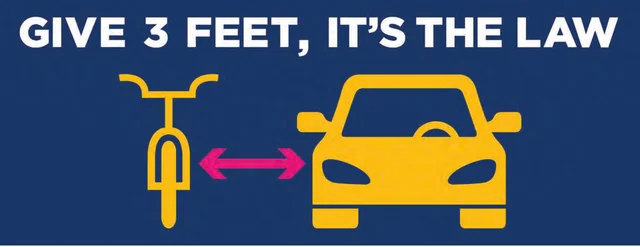
- Shows gas, food, and lodging services available at the next right.
- Shows nearby services such as fuel, food and lodging.
- Provides a phone number to report a problem at this railroad crossing.
- Drivers must leave at least 3 feet when passing a bicyclist.
Answer: Drivers must leave at least 3 feet when passing a bicyclist.
3-foot passing law (bicycles): Drivers must leave at least 3 feet when passing a bicyclist. Give at least 3 feet of space when passing a cyclist.
Handbook p. 6 ↗What to study next
The practice question pool spans the course. Use the topics below to read the rules behind an answer, then return to practice.
5 lessons
Your License
GDL permit and provisional rules, renewal, losing your license, safety belts
Explore5 lessons
Traffic Control Devices
Signals, signs, pavement markings and special lanes
Explore6 lessons
Right-of-Way, Speed & Parking
Lane rules, who yields, speed limits, parking and points
Explore5 lessons
Basic Driving Skills
Starting, steering, scanning, looking behind and headlights
Explore7 lessons
Communicating & Managing Space
Lights, horn, signals, road conditions and space cushions
Explore4 lessons
Sharing the Road
Passing, bicycles, sharrows, trucks and RVs
Explore4 lessons
Fit to Drive
Vision, fatigue, alcohol, drugs, health and distractions
Explore3 lessons
Emergencies & Collisions
Vehicle failures, avoiding crashes, skids and crash protection
Explore2 lessons
Accidents & Insurance
What to do at a crash, reporting it, and insurance minimums
Explore4 lessons
Motorcycles
Braking, lane position, helmets, group riding and hazards
Explore