roadwise.Open study app

West Virginia driving lesson · Signs, Signals, and Markings

Pavement markings

A 3-minute lesson from the West Virginia course. Read the rules and examples, follow the handbook page references, and check your understanding before you move on.

Read time
3 minutes
Course unit
Signs, Signals, and Markings
Checkpoint questions
6
Source pages
51

Lines on the road work like signs. Their color tells you which way the traffic beside you is moving, and whether the line is broken or solid tells you whether you may cross it.

Know the rule

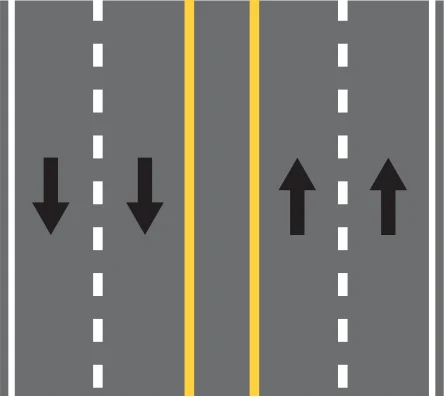
WHITE lines separate lanes moving in the SAME direction. YELLOW lines separate traffic moving in OPPOSITE directions.

Handbook p. 51 ↗
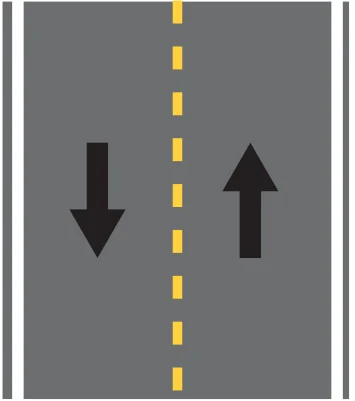
Broken yellow center line

Know the rule

Broken yellow on your side: you may pass when it is safe.

Handbook p. 51 ↗
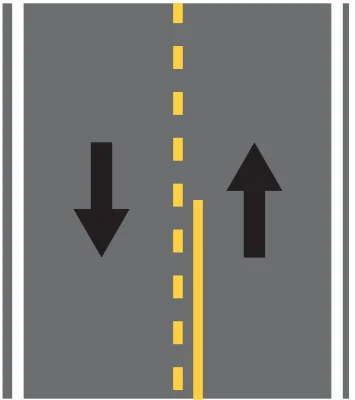
Solid and broken yellow lines
Solid yellow on one side

Know the rule

Solid yellow on your side: you MUST NOT pass. On interstates, one-way streets and divided four-lane roads, a solid yellow line marks the left edge of the pavement.

Handbook p. 51 ↗
Double solid yellow lines
Broken white lane lines

Know the rule

Broken white lines separate lanes going the same way (black may be added for contrast). Stay between them; straddle only while changing lanes.

Handbook p. 51 ↗

Know the rule

Solid white lines mark the pavement edge. When a solid white line separates same-direction lanes, do not change lanes.

Handbook p. 51 ↗
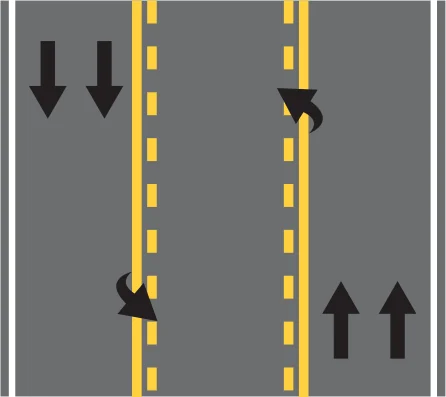
Two-way left turn lane markings
Center left-turn lane

Know the rule

Center left-turn lanes, marked by solid yellow lines nearest the through lanes with broken lines inside, are for left turns from either direction, never for through travel or passing.

Handbook p. 51 ↗

Know the rule

Reversible lanes are marked on both sides by double broken yellow lines. This is the only case where you may drive any distance to the left of a yellow line.

Handbook p. 51 ↗

Know the rule

White diamond shapes mark special lanes for car pools, bicycles, or buses.

Handbook p. 51 ↗

Know the rule

Crosswalks are often marked with solid white lines across the pavement (some residential ones are unmarked). Never block a crosswalk.

Handbook p. 51 ↗

Know the rule

A wide white stop line across your lane marks where to stop at an intersection. With no stop line or crosswalk, stop before entering the intersection where you can see traffic from all directions.

Handbook p. 51 ↗

Put it into practice

On a two-lane road you're behind a slow truck. On your side of the center there's a solid yellow line next to a broken one. The solid line is on your side, so you may not pass, even if the road looks clear.

Check your understanding

Read the question, decide on an answer, then open it to check the explanation. These are Roadwise study questions based on the source handbook.

What do broken yellow lines on your side of the road mean?
  1. You must never pass
  2. The road is one-way only
  3. You may pass when it is safe
  4. You are entering a school zone

Answer: You may pass when it is safe

Broken yellow lines separating opposite-direction traffic allow passing on your side when safe.
Handbook p. 51 ↗
What do solid yellow lines on your side of the road mean?
  1. You must not pass
  2. You may pass when clear
  3. You are on a one-way street
  4. Parking is prohibited here

Answer: You must not pass

A solid yellow line on your side means you must not pass.

Handbook p. 51 ↗
What does a solid white line separating two lanes of same-direction traffic mean?
  1. You may change lanes freely
  2. Do not change lanes across it
  3. It marks a bike lane
  4. It marks a passing zone

Answer: Do not change lanes across it

Solid white lines separating same-direction lanes mean drivers should not change lanes across them.

Handbook p. 51 ↗
A center left-turn lane is marked by what combination of lines?
  1. Solid white lines on both sides
  2. Solid yellow inner, broken outer lines
  3. Double solid yellow lines on both sides
  4. A single broken white line

Answer: Solid yellow inner, broken outer lines

Center left-turn lanes have solid yellow lines closest to through traffic and broken lines further out.

Handbook p. 51 ↗
Reversible lanes, where traffic direction changes during the day, are marked by what?
  1. A single solid white line
  2. A double yellow broken line on both sides
  3. Orange cones only, no pavement marking
  4. A dashed white line on both sides

Answer: A double yellow broken line on both sides

Reversible lanes are marked on both sides by a double yellow broken line, the only case allowing driving left of a yellow line for any distance.

Handbook p. 51 ↗
It is legal to drive to the left of a solid yellow line for any distance on an ordinary two-way road.
  1. True
  2. False

Answer: False

The only case where driving left of a yellow line for any distance is legal is in a marked reversible lane.

Handbook p. 51 ↗
Take the lesson checkpoint in the app

More in Signs, Signals, and Markings