roadwise.Open study app

West Virginia driving lesson · Signs, Signals, and Markings

Regulatory signs: what you must and must not do

A 3-minute lesson from the West Virginia course. Read the rules and examples, follow the handbook page references, and check your understanding before you move on.

Read time
3 minutes
Course unit
Signs, Signals, and Markings
Checkpoint questions
4
Source pages
45

Square and rectangular signs state traffic laws: speed limits, turns you can't make, and which way traffic flows. Most are white with black letters; the most important ones are red with white letters.

Know the rule

Most regulatory signs are white with black letters; when the message is very important, the sign is red with white letters.

Handbook p. 45 ↗

Know the rule

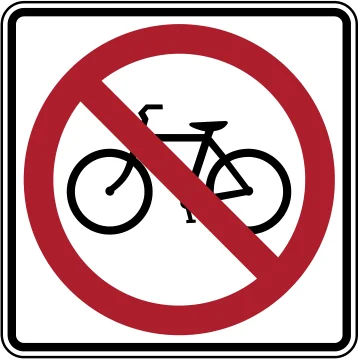
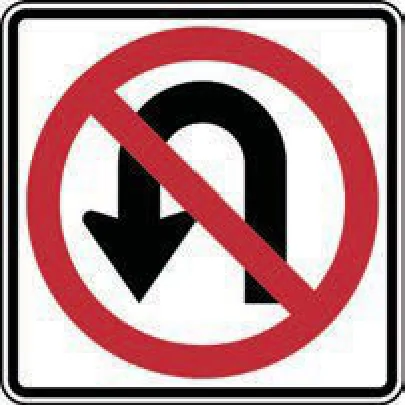
A red outline with a diagonal bar through it always means "NO."

Handbook p. 45 ↗
No U-turn
No U-turn

Know the rule

No U-Turn means do not turn around in the middle of a street or an intersection.

Handbook p. 45 ↗
No bicycles
No left turn

Know the rule

No Right Turn and No Left Turn signs show which way you can't turn at an intersection, such as when meeting a one-way street or where turning is unsafe.

Handbook p. 45 ↗
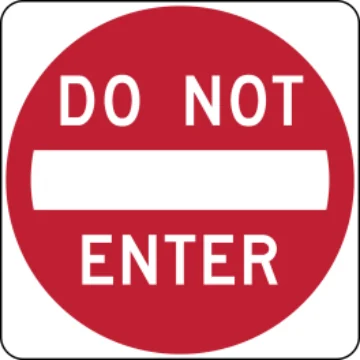
Do not enter
Do Not Enter

Know the rule

Wrong Way and Do Not Enter signs warn that traffic in that direction is prohibited; entering that lane will likely put you head-on with another vehicle.

Handbook p. 45 ↗
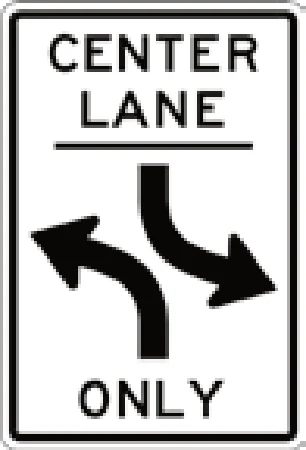
Center lane left turn only (two-way left turn)
Dual (center) turn lane

Know the rule

A Dual Turn Lane sign hangs over a lane used only for left turns from either direction. Never use a turning lane to overtake and pass.

Handbook p. 45 ↗
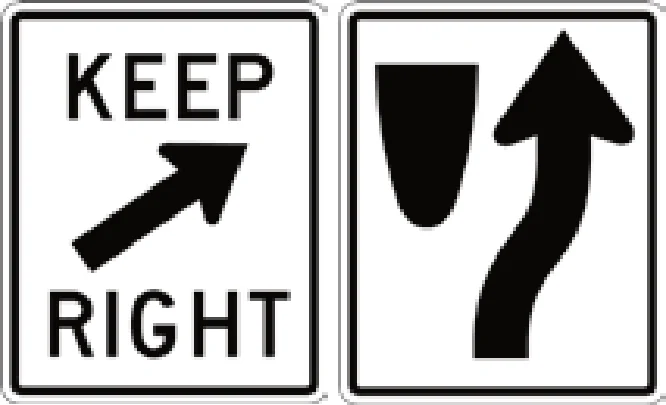
Keep right
Lane direction (keep right) signs

Know the rule

Lane Direction signs sit at openings in a divided highway's median to remind you which side of the divider you belong on.

Handbook p. 45 ↗

Know the rule

A One Way sign shows that a cross street carries traffic in one direction only; usually each consecutive block runs the opposite way.

Handbook p. 45 ↗

Know the rule

Speed Limit signs show the fastest speed allowed under optimal weather and road conditions; some also show a minimum speed. Advisory speed signs on interstate ramps are black on yellow.

Handbook p. 45 ↗

Put it into practice

You come off an interstate and see a black-on-yellow 35 mph sign on the curving ramp. That's an advisory speed: the maximum recommended safe speed for that ramp. Slow to it before the curve.

Check your understanding

Read the question, decide on an answer, then open it to check the explanation. These are Roadwise study questions based on the source handbook.

What does a red circle with a diagonal bar through a symbol always mean?
  1. Proceed with caution
  2. Yield to oncoming traffic
  3. 'NO' — that action is prohibited
  4. Merge left

Answer: 'NO' — that action is prohibited

A red circle with a diagonal bar always means 'NO,' prohibiting the pictured action.
Handbook p. 45 ↗
Advisory speed signs found on interstate entrance and exit ramps are what color combination?
  1. White on green
  2. Red on white
  3. Black on white
  4. Black on yellow

Answer: Black on yellow

Advisory speed signs on ramps showing the maximum recommended safe speed are black on yellow.

Handbook p. 45 ↗
A sign over a center lane shows two curved arrows turning left in opposite directions. Who may use that lane?
  1. Drivers passing slower vehicles
  2. Left-turning traffic from either direction
  3. Left-turning traffic in your direction only
  4. Buses and car pools only

Answer: Left-turning traffic from either direction

A dual turn lane sign marks a lane used only for left turns from either direction; never use it to overtake and pass.

Handbook p. 45 ↗
What do Wrong Way and Do Not Enter signs tell you?
  1. The road ahead is closed for repairs
  2. You must yield to merging traffic
  3. Traffic in that direction is prohibited
  4. Only emergency vehicles may enter

Answer: Traffic in that direction is prohibited

These signs warn that traffic in that direction is prohibited; entering that lane will likely lead to a collision.

Handbook p. 45 ↗
Take the lesson checkpoint in the app

More in Signs, Signals, and Markings